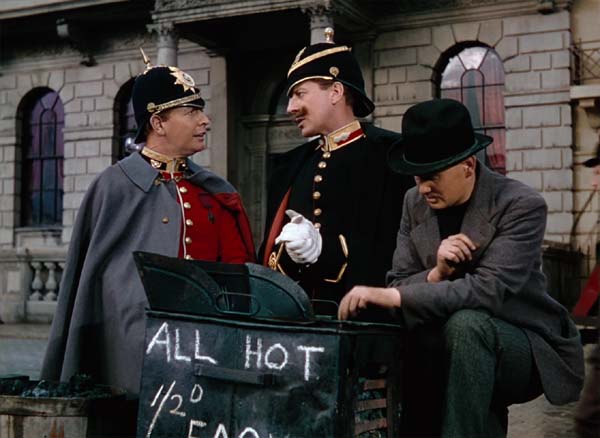
The Life and Death of Colonel Blimp (1943)
Rent The Life and Death of Colonel Blimp on Amazon Video
Written by: Michael Powell, Emeric Pressburger
Directed by: Michael Powell, Emeric Pressburger
Starring: Roger Livesey, Deborah Kerr, Anton Walbrook
Rated:--
My rating is simple, Watch It, It Depends, Skip it. Read my previous movie reviews!
Plot
The story of Major-General Clive Wynne-Candy as he rises up the ranks of the British military.
Verdict
It's an amazing movie, indeed a classic. We start with a blustery old general and the movie shows us how he became as such through his military service, friendships, and loves. It's quite a transformation that brings the movie full circle. It's a sprawling and sentimental story featuring great acting and direction. This is how you tell a story.
Watch it.
Review
The name is based on the popular (at the time) comic strip, though the movie is completely unrelated.
During a war game exercise, an upstart lieutenant starts before the designated time and marches into the bath house and apprehends Major General Wynne-Candy. Despite Wynne-Candy protesting that, "War starts at midnight!" The lieutenant dismisses Wynne-Candy as a blustery old man. We see him as the same, though Wynne-Candy chides the lieutenant, and us, that don't know how he got the big belly or why he wears a mustache. Forty years of military service a is a long time. They scuffle and fall into a pool, which triggers the flashback.
This is a sprawling tale of a soldier. It takes an old man that we would dismiss and gives him a backstory, transforming him into a hero. It explores to a degree what it's like to be old and how you get there.
It's a very English movie, as Wynne-Candy often refers to honor and fighting the right way. It's this honor that causes him to defy his superiors and enter a sword dual with a German officer. While they recuperate from their wounds, they become friends. Their friendship continues from the Boer War and through World War I and II despite their English and German backgrounds.
The movie traces Wynne-Candy's career and relationships, finally reaching the point at which the movie started. This is simply an incredible movie.
The British government disapproved of this film because a German soldier is portrayed as sympathetic. Winston Churchill was against this movie, possibly because he viewed it as a parody of himself.
While Wynne-Candy is a stout believer in honor, many of the things he dismisses as cruel and unfitting of England, these atrocities were committed in real life.
Saturday, 4 February 2017
Fletch Movie Review
Fletch (1985)
Rent Fletch on Amazon Video
Written by: Gregory McDonald (novel), Andrew Bergman (screenplay)
Directed by: Michael Ritchie
Starring: Chevy Chase, Joe Don Baker, Dana Wheeler-Nicholson
Rated: PG
My rating is simple, Watch It, It Depends, Skip it. Read my previous TV reviews!
Plot
Newspaper reporter Fletch is offered a large sum of money to kill a millionaire with terminal cancer, but he begins investigating when the man seems perfectly healthy.
Verdict
This movie is solely a Chevy Chase vehicle. Every part of it is to cater to or set up his style of comedy. While he helps carry an otherwise bland movie, it also makes this a bit of a sketch show, the story always relegated to a subordinate role, though it's a great collection of one liners and camera mugging from him.
It depends.
Review
Gregory Mcdonald's popular Fletch novels served as the inspiration, though Chase largely got to put his own spin on, improvising many of his lines. He's stated it's his favorite performance due to that reason.
This movie is a perfect fit for Chase as he exhibits his smug brand of comedy, but that's also the only reason to see this. There isn't much of a movie without Chase. It's a film noir meets comedy with Chase's voice over summarizing swaths of the movie. The story is a bland would be detective adventure. This starts with a man mistaking Fletch (Chevy Chase) for a junkie. That's easy to do since Fletch is undercover for a story. Fletch is offered fifty thousand to kill the man who claims to have bone cancer. Fletch being a reporter has to investigate.
Fletch muddles his way through the movie masquerading as any number of characters to find the truth, effortlessly faking his way through every interaction. While too many of the interactions rely on Fletch name dropping somebody he doesn't know, the rest of the dialog more than makes up for it. It's incredibly quotable and quite witty.
The story doesn't matter. I can't imagine anyone sees this for the story as the only reason this exists is to showcase Chevy Chase. If you want to watch this for any other reason, you've picked the wrong movie.
Rent Fletch on Amazon Video
Written by: Gregory McDonald (novel), Andrew Bergman (screenplay)
Directed by: Michael Ritchie
Starring: Chevy Chase, Joe Don Baker, Dana Wheeler-Nicholson
Rated: PG
My rating is simple, Watch It, It Depends, Skip it. Read my previous TV reviews!
Plot
Newspaper reporter Fletch is offered a large sum of money to kill a millionaire with terminal cancer, but he begins investigating when the man seems perfectly healthy.
Verdict
This movie is solely a Chevy Chase vehicle. Every part of it is to cater to or set up his style of comedy. While he helps carry an otherwise bland movie, it also makes this a bit of a sketch show, the story always relegated to a subordinate role, though it's a great collection of one liners and camera mugging from him.
It depends.
Review
Gregory Mcdonald's popular Fletch novels served as the inspiration, though Chase largely got to put his own spin on, improvising many of his lines. He's stated it's his favorite performance due to that reason.
This movie is a perfect fit for Chase as he exhibits his smug brand of comedy, but that's also the only reason to see this. There isn't much of a movie without Chase. It's a film noir meets comedy with Chase's voice over summarizing swaths of the movie. The story is a bland would be detective adventure. This starts with a man mistaking Fletch (Chevy Chase) for a junkie. That's easy to do since Fletch is undercover for a story. Fletch is offered fifty thousand to kill the man who claims to have bone cancer. Fletch being a reporter has to investigate.
Fletch muddles his way through the movie masquerading as any number of characters to find the truth, effortlessly faking his way through every interaction. While too many of the interactions rely on Fletch name dropping somebody he doesn't know, the rest of the dialog more than makes up for it. It's incredibly quotable and quite witty.
The story doesn't matter. I can't imagine anyone sees this for the story as the only reason this exists is to showcase Chevy Chase. If you want to watch this for any other reason, you've picked the wrong movie.
Friday, 3 February 2017
Orpheus Movie Review
Orpheus (1950)
Orphée
Buy Orpheus on Amazon
Written by: Jean Cocteau
Directed by: Jean Cocteau
Starring: Jean Marais, François Périer, María Casares
Rated:--
My rating is simple, Watch It, It Depends, Skip it. Read my previous TV reviews!
Plot
Infatuated with death, a poet travels to the underworld.
Verdict
This is a movie distinctly ahead of it's time with a complex story and experimental style. It explores love, death, and art as it journeys through the underworld and back. The movie may be old, but this story is still fresh.
Watch it.
Review
Another Cocteau film that is surreal and other worldly. It's a progression from Beauty and the Beast (1946) (read my review). In that Cocteau did a fairy tale, in this he tackles mythology.
Orpheus was a troubadour from Greek mythology. The movie opens with a reciting of the myth.
In the movie, Orpheus is a poet mixed up with a princess. She and a young poet she supports, Cègeste, visit a cafe. When Cègeste starts a fight and is knocked down by motorcycle riders, the princess gets him back in her car with help to take him to the hospital, but orders Orpheus to get in as well to act as a witness.
Orpheus is taken to the princess's chateau where on the way he discovers Cègeste is dead. At the house, the princess reanimates Cègeste entering a mirror with the same two motorcycle riders as before. The effects have to be simple, but are incredibly effective. They look really good.
Orpheus determines he must be dreaming and is told he is. Orpheus endures a wild sequence of events with the recurring question of "are you asleep?" never far away.
This feels like a precursor to David Lynch's Lost Highway (1997) or Mulholland Drive (2001). We constantly wonder what's real and what we're seeing really means. Orpheus wakes in the middle of nowhere, and he stumbles upon the princess's chauffeur who drives him home. The car is stored in Orpheus's garage.
Cègeste transmits poetry and information over the radio that Orpheus hears only in the car. He becomes obsessed with listening to it and ignores all else. Orpheus is listening to the radio hoping for inspiration, but he is no longer a poet or writer, just a listener. Cègeste has caused him to stop living in essence.
A string of events causes Orpheus to travel to the underworld. Love death, and art, where does Orpheus's allegiance lie? Cègeste has already caused him to abandon his art and his wife. While Orpheus travels to the underworld, what's the real reason he's going?
Orpheus claims, "I would follow her to hell." While the chauffeur responds, "You needn't go that far." The question is, which "her" is Orpheus following.
It's a complex story, but it isn't convoluted. I don't want to spoil it, you need to watch it.
Orphée
Buy Orpheus on Amazon
Written by: Jean Cocteau
Directed by: Jean Cocteau
Starring: Jean Marais, François Périer, María Casares
Rated:--
My rating is simple, Watch It, It Depends, Skip it. Read my previous TV reviews!
Plot
Infatuated with death, a poet travels to the underworld.
Verdict
This is a movie distinctly ahead of it's time with a complex story and experimental style. It explores love, death, and art as it journeys through the underworld and back. The movie may be old, but this story is still fresh.
Watch it.
Review
Another Cocteau film that is surreal and other worldly. It's a progression from Beauty and the Beast (1946) (read my review). In that Cocteau did a fairy tale, in this he tackles mythology.
Orpheus was a troubadour from Greek mythology. The movie opens with a reciting of the myth.
In the movie, Orpheus is a poet mixed up with a princess. She and a young poet she supports, Cègeste, visit a cafe. When Cègeste starts a fight and is knocked down by motorcycle riders, the princess gets him back in her car with help to take him to the hospital, but orders Orpheus to get in as well to act as a witness.
Orpheus is taken to the princess's chateau where on the way he discovers Cègeste is dead. At the house, the princess reanimates Cègeste entering a mirror with the same two motorcycle riders as before. The effects have to be simple, but are incredibly effective. They look really good.
Orpheus determines he must be dreaming and is told he is. Orpheus endures a wild sequence of events with the recurring question of "are you asleep?" never far away.
This feels like a precursor to David Lynch's Lost Highway (1997) or Mulholland Drive (2001). We constantly wonder what's real and what we're seeing really means. Orpheus wakes in the middle of nowhere, and he stumbles upon the princess's chauffeur who drives him home. The car is stored in Orpheus's garage.
Cègeste transmits poetry and information over the radio that Orpheus hears only in the car. He becomes obsessed with listening to it and ignores all else. Orpheus is listening to the radio hoping for inspiration, but he is no longer a poet or writer, just a listener. Cègeste has caused him to stop living in essence.
A string of events causes Orpheus to travel to the underworld. Love death, and art, where does Orpheus's allegiance lie? Cègeste has already caused him to abandon his art and his wife. While Orpheus travels to the underworld, what's the real reason he's going?
Orpheus claims, "I would follow her to hell." While the chauffeur responds, "You needn't go that far." The question is, which "her" is Orpheus following.
It's a complex story, but it isn't convoluted. I don't want to spoil it, you need to watch it.
The Fall Season 3 Netflix Series Review
The Fall (2013-)
Season 3 - 6 episodes (2016)
Watch The Fall on Netflix
Created by:Allan Cubitt
Starring: Gillian Anderson, Jamie Dornan, John Lynch
Rated: TV-MA
Plot
DSI Stella Gibson (Gillian Anderson) chases serial killer Paul Spector (Jamie Dornan).
In season three, Gibson discovers more about Spector's past, while Spector may not be fit for trial.
Verdict
While not as good as the first two seasons, it is a conclusion to the Paul Spector arc, albeit a bit underwhelming.
This series started off with such a unique way to tell the story of a serial killer, and in season three it relies on an amnesia trope. The story becomes contrived and is far too static most of the season as the detectives uncover Spector's background. The first episode is great and never matched after that. It's not a bad season, but it doesn't live up to the first two.
Watch it.
Review
Season one was the setup, season two the case, and season three the aftermath (Read my Season 1 & 2 reviews).
Creator Cubitt does have ideas for future seasons, though thankfully Dornan won't be back. Cubitt had originally envisioned this show as Gibson tracking a different murderer each season.
I had heard season three was bad, and while the story isn't as well plotted as the first two seasons, it was serviceable as a conclusion to the story. For most of the season Spector thinks he's in the past, suffering from acute short term memory loss. We're left guessing as to the true status of his mind, as are the cops. This part of the story was annoying, but the show uses that to spur the detectives to dig into his past. We learn more about Spector, but it wasn't really necessary.
I wondered if this season would focus on his trial, as a way to end his story, but while we enter the court, there is no trial. The first episode picks up immediately after the final episode of season two. Doctors are trying to save Spector from his gunshot wounds. These scenes were electric as the staff is frantic. While we don't see much, it's still hard to watch. It could have been much gorier, but it isn't indulgent. As Spector is wheeled away, we see blood and surgical gloves on the floor. Gibson has to watch as the staff try to save a killer. It's certainly a conflict, but she doesn't want him to take the easy way out.
In episode two Paul finally wakes up and we discover that he thinks it's 2006 instead of 2012. I had to wonder if the show was really going to do this. I guess they had to add some kind of drama.
With Spector in custody this season is a lot slower, relying on interviews and bombshells about his past for excitement. While it's a method to develop his character, it just feels clumsy. The show plants a few seeds to indicate he might be lying, but that's because the cops are as incredulous as the viewer.
The cops dig up someone he knew in the past and ret-con a crime so they have charges for him despite his memory loss. It feels a bit disingenuous as it's pulled from thin air.
Katie and Spector's wife Sally Ann are left wondering who Spector really is as they read about the case on the internet after his name is released. Gibson wanted him tried in a court of law, not public opinion. Gibson has to endure an investigative panel questioning her safety protocols during the hunt for Rose. No one wore vests and Spector was out in the open with a known criminal hunting him.
In episode four Spector's lawyers begin creating a defense. They question the relationship between Gibson and Spector. If they are going to have any shot at this case, that seems like a good place to start. If they get into her relationships with other men on the force, it could certainly hurt the prosecution.
The driving question this season is whether Spector is faking memory loss. We get hints he might be, but nothing conclusive. What I don't like about this plot line is that it's such a typical story. What I liked about season one is that it subverted the usual mystery. Instead of leaving the viewer in the dark about who the killer is, it shows us in the first scene. The show isn't about who did it, but about what kind of person would commit such crimes. The show felt smart and treated us that way. This season is a reversion to typical plot tropes. It's just too easy of a story. We get a tried and true mystery, not befitting of this show.
It's a conclusive ending, certainly, but it feels a bit underwhelming. It's not a bad ending, and at least it's better than Spector becoming a lumberjack.
Season 3 - 6 episodes (2016)
Watch The Fall on Netflix
Created by:Allan Cubitt
Starring: Gillian Anderson, Jamie Dornan, John Lynch
Rated: TV-MA
Plot
DSI Stella Gibson (Gillian Anderson) chases serial killer Paul Spector (Jamie Dornan).
In season three, Gibson discovers more about Spector's past, while Spector may not be fit for trial.
Verdict
While not as good as the first two seasons, it is a conclusion to the Paul Spector arc, albeit a bit underwhelming.
This series started off with such a unique way to tell the story of a serial killer, and in season three it relies on an amnesia trope. The story becomes contrived and is far too static most of the season as the detectives uncover Spector's background. The first episode is great and never matched after that. It's not a bad season, but it doesn't live up to the first two.
Watch it.
Review
Season one was the setup, season two the case, and season three the aftermath (Read my Season 1 & 2 reviews).
Creator Cubitt does have ideas for future seasons, though thankfully Dornan won't be back. Cubitt had originally envisioned this show as Gibson tracking a different murderer each season.
I had heard season three was bad, and while the story isn't as well plotted as the first two seasons, it was serviceable as a conclusion to the story. For most of the season Spector thinks he's in the past, suffering from acute short term memory loss. We're left guessing as to the true status of his mind, as are the cops. This part of the story was annoying, but the show uses that to spur the detectives to dig into his past. We learn more about Spector, but it wasn't really necessary.
I wondered if this season would focus on his trial, as a way to end his story, but while we enter the court, there is no trial. The first episode picks up immediately after the final episode of season two. Doctors are trying to save Spector from his gunshot wounds. These scenes were electric as the staff is frantic. While we don't see much, it's still hard to watch. It could have been much gorier, but it isn't indulgent. As Spector is wheeled away, we see blood and surgical gloves on the floor. Gibson has to watch as the staff try to save a killer. It's certainly a conflict, but she doesn't want him to take the easy way out.
In episode two Paul finally wakes up and we discover that he thinks it's 2006 instead of 2012. I had to wonder if the show was really going to do this. I guess they had to add some kind of drama.
With Spector in custody this season is a lot slower, relying on interviews and bombshells about his past for excitement. While it's a method to develop his character, it just feels clumsy. The show plants a few seeds to indicate he might be lying, but that's because the cops are as incredulous as the viewer.
The cops dig up someone he knew in the past and ret-con a crime so they have charges for him despite his memory loss. It feels a bit disingenuous as it's pulled from thin air.
Katie and Spector's wife Sally Ann are left wondering who Spector really is as they read about the case on the internet after his name is released. Gibson wanted him tried in a court of law, not public opinion. Gibson has to endure an investigative panel questioning her safety protocols during the hunt for Rose. No one wore vests and Spector was out in the open with a known criminal hunting him.
In episode four Spector's lawyers begin creating a defense. They question the relationship between Gibson and Spector. If they are going to have any shot at this case, that seems like a good place to start. If they get into her relationships with other men on the force, it could certainly hurt the prosecution.
The driving question this season is whether Spector is faking memory loss. We get hints he might be, but nothing conclusive. What I don't like about this plot line is that it's such a typical story. What I liked about season one is that it subverted the usual mystery. Instead of leaving the viewer in the dark about who the killer is, it shows us in the first scene. The show isn't about who did it, but about what kind of person would commit such crimes. The show felt smart and treated us that way. This season is a reversion to typical plot tropes. It's just too easy of a story. We get a tried and true mystery, not befitting of this show.
It's a conclusive ending, certainly, but it feels a bit underwhelming. It's not a bad ending, and at least it's better than Spector becoming a lumberjack.
Thursday, 2 February 2017
Time Bandits Movie Review
Time Bandits (1981)
Buy Time Bandits on Amazon
Written by: Michael Palin, Terry Gilliam
Directed by: Terry Gilliam
Starring: Sean Connery, Shelley Duvall, John Cleese
Rated: PG
My rating is simple, Watch It, It Depends, Skip it. Read my previous movie reviews!
Plot
A young boy joins a group of time traveling dwarves seeking treasure.
Verdict
This movie taps into a child's imagination, and thus it's best if you watch it with that mindset. It's a fun adventure with witty dialog and a commentary on imagination, adventure, and the universe.
Watch it.
Review
This is part of Gilliam's imagination trilogy, followed by Brazil (1985) and The Adventures of Baron Munchausen (1988). In these films, the protagonist uses imagination to escape the struggles of daily life.
This is aimed squarely at kids. Kevin is mostly ignored by his parents, entertaining himself with an active imagination and a fervor for history. His parents order him to bed, telling him "No noise." despite the television being so loud he can barely him them. It captures that disconnect between children and parents from the child's point of view.
Kevin wants to capture a photo of a medieval knight that rode out of his wardrobe the previous night. While he saw it and was transported to a forest, when he looked again he's back in his room with a picture he drew that makes you wonder if it was his imagination.
On the next night, Kevin finds time traveling dwarves that take him on a sprawling adventure where he meets Napoleon, Robin hood, and King Agamemnon.
Kevin experiences a fantastical journey, everything a kid could imagine. This feels very '80s with the setting and tone. The dwarves are pursued by Evil and the Supreme Being is a suit wearing bureaucrat. The Supreme Being helps them in the end, assuring that everything is under control. It's a parallel between his parents, a stand offish guardian that leaves him alone.
Kevin wakes up in his bedroom, causing us to wonder if it was all a dream, an adventure of the imagination. We don't wonder long, Kevin still has his pictures from the adventure. I was surprised at the fate of his parents!
Buy Time Bandits on Amazon
Written by: Michael Palin, Terry Gilliam
Directed by: Terry Gilliam
Starring: Sean Connery, Shelley Duvall, John Cleese
Rated: PG
My rating is simple, Watch It, It Depends, Skip it. Read my previous movie reviews!
Plot
A young boy joins a group of time traveling dwarves seeking treasure.
Verdict
This movie taps into a child's imagination, and thus it's best if you watch it with that mindset. It's a fun adventure with witty dialog and a commentary on imagination, adventure, and the universe.
Watch it.
Review
This is part of Gilliam's imagination trilogy, followed by Brazil (1985) and The Adventures of Baron Munchausen (1988). In these films, the protagonist uses imagination to escape the struggles of daily life.
This is aimed squarely at kids. Kevin is mostly ignored by his parents, entertaining himself with an active imagination and a fervor for history. His parents order him to bed, telling him "No noise." despite the television being so loud he can barely him them. It captures that disconnect between children and parents from the child's point of view.
Kevin wants to capture a photo of a medieval knight that rode out of his wardrobe the previous night. While he saw it and was transported to a forest, when he looked again he's back in his room with a picture he drew that makes you wonder if it was his imagination.
On the next night, Kevin finds time traveling dwarves that take him on a sprawling adventure where he meets Napoleon, Robin hood, and King Agamemnon.
Kevin experiences a fantastical journey, everything a kid could imagine. This feels very '80s with the setting and tone. The dwarves are pursued by Evil and the Supreme Being is a suit wearing bureaucrat. The Supreme Being helps them in the end, assuring that everything is under control. It's a parallel between his parents, a stand offish guardian that leaves him alone.
Kevin wakes up in his bedroom, causing us to wonder if it was all a dream, an adventure of the imagination. We don't wonder long, Kevin still has his pictures from the adventure. I was surprised at the fate of his parents!
Pickpocket Movie Review
Pickpocket (1959)
Rent Pickpocket on Amazon Video
Written by: Robert Bresson
Directed by: Robert Bresson
Starring: Martin LaSalle, Marika Green, Jean Pélégri
Rated:--
My rating is simple, Watch It, It Depends, Skip it. Read my previous TV reviews!
Plot
After his mother dies, Michel resorts to pick pocketing to survive.
Verdict
It's a simple story, but engrossing. Michel is a pickpocket, but discontent. It's only after he loses everything that he determines his priorities.
The slower pace leaves ample room to speculate about the character. While most movies give you all the information you could want, this lets you fill in the blanks in whichever way you see fit.
Watch it.
Review
This movie isn't for everyone. It's a slow pace and there isn't a lot of out and out action. It's more like a poem. Our experiences play a large part in the interpretation.
Michel is a good guy doing bad things. He can't find a job. While that doesn't excuse his actions, he needs money and resorts to the only thing he thinks he's good at, pickpocketing. Michel's attitude is entitled. He thinks the general population should reward him with money. They do, albeit against their will.
He works his way into a group of pickpockets and they steal from people in broad daylight with choreographed hand offs. The pickpocket scenes are slick. While I've seen many movies do it, for this movie to feel as slick as it does as old as it is, that's impressive.
While the plot feels a bit dated, the directing provides time to speculate about Michel's thoughts. Why doesn't he want to see his sick mother? We don't know if something happened between them, but Michel seems to prefer being alone. You get the feeling Jeanne likes him, but he's either oblivious or disinterested.
Michel leaves France, fearing the police are closing in. He travels around the world but isn't content. He returns to Paris and meets Jeaane again. He attempts legitimate work to support her, but returns to theft. This times he's not so fortunate and is arrested. Michel tried to leave pickpocketing behind, but it became his identity, a compulsion.
Jeanne visits him in jail, and it's at that point he realizes that he's in love with her. It's a bittersweet irony, but he couldn't see it until all distractions were removed.
Rent Pickpocket on Amazon Video
Written by: Robert Bresson
Directed by: Robert Bresson
Starring: Martin LaSalle, Marika Green, Jean Pélégri
Rated:--
My rating is simple, Watch It, It Depends, Skip it. Read my previous TV reviews!
Plot
After his mother dies, Michel resorts to pick pocketing to survive.
Verdict
It's a simple story, but engrossing. Michel is a pickpocket, but discontent. It's only after he loses everything that he determines his priorities.
The slower pace leaves ample room to speculate about the character. While most movies give you all the information you could want, this lets you fill in the blanks in whichever way you see fit.
Watch it.
Review
This movie isn't for everyone. It's a slow pace and there isn't a lot of out and out action. It's more like a poem. Our experiences play a large part in the interpretation.
Michel is a good guy doing bad things. He can't find a job. While that doesn't excuse his actions, he needs money and resorts to the only thing he thinks he's good at, pickpocketing. Michel's attitude is entitled. He thinks the general population should reward him with money. They do, albeit against their will.
He works his way into a group of pickpockets and they steal from people in broad daylight with choreographed hand offs. The pickpocket scenes are slick. While I've seen many movies do it, for this movie to feel as slick as it does as old as it is, that's impressive.
While the plot feels a bit dated, the directing provides time to speculate about Michel's thoughts. Why doesn't he want to see his sick mother? We don't know if something happened between them, but Michel seems to prefer being alone. You get the feeling Jeanne likes him, but he's either oblivious or disinterested.
Michel leaves France, fearing the police are closing in. He travels around the world but isn't content. He returns to Paris and meets Jeaane again. He attempts legitimate work to support her, but returns to theft. This times he's not so fortunate and is arrested. Michel tried to leave pickpocketing behind, but it became his identity, a compulsion.
Jeanne visits him in jail, and it's at that point he realizes that he's in love with her. It's a bittersweet irony, but he couldn't see it until all distractions were removed.
Playtime Movie Review
Playtime (1967)
Rent Playtime on Amazon Video
Written by: Jacques Tati (original screenplay, collaboration), Art Buchwald (additional English dialogue)
Directed by: Jacques Tati
Starring: Jacques Tati, Barbara Dennek, Rita Maiden
Rated:--
My rating is simple, Watch It, It Depends, Skip it. Read my previous movie reviews!
Plot
Monseiur. Hulot wanders around lost a futuristic Paris with American tourists.
Verdict
This movie had a lot of potential, but it doesn't capitalize. While it could be the jokes are lost in translation or over fifty year, why would you watch a movie that isn't that funny?
It's subtle to the point of boring and lacks a plot. Large swaths of the movie don't even contain the main character.
Skip it.
Review
While I like this better than Monsieur Hulot's Holiday (read my review), that's not saying much. Maybe the well meaning oafish character was revolutionary at the time, but this relies on such subtle humor that's been run into the ground by today that it's completely boring.
One of the sequences, which had to have lasted thirty minutes or more, showcased a newly finish restaurant. The gag is that it's falling apart and not quite finished. There's confusion among waiters and bickering over reserved tables, but one of the big gags is the doorman touching wet paint. That's it. This isn't done in an over the top manner. This sequence doesn't even include the main character, who finally shows up late towards the end.
Why is the main character absent from much of the movie? Tati no longer liked the character and didn't really want to do another movie about Hulot. While it was a critical success, no one flocked to the theater to see this.
While the sight gags are intricate, they need to entertain as well.
Rent Playtime on Amazon Video
Written by: Jacques Tati (original screenplay, collaboration), Art Buchwald (additional English dialogue)
Directed by: Jacques Tati
Starring: Jacques Tati, Barbara Dennek, Rita Maiden
Rated:--
My rating is simple, Watch It, It Depends, Skip it. Read my previous movie reviews!
Plot
Monseiur. Hulot wanders around lost a futuristic Paris with American tourists.
Verdict
This movie had a lot of potential, but it doesn't capitalize. While it could be the jokes are lost in translation or over fifty year, why would you watch a movie that isn't that funny?
It's subtle to the point of boring and lacks a plot. Large swaths of the movie don't even contain the main character.
Skip it.
Review
While I like this better than Monsieur Hulot's Holiday (read my review), that's not saying much. Maybe the well meaning oafish character was revolutionary at the time, but this relies on such subtle humor that's been run into the ground by today that it's completely boring.
One of the sequences, which had to have lasted thirty minutes or more, showcased a newly finish restaurant. The gag is that it's falling apart and not quite finished. There's confusion among waiters and bickering over reserved tables, but one of the big gags is the doorman touching wet paint. That's it. This isn't done in an over the top manner. This sequence doesn't even include the main character, who finally shows up late towards the end.
Why is the main character absent from much of the movie? Tati no longer liked the character and didn't really want to do another movie about Hulot. While it was a critical success, no one flocked to the theater to see this.
While the sight gags are intricate, they need to entertain as well.
Subscribe to:
Posts (Atom)


