Sunday, 29 May 2016

Game of Thrones Season 6 Episode 6 Recap

Game of Thrones (2011-)
Season 6 (2016)

Created by: David Benioff, D.B. Weiss
Starring: Emilia Clarke, Peter Dinklage, Kit Harington, Sophie Turner, Lena Headey, Maisie Williams, Nikolaj Coster-Waldau, Aidan Gillan, Gwendoline Christie


Plot: 
HBO's fantasy drama series adapted from George R.R. Martin's book series A Song of Ice and Fire follows the civil war of kings and usurpers in Westeros who wish to sit one the throne. The scale and scope of the story is staggering, fully realized with a large ensemble cast.

Previously
The white walkers were the biggest surprise last episode. They weren't at the wall, they were outside of the Three Eyed Raven's cave.
Bran and Meera are on the run. Are white walkers going to be able to track Bran wherever he goes? How will he manage? What does it mean now that he's the Three Eyed Raven? I bet he'll still be able to have visions, and he will fill in the blanks on the region's history. How powerful is he? He has to be powerful, but he's also untrained.

Yara and Theon Greyjoy fled. Where do they go? They are small in number, so while they have a head start on Euron I doubt they can storm a castle. They've tried that before and couldn't keep a castle. Is Euron going to be a major story? He has to start from scratch building boats, and it's not like this series needs another main character. There's no way he becomes husband to Daenerys as he claims.

Sansa and Jon Snow ride South to recruit armies under the Stark banner. Daenerys didn't do anything last episode, so I'm wondering when she'll implement her plan of world domination. Blood of my blood sounds like a Daenerys episode.

Jorah is riding solo again, charged with finding a cure for stone flesh. I don't think we'll see much of Jorah. I'm guessing this is a way to write him off. At least I hope they write him off. We don't need his solo story.

This has to be the episode where zombie Gregor Clegane undertakes trial by combat. The show has teased that for long enough.

Check out my Game of Thrones season 6 recaps. 

Review: Episode 6 - Blood of My Blood
Bran and Meera are wandering the woods, with Bran in a vision. He's seeing a lot of history, his own, the region's, and the world's. When you're the Raven, you need to know the history of the world.
Meera can't protect him, which I didn't expect her to. The white walkers have found them, but a black robed man with a covered face saves them. Could this be Benjen Stark? If so why wouldn't he have been turned to a white walker? He's obviously too pale to be fully human. Possibly he's been raised from the dead, but wouldn't that have to happen before dying North of the wall? Benjen was last seen on an expedition North of the wall.
Episode 6 - The Benjen mystery is resolved.
Coldhands claims the Three Eyed Raven sent for him. Coldhands is Benjen. How is he alive and how is he connected to the Three Eyed Raven?
Benjen was killed by a white walker, but the Children of the Forest stopped him from turning. He's been an agent for the Three Eyed Raven since.

Samwell and Gilly visit his home. This is a way to ensure Gilly's child has a good life. Gilly has to hide she's from North of the wall though. It's a foreign environment for Gilly, and Samwell's father Randyll misses his arrival while out on a hunt.
Episode 6 - Gilly and Samwell visit his home.
Gilly cleans up nice, when she dresses up for dinner. Samwell's father is just as cold and menacing as expected. Dinner is quite awkward. Randyll insults his least favorite son. Gilly defends Samwell, recounting the time he killed a white walker. That illicits a few chuckles, and she lets slip that she's a wildling. Randyll responds that Samwell would never wield the family sword, and that he would never be head of the family. He insults Samwell and Gilly in equal measure. Randyll agrees to let Gilly work in the kitchen and take in the child, but Samwell will never set foot in the castle again. This might be the first time the Samwell story is actually interesting.
Samwell decides to take Gilly with him and steals the family sword as well. It's the first bold move he's made, but how can he train to be a maester with a wife in tow?

Tommen is concerned about Magaery's walk of shame, discussing it with the High Sparrow. Tommen gets to meet his queen. Magaery seems to have fully repented, realizing she was never devoted to helping the poor. I can't help but think this is a ruse, pleading to the story to get out of imprisonment. That or she's putting on a show for Tommen. It could be a bit of both.
Episode 6 -Jamie takes a few losses this episode.
Jamie gathers Lord Tyrell and the Tyrell troops to stop Magaery's walk. Jamie demands Magaery and Loras. The High Sparrow dismisses death as a great achievement in the service of the gods, but relents. Magaery doesn't have to walk as her atonement is complete by bringing Tommen into the light of the Sparrows. Magaery is trickster.  Her ruse was to fool Tommen, not the Sparrows. Tommen unites the crown and the faith to Jaime's chagrin.
This isn't Magaery pulling a fast one, this is the High Sparrow. He's won.
Tommen banishes Jaimes from King's Landing. Jamie will deal with the Blackfish at Riverrun. He pledges to  hire Bronn to kill the High Sparrow, but Cersei cautions him against it. Jaime should take the castle back because it should be a Lannister castle. Cersei will face trial by combat soon, which means we won't see the Zombie Gregor in this episode either.

Arya gets to see more of the Bravos play. This time Joffrey dies. She's touched by the monologue delivered by the actress she's contracted to kill, and this causes her to hesitate before adding the poison to her drink. This is her first true step into the brotherhood of assassins. She's confronted by the contract and gets a story of how the actress got started. Arya gets to offer her own suggestions to tweak the actress's monologue. Arya steps in and stops her contract from drinking the poison. She reveals who gave her the contract and the girl from the House of Black and White is of course spying on her. Arya retrieves her sword Needle. She's no longer on track to be one of the many faced men.
Episode 6 - Arya is no longer the girl without a name.
Jaqen promises the other girl that she can kill Arya. He's disappointed in Arya's decision as she had many gifts, but she isn't made to be an assassin.

The Blackfish takes back Riverrun from the Freys.  Walder Frey demands it back, but he's met with excuses. Walder Frey plans to use Edmure Tully as a bargaining chip.

Episode 6 -Daenerys the dragon rider.
Daenerys and Daarios discuss the invasion of Westeros. He claims she's a conqueror, not meant to sit on a throne. She stops him, a strange breeze having caught her attention. She rides ahead on the path alone. She returns riding a dragon, because of course she is. She delivers an impassioned speech and the Dothraki agree to ride across the sea to Westeros and conquer the realm for her. It's not like you refuse a woman riding a dragon.

In Bob We Trust: GHOSTBUSTERS - WHY GET SO MAD?


FYI: There have been questions re: AGENTS OF S.H.I.E.L.D. recaps. Short answer: Yeah, Season 3 ultimately got so tiresome I couldn't bring myself to do write-ups of it anymore. However, with the season now concluded, I will be addressing that on the next installment of this series, tentatively arriving one week from today. Stay tuned :)

Norm of the North (2016)

Genre

Adventure | Animation | Comedy

Director

Trevor Wall

Country

USA

Voice Cast

Rob Schneider, Heather Graham, Maya Kay, Ken Jeong, Colm Meaney, Loretta Devine, Gabriel Iglesias, Michael McElhatton, Bill Nighy, Salome Jens, Charlie Adler, G.K. Bowes, Debi Derryberry, Ben Diskin

Storyline

When a real estate (Ken Jeong) development invades his Arctic home, Norm (Rob Schneider) and his three lemming friends head to New York City, where Norm becomes the mascot of the corporation in an attempt to bring it down from the inside and protect his homeland.

Opinion

I am speechless. I've had my fair share of animated films in my 22 years, but never, and I repeat, never before I saw an atrocity like this one.

Easily one of the worst animated films ever made, "Norm of the North" is an embarrassing, horrendous film in every possible way, and while some believes it should have been released straight to DVD, I believe it shouldn't have been released at all.

The story, just another fish-out-of-water kind of story, is utterly boring and unengaging, and it's dragged on and on to fit in 93 minutes of life I'll never get back. The bear can speak human, so he is the one supposed to save the north from humans, but the character is so lame - a twerking bear, seriously? - you don't even care about him, and you are most likely to root for the bad guys.

Okay, this film targets a young audience so you may say it doesn't need to have a good story. What about the message that it is supposed to send to kids then? The film fails completely. It indeed takes for granted the severity of the environmental impact that a human settlement at the North Pole would cause, and even though the adults will understand that, I highly doubt kids will.

"Norm of the North" is also supposed to be a comedy. But is it fair to call a comedy a film that is so unfunny that the only person who would have a smile on his face while watching it would be the Joker? Or maybe not, because the jokes are so atrocious, maybe the Joker will find a way to erase that smile from his face.

And now the most important thing when talking about animated flicks. The animation. Guess what, it's atrocious, so atrocious if this was the first animated film ever made, it would have also been the only one. The early episodes of "The Simpsons" are better animated, and we all know how they looked.

Bottom line, unless you like polar bears twerking and/or you have the IQ of a peanut, don't watch it.

Saturday, 28 May 2016

The Weekly Movie Watch Volume 97

This week I watched Goosebumps, The Act of Killing, Au Revoir Les Enfants

I watch movies every week and then write down my thoughts. Read my previous reviews!
My rating is simple, Watch It, It Depends, Skip it.

Dylan Minnette, Jack Black, Odeya Rush in Goosebumps
Goosebumps - Don't ask questions, and don't look down.
Goosebumps (2015)
Watch Goosebumps
Written by:
Darren Lemke (screenplay), Scott Alexander & Larry Karaszewski (story), R.L. Stine ("Goosebumps" books)

Directed by: Rob Letterman
Starring: Jack Black, Dylan Minnette, Odeya Rush
Rated: PG

Plot:
R.L. Stine's books come to life and it's up to Stine (Jack Black) and a couple of kids to save the town.

Verdict:
It's light entertainment that's pretty family friendly. You'll enjoy it more if you're familiar with the books. While it's in no way constrained to reality, even still the logic is lacking.
It depends.

Review:
It's a serviceable story as it's main point is to showcase Stine monsters and make jokes about Stine and Stephen King.
It even starts like a Goosebumps book, with a family moving into a new town next to an odd neighbor. It's not bad, as long as you know this is very light entertainment. Think about anything in this movie for longer than two seconds and it won't make sense. The amusement park in the woods has so many things wrong with the logic, when it easily could have been just an abandoned amusement park with a logical explanation. For some reason the writers went out of their way to make sure no part of it made sense. It doesn't help that it's obviously a set. Maybe this is a joke at  on Stine's expense on his books, but that's being generous.

Like any good Goosebumps book it includes an otherworldly romance, though nobody disappears.
 
Even in a movie where R.L. Stine willed monsters into existence through sheer mental power, this movie still lacks in logic. It's better if you don't ask any questions. Jack Black does a nice job as R.L. Stine, with a great monologue extolling his virtues over Stephen King.

I wonder who the audience is for this.The story is at a young child level, though the people who first read these books are now adults.

As you'll probably guess, the only way to stop the monsters from escaping the books is to write a new story.
Somehow Stine's manuscripts have power. If you open them, the monsters jump out. That's why all of his manuscripts are locked, with the key in plain sight just two feet away.
So how does he print his manuscripts? Does the power only happen once the book is completely finished? Obviously I'm getting technical on a movie that's anything but. I just don't understand how he ever printed the books in the first place.


Anwar Congo in The Act of Killing
The Act of Killing - Chilling, emotional, raw.
The Act of Killing (2012)
Watch The Act of Killing

Directed by: Joshua Oppenheimer
Starring: Anwar Congo, Herman Koto, Syamsul Arifin 
Rated: --

Plot:
A documentary about the Indonesian death squad leader of 1965-66 who is now working on an art project to recreate his experience through film.

Verdict:
This movie is uncomfortable. Death squad leaders recount their acts of murder with glee. They see themselves as the heroes of the story. As Anwar Congo begins filming his scenes, the reenactment becomes too real as he realizes the terror he inflicted on his victims. He's the only one in this movie that appears to feel any guilt for the crimes committed.
Watch it.

Review:
In 1965 Indonesia experienced a military coup. The new regime then began systematically killing anyone opposing them. Even now, this genocide is not in their history books. Many of the Indonesian crew that helped film this movie declined credit because they are afraid of retribution.

Anwar Congo is creating a movie to document the history of what happened. He was a small time con-man that became the leader of a death squad after the coup. He's a mass murderer reenacting his own memories. Other killers are eager to help him with the project. They reenact scenes with people that could be friends of or even related to the victims.

While Congo wants to document history, others only want to document what makes them look good. They want to be sure the scenes reinforce that Communists were bad and they were performing a public service.

Some of the former lieutenants justify what they did as following orders. A journalist claims he had no idea about the death squads, despite murders happening in his building. His denial is questioned, and while he reaffirms, no one believes him.

The scenes blur the line of what's real. The actors are either stellar or getting so caught up in the scene that it feel real. Maybe they're mentally reliving it. Even watching reenactments are hard to bear. Some of these men feel no remorse whatsoever.

Congo becomes remorseful after a scene in which he pretends he's strangled to death. He halts filming and says he can't do it any more. He states he realizes the fear his victims had.

Oppenheimer questions Congo, telling him that he can't possibly know what they felt. His victims knew they were going to die, while Congo knows it's just an act. This is the penultimate scene in the documentary.

Congo revisits a location where most of his murders took place and begins retching. On film, we see the instant where his sins, murder and torture, catch up to him.


Gaspard Manesse, Raphael Fejtö in Au Revoir Les Enfants
Au Revoir Les Enfants - Measured and engaging.
Au Revoir Les Enfants (1987)
Watch Au Revoir Les Enfants
Written by:
  Louis Malle (scenario)

Directed by:  Louis Malle
Starring:  Gaspard Manesse, Raphael Fejtö, Francine Racette
Rated: PG

Plot:
A French Catholic boarding school becomes a safe haven during World War II. Two boys start as enemies before becoming friends

Verdict:
The title translates to Goodbye Children, and is based on events from Malle's childhood. It depicts the world war as the backdrop for kids bullying each other in school. Childhood feels grave. A social misstep could end your life... except it can't. It just feels that way. Kids bully others to hide their own insecurities and flaws. For a few students, this school is the only thing preventing them from being killed.
Watch it.

Review:
The first few scenes juxtapose how vulnerable Julian is with his mother before school, but a bully in school. It's part survival and part coping with those feelings. The children lash out because they can't adequately deal with how they feel. It's easier to hide your shortcomings than to admit to them. An admission would result in the other kids exploiting it to their own benefits and to mask their own failures.

The new kid, Bonnet, is bullied just because he's new. He's different, so the children capitalize on it to hide in plain sight. If everyone picks on one kid, they won't pick on you.
The kids are trying to be tough and prove to others and themselves that they aren't scared or homesick. They lash out. Cruelty occurs when you confine a large number of kids to a small area.

Julian picks on Bonnet at first, joining the other children. At times he feels sorry for him, but voicing that would divert attention to himself. They slowly bond, at first realizing they both like books and are good students.

It's a very measured story. Very little happens, but you're forming an emotional connection. Julian is the focus, a leader among the boys and fairly smart. Bonnet is smarter, though unpopular. Julian realizes something is different about Bonnet, but can't figure out what. So few movies rely so completely on the story. It unfolds at an almost glacial pace, but it's never boring. Each scene, though slow, is full of tension. Jewish children are hiding at the school to avoid German persecution and internment.
If you don't know the details of the synopsis you're trying to figure out Bonnet's secret. If you know the details, you experience the tension as Bonnet tries to keep the secret.

Julian and Bonnet's emotion erupt in fisticuffs, and at the end of the fight they're friends. Julian confides in Bonnet and in return is taught piano.

The Gestapo search the school, seizing the headmaster and the Jewish students. They were tipped off by the former cook who was fired for stealing food. He was bullied by the students, and this is his revenge. It's an unexpected, though completely logical twist.

This movie focuses on how children treat each other. The children don't share their food from home, even after the headmaster urges them. The headmaster also urges the parents to share what they have, but the parents don't. Those given much are tasked with much. The headmaster provides a safe haven and is ultimately interned at a German camp.
The harassment the assistant cook received  played a part in him bringing the Gestapo to the school.
Even the games the kids play involve the kids on stilts trying to knock each other down. Childhood and the world is cruel. Even doing the right thing may culminate in sadness and loss.

Trigger in "Son of Paleface" (1952)

 
A four-legged friend,
He'll never let you down.
He's honest and faithful right up to the end,
That wonderful one, two, three, four-legged friend.
 
Trigger - the most famous and talented horse in the movies. Only, that isn't Trigger in the film Son of Paleface (1952). It's Little Trigger.

Bob Hope, Jane Russell, Little Trigger, & Roy Rogers

That's right. Apparently the original Trigger, the one who made his film debut as Maid Marion's horse in The Adventure's of Robin Hood (1938) before being adopted by Roy Rogers, had by the 1950s retired from films.

 
Little Trigger, a Morgan, was smaller than Trigger and a lighter honey color. He was exceptionally smart and learned cues for over 100 tricks. He was also a good dancer, as can be seen in the video at the top of the post. He was also housebroken, meaning he could accompany Roy Rogers on visits to children's hospitals.  


Little Trigger's performance in Son of Paleface is amazing to watch. He does all kinds of tricks - untying knots, running up stairs, and even is able to steal a scene from Bob Hope. In the scene, Bob and Trigger are sharing a bed. Trigger keeps stealing the covers from off of Bob. Unfortunately it's not of YouTube.
Trigger turns comedian and is by all odds the handsomest as well as the funniest performer in the film.
~ Film Critic Catherine Edwards
 
Trigger even won the Patsy Award (an award like an Oscar from the American Humane Association) for his role.
 
This post is part of The Animals in Film Blogathon hosted by In the Good Old Days of Classic Hollywood (and my upcoming co-host to the Olivia de Havilland Centenary Blogathon). Check out my other post on The Film Career of Skippy aka "Asta" and be sure to read all of the other posts about Hollywood's most talented four-legged friends!
 
 
Sources:
 
Hollywood Hoofbeats: Trails Blazed Across the Silver Screen. Petrine Day Mitchum with Audrey Pavia.
 
Horses in the Movies. H.F. Hintz.

X-Men: Apocalypse Movie Review

X-Men: Apocalypse (2016)

Written by:
Simon Kinberg (screenplay), Bryan Singer & Simon Kinberg & Michael Dougherty & Dan Harris (story)

Directed by: Bryan Singer
Starring: James McAvoy, Michael Fassbender, Jennifer Lawrence, Oscar Isaac, Sophie Turner, Rose Byrne, Evan Peters, Nicholas Hoult, Tye Sheridan     Tye Sheridan 
Rated: PG-13
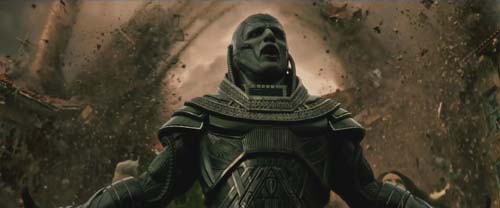
Oscar Isaac as Apocalypse in X-Men: Apocalypse
X-Men: Apocalypse - How can the X-Men defeat the most powerful villain ever?
Plot:
Apocalypse awakens after thousands of years and recruits four new mutant body guards. It's up to Charles Xavier and his gifted youngsters to save the world.

Verdict:
This movie had enough stories for three movies. It suffers from trying to throw everything in and thus not having enough time to focus on any one story. It actively avoids trying to make a statement or have any meaning which is unfortunate. Worrying less about shoehorning big name stars into the movie and focusing on the story would have made this better as Apocalypse is a half baked villain. There is a lot of squandered potential and it lacks a memorable new mutant introduction like Quicksilver in X-Men: Days of Future Past.
It depends.

Review:
I will avoid any major spoilers until my spoiler warning section. I will reveal a few minor spoilers related to the plot at large. The movie trailers reveal more information than I reveal pre-spoilers.

Apocalypse is an ancient being, possibly the first mutant, that was powerful thousands of years ago. He can absorb other mutants' powers, and is awoken in the '80s, which is when this movie takes place, ten years after Days of Future Past. Upon awakening he touches a television, and even allowing him the power to read an analog television signal and every channel simultaneously just from touching the screen, he's also imbued with the knowledge of things that wouldn't even be on television. Of course his desire is world domination. I assume his reasoning is that since he's the strongest mutant he should rule the world and enact survival of the fittest. I get that, and the movie hints at it, but we still needed a few more scenes to legitimize him as a villain. Why does he need four bodyguards? That's an explanation that would have been helpful.
That's part of the problem with this movie, it tries to include too much and doesn't give any story its full due.
The X-Men in X-Men: Apocalypse
X-Men Apocalypse - There's four of them and not a horse in sight.
Apocalypse recruits four bodyguards, his four horseman. This introduces or reintroduces characters, with the fourth not quite fitting the role. Check spoilers below for specifics. The fourth horseman felt contrived, just for the star power.

Quicksilver's sequence again was one of the best, though this time it was not original and just a repeat. He brought a lot of levity to the movie, though Nightcrawler ruined a touching moment with Charles and the X-Men after they defeated Apocalypse. It's another instance of this movie getting close to making a statement or having meaning and backing off completely.

We get an update on Magneto that could be it's own movie. Magneto has been keeping a low profile since X-Men: Days of Future Past, but events converge to bring him back as an antagonist seeking revenge on the world. He's filled with rage and wants someone to pay. By taking out humans, he's also leaving children orphaned just like he was. His vengeance would make him become the very thing that makes him an antagonist. The movie has no inclination to explore this.

Mystique's story line also follows from Days of Future Past. She is regarded as hero, but she's reluctant to accept such a title. What she's been doing since then is just as interesting as what Magneto's been doing. Part of her story, has her finally accepting that she can be a force of good despite her transgressions. It's such a minor plot point that it's almost irrelevant.  The movie could have been built around that. The X-Men at large are heroes to humans that often ridicule them and want to imprison them. Even Wolverine in previous movies has wanted to shirk the responsibility of helping people. Xavier sees their power as the reason they should help the weak. This is the crux of the differing ideologies between Charles Xavier and Magneto. Magneto sees their power as a reason to subjugate humans. I thought the movie might explore this, but it doesn't.

This is also the re-introduction of Cyclops, Jean Grey, and Storm to the X-men through new actors, though in this movie there are no X-men, at least not officially. They're just mutants. In the next movie I forsee them banding together as X-men and actually making a team.
The movie forces Cyclops and Jean Grey into an awkward romance early on when Cyclops bumps into her before he has special glasses that lets him see without blowing stuff up. It was completely contrived and unnecessary, especially when there are better stories to tell in this movie. They later share a moment when she comforts him that fits much better.

The movie goes out of it's way to take a jab at X-Men: The Last Stand (aka X-Men 3), with a pointed reference about how the third movie is always terrible. The problem with this scene is that Nightcrawler goes out in public to see a movie with Cyclops, Jean Grey, and Jubilee but isn't ridiculed by the public. We never see him interact with anyone, and that's always been the underlying subtext of the X-Men. Despite looking like humans, they are ostracized because they have (usually) imperceptible differences. I thought this scene might reinforce Mystique's reluctant hero idea or even Magneto's rage, but it's just included as a cheap shot.

Apocalypse uses Charles Xavier to launch all nuclear missiles into outer space so that no country is a super power and open his path to world domination. He also wants Xavier's powers so that he can control anyone in the world and in essence become omnipresent. The X-Men win because they are a team, and Apocalypse is fighting alone. I'll get into that more in spoilers below.
Where Captain America: Civil War combined the super hero's powers for inventive fight sequences, the Apocalypse movie doesn't capitalize on them working as a team. The fights are disappointing.
Xavier's argument that teamwork triumphs is completely undermined and it didn't have to be. As a result, the final fight was underwhelming and potentially detrimental to future movies. Where do you go from here with such a display of power?


SPOILERS BELOW! SPOILERS BELOW! SPOILERS BELOW! SPOILERS BELOW!

Spoilers are incoming so bail out!

Apocalypse recruits Angel, Storm, Psylocke and Magneto. Magneto has been a main villain in previous movies, and it felt weird for him to play second fiddle to Apocalypse especially since Magneto's story is much more nuanced and in turn better. It felt like the movie shoehorned him in just for the star power. He has no issue playing backup? That and he's also much more powerful, than the other horseman. I would have preferred to see Gambit or another mutant instead. Gambit would be a nice introduction since there is potentially a Channing Tatum/ Gambit vehicle in the works.
Magneto got a wife and had a child since the last movie. It's the death of his child that causes him to access the rage he's been hiding. This just didn't feel earned. It's a terrible event, but the pacing felt too quick. We didn't have time to explore his emotions, so we just skipped ahead to where he goes on a murderous rage and teams up with Apocalypse to destroy the world.

Speaking of contrived, just as I was thinking it's nice the movie didn't have to shoehorn Wolverine into an X-Men film for once, it does just that. There was no reason for Wolverine to be in this movie. He's unleashed, wearing a nice little headset that I guess controls his brain. He murders a large number of guards before Jean Grey calms him down by helping him remember his name, Logan, and a few memories. It was a nice touch as Wolverine is later attracted to Jean Grey. She also gently lifts his headset off, which caused me to wonder if it comes off so easily, how come it didn't fly off while he was gutting all the guards. Wolverine runs off into the woods after maybe two minutes of screen time.

Apocalypse enters Charles Xavier's mind as he's communicating with Magneto. Later, Xavier is able to enter Apocalypse's mind and fight him because they are still linked. Xavier states the X-Men will win because they are a team and Apocalypse is fighting alone. Apocalypse does have his four horseman though, not that they matter.
Jean Grey completely eviscerates Apocalypse to where there isn't even a trace left of him. With Xavier's teamwork statement, I was expecting his and Jean Grey's powers to combine or for him to amplify her power but that doesn't happen. Jean Grey defeats Apocalypse completely on her own. With that display of power, how will future enemies not be taken out instantly by her power? Call her and the fight is over. I suppose this is the precursor to the Dark Phoenix saga, but it would be nice to see a movie or two with normal Jean Grey before getting into that. Is the movie series not going to explore the Cyclops and Jean Grey or Wolverine and Jean Grey story lines and conflicts?

What's cannon in this movie series? Is this First Class series of movies overwriting the movies that started in 2000? Hugh Jackman is the only actor that has been in the original trilogy and the first class trilogy.

With this ending and a potential evil Jean Grey as Dark Phoenix I wonder if the link that existed between Xavier and Apocalypse bled into the Xavier and Jean Grey link. A partial piece of Apocalypse's psyche could be imprinted into Jean Grey which could explain her evil turn and her immense power. This is backed up by the fact that the last scene has Magneto and Jean Grey rebuilding the completely obliterated X-Men school. If you'll notice, the bushes along the front walk are trimmed into pyramids. Jean Grey would have planted them sine they aren't metal. Pyramids are Apocalypse's favorite shape. He's the reason ancient Egypt use them, and it was also the shape of the temple he built in this movie. That can't be coincidence.

The stinger after the credits that introduces Essex Corp. is related to Mr. Sinister. He will be a villain, but in which Marvel series? X-Men seems like to obvious of an answer.

The Film Career of Skippy aka Asta

 
Skippy, a wire-haired terrier, was born in 1931/1932 and enjoyed an illustrious Hollywood career until his retirement in 1941. One of the smartest dogs in Hollywood, enjoying a salary of $125 a week compared to $3.50 a day of other canine actors, Skippy began training at 3 months old. Soon he was able to respond to both verbal and hand cues.
 
His first film launched him to stardom, almost equal to that of his co-stars who had been in pictures for many years. It was The Thin Man (1934) and Skippy played the world's bravest (ok, not really) detective's dog, Asta. He often follows Nick (William Powell) on his investigations, covers his face with his paw when Nick and Nora kiss, run off with valuable clues, and hide under the furniture when he is scared. He is also a family man (with a not so faithful "wife"). After the success of the film, everyone wanted a wire-haired terrier.
 
 
Skippy was then cast in small roles in four films in the year 1935 (The Big Broadcast of 1936, Lottery Lover, It's a Small World, and The Daring Young Man) and the following year reprised his role as Asta in After the Thin Man (1936).
 
Skippy's two other big roles included his role as Mr. Smith in The Awful Truth (1937) starring Cary Grant and Irene Dunne and as George in Bringing Up Baby (1938) starring Grant and Katharine Hepburn.
 
The Awful Truth

"Singing" with Grant
 
As George, running off with Grant's intercostal clavical.
 
An article about Skippy, titled "A Dog's Life in Hollywood," appeared in the August 1938 issue of The American Magazine:
 
Movie actresses stroke Skippy lovingly. They coo at him and murmur endearing terms in his ears. He takes it all in his stride, because, what with contracts, options, and exacting work before the movie cameras, he hasn't much time for the attentions of Hollywood's most beautiful stars. But if he's paid for it and given the proper cue he will snuggle in the arms of the loveliest of stars, gaze into her limpid eyes, and, if necessary—howl.

Skippy, a smart little wire-haired terrier, is one of the leading stars in pictures. He leads a glamorous life—a dog's life de luxe. He is rated as one of the smartest dogs in the world, and when contracts are signed for his appearance in a picture he gets $200 a week for putting his paw-print on the dotted line. His trainer gets a mere $60.
His owner is Mrs. Gale Henry East, once a prominent movie comedienne. ... "When Skippy has to drink water in a scene, the first time he does it he really drinks. If there are retakes and he's had all the water he can drink, he'll go through the scene just as enthusiastically as though his throat were parched, but he'll fake it. If you watch closely you'll see he's just going through the motions of lapping and isn't really picking up water at all. And, because he has a sense of humor, he loves it when you laugh and tell him you've caught him faking but that it's all right with you.
"Treat a dog kindly and he'll do anything in the world for you."
"Signing" his contract for Bringing Up Baby.
 
This post is part of The Animals in Film Blogathon hosted by In the Good Old Days of Classic Hollywood (and my upcoming co-host to the Olivia de Havilland Centenary Blogathon). Check out my other post on Trigger in Son of Paleface (1952) and be sure to read all of the other posts about Hollywood's most talented animals!