I NEVER thought I'd say this but... I have a thing for Robert Ryan now. It started last month with Tender Comrade and has continued this month with me watching whatever movies of his I could get my hands on. I also discovered there is a shameful lack of Robert Ryan gifs out there. I'm going to have to fix that...
Also this month I watched, you guessed it, Christmas movies. I didn't watch some of the ones I usually watch - Miracle on 34th Street, The Bishop's Wife - as it literally felt like I had just watched them. Some were not classic Christmas films but set at Christmas (Susan Slept Here, Period of Adjustment).
Anne of Green Gables (1934) - Anne Shirley, Tom Brown
A Slight Case of Murder (1938) - Edward G. Robinson
Golden Boy (1939) - William Holden & Barbara Stanwyck, Adolph Menjou, Lee J. Cobb
*Meet John Doe (1941) - Gary Cooper & Barbara Stanwyck, Edward Arnold, Walter Brennan
Manpower (1941) - Edward G. Robinson & Marlene Dietrich, George Raft
Dressed to Kill (1941) - Lloyd Nolan
Rage in Heaven (1941) - Robert Montgomery & Ingrid Bergman, George Sanders
One Foot in Heaven (1941) - Fredric March & Martha Scott
The Constant Nymph (1943) - Joan Fontaine & Charles Boyer
Marriage is a Private Affair (1944) - Lana Turner & John Hodiak, James Craig
Action in Arabia (1944) - George Sanders, Virginia Bruce
*Christmas in Connecticut (1945) - Barbara Stanwyck & Dennis Morgan, S.Z. Sakall
Homecoming (1948) - Clark Gable & Lana Turner, John Hodiak, Anne Baxter
Berlin Express (1948) - Robert Ryan & Merle Oberon
Act of Violence (1949) - Van Heflin & Janet Leigh, Robert Ryan, Mary Astor, Phyllis Thaxter
The Breaking Point (1950) - John Garfield, Patricia Neal, Phyllis Thaxter
Three Little Words (1950) - Fred Astaire & Vera-Ellen, Red Skelton, Arlene Dahl
I'll See You in My Dreams (1951) - Doris Day & Danny Thomas
Duchess of Idaho (1951) - Esther Williams & Van Johnson
The Day the Earth Stood Still (1951) - Patricia Neal, Hugh Marlowe
Lovely to Look At (1952) - Kathryn Grayson, Red Skelton, Marge & Gower Champion, Howard Keel, Ann Miller
The Naked Spur (1953) - James Stewart, Janet Leigh, Robert Ryan, Ralph Meeker
Dream Wife (1953) - Cary Grant & Deborah Kerr
Pushover (1954) - Fred MacMurray & Kim Novak, Dorothy Malone
*White Christmas (1954) - Bing Crosby, Danny Kaye, Rosemary Clooney, Vera-Ellen, Dean Jagger, Mary Wickes
Susan Slept Here (1954) - Dick Powell & Debbie Reynolds
*Three Coins in the Fountain (1954) - Clifton Webb & Dorothy McGuire, Louis Jourdan & Maggie McNamara, Rossano Brazzi & Jean Peters
Betrayed (1954) - Clark Gable & Lana Turner, Victor Mature
The Last Voyage (1960) - Robert Stack & Dorothy Malone, George Sanders
Period of Adjustment (1962) - Jane Fonda & Jim Hutton, Anthony Franciosa
*Mickey’s Christmas Carol (1983) - Alan Young
*Elf (2003) - Will Ferrell, Zooey Deschanel, Bob Newhart, Ed Asner
Psych: The Movie (TV Movie-2017) - James Roday, Dule Hill, Maggie Lawson, Kirsten Nelson, Zachary Levi
Least Favorite Movie: Lovely to Look At but ONLY because I can't stand Howard Keel. Oh, and the end of Susan Slept Here was pretty disturbing. Apparently there were no 35 year old actors in Hollywood that year and the closest they could get was a 50 year old actor that looked 50.
Favorite Movie: There were lots of movies I really enjoyed this month but my favorite performance by far was Danny Thomas in I'll See You in My Dreams. I was so excited that TCM aired it this month as I read Thomas's autobiography recently and really wanted to see it after reading his memories of the film. He was adorable in it and I learned that his character Gus Kahn wrote the lyrics to a couple of my favorite songs. I'll leave you with this scene.
The 1946 Macy's Thanksgiving Day Parade was special for two reasons: It was the first year the parade was televised locally (it would go national in 1947) and it appeared in a movie that was destined to become a perennial Christmas classic - Miracle on 34th Street (1947).
That's right! The crew filmed the actual 1946 parade and Edmund Gwenn actually played Santa Claus. Of the two million live spectators that year, I wonder how many people watching recognized the movie star or realized it was being filmed for a movie that would be coming to theaters the following summer!
When I first started this blog, my second post was a list of Halloween Films. They were almost all comedies. Since then I have watched some scarier (to me) films that I would like to share with you:
The Leopard Man (1943) - another Val Lewton/Jacques Tourneur classic, this one came out the year after the more well-known cult-film Cat People (1942). Set in New Mexico, it features Lewton's signature shadows and sounds, and even the same panther!
That moment when you show up to a party in a killer dress and with a panther
><><><
The Uninvited (1944) - starring Ray Milland and Gail Russell, this haunting film is a must-watch. Milland and his sister (Ruth Hussey) buy a cheap mansion that happens to be haunted. At night they hear a woman moaning but no one can ever be found. Gail Russell is a neighbor who lived there as a child - until her mother fell, or jumped, of the nearby cliff. When Russell comes to visit her new neighbors she falls into a trance.
A séance is always a good idea.
><><><
The Innocents (1961) - a classic starring Deborah Kerr, a governess who is convinced that the two children in her charge are possessed by a couple that died there. I only watched a little bit of it on TCM, but I plan to watch the whole film soon.
What do you first think of when you see this scene? Did any of you think asbestos? How about cornflakes? If you're like me you most likely thought, "Christmas in Connecticut! I love that scene! The snow is so pretty."
Well, you're right, it IS Christmas in Connecticut and the snow is pretty! Wait, did I just say snow?
Everyone knows that Hollywood, California, is where movies are made. Everyone ALSO knows it doesn't snow there. So how did scenes like the one in Christmas in Connecticut come about? Did the entire movie set pack up and head to where the real snow was? Did they bring the snow to Hollywood? Or did they make their own?
Click here in case you now need to listen to "Snow."
Silent, and not so silent Snow
Snow scenes in films have been around since the beginning of movies themselves. In order to have them be as realistic as possible, the whole cast and crew would pack up in search of snow and ice. And while it looked nice on film, there were numerous problems and accidents associated with it. Camera's froze, actors fell into ice waters or suffered hypothermia leading to lost toes and rheumatism, got lost in snow storms, fell down mountains... pretty much anything that could happen, did.
A popular silent film, The Gold Rush (1925) starring Charlie Chaplin, featured both real snow and fake. The film was shot in the Sierra Nevada Mountains and made to look like the famous Chilkoot Pass in Alaska. However, after Chaplin came down with pneumonia, the crew headed back to Hollywood and constructed snow-covered mountains with timber, chicken wire, and burlap covered with salt and flour. Other early snow scenes used everything from white pine sawdust, scraps of paper mixed with salt (thrown in front of a wind machine it made very convincing snowfall), cotton wool, paraffin (for ice) and crushed gypsum (from their own mine), the last of which probably contributed to the early death of actor Lon Chaney, who died of lung cancer in his mid-forties.
The most popular form of early movie snow was cornflakes painted white or bleached, mixed with shaved gypsum. Yes, cornflakes. However, once sound entered the picture, cornflakes posed a huge problem: when the actors walked on it you couldn't hear what they were saying! Dialogue had to be added later.
Hey, I've got an idea!
In the late 1920s, a firefighter had a "bright" idea. Why not use Asbestos? The chrysotile asbestos fibers were cheap, versatile, and thought to be harmless (we now know it causes mesothelioma as the loose fibers were easily inhaled). A huge plus was that it didn't make noises when actors walked on it, an important feature once synchronized sound in film was the norm. It also wouldn't catch fire, something that cotton batting was in danger of doing (though in reality not much of a threat). Films such as The Wizard of Oz (1939) and Holiday Inn (1942) feature the harmful substance, sold under the harmless sounding names of "Pure White" and "Snow Drift." It was used not only in movies, but on the stage, department store window displays, and as decoration in homes throughout the 30s and early 40s. The product was popular up until the start of WWII, when asbestos was needed instead for ships, planes, and other military equipment. However, the product was still used all the way up until the mid-50s.
Don't breath it in, Bing!
It's a Wonderful Idea
In the summer of 1946, a new "snowstorm" was brewing. The film was the now iconic classic It's a Wonderful Life starring the just-returned-from-the-war veteran James Stewart and it needed snow... lots of it. Shaved ice could be used for icy paths and plaster would be used for snowbanks and spryed on trees but for the snow they wanted something different. Russell Sherman, RKO studio's head of special effects and a much more brilliant man than that fireman, used his engineering skills and some post-WWII technology to come up with silent, unmeltable, and realistic-looking fake snow. The chemical mixture he came up with used foamite—a material used in fire extinguishers—and mixed it with sugar, water, and even soap flakes. It was sprayable and could be quickly blasted over set pieces using wind machines. The film used 6,000 gallons of the substance, which "clung convincingly to clothing and created picture-perfect footprints, while generating nothing like the sound of trod-upon breakfast cereal." Sherman, along with the rest of the RKO Special Effects Department received a Class III Scientific or Technical Oscar from the Academy of Motion Picture Arts and Sciences for "developing a new method of simulating falling snow on motion picture sets."
Sherman's snow, called Phomaide, revolutionized snow in film, yet as time went on, other methods were developed to meet different needs. Dr. Zhivago (1965) called for Siberian ice. Since filming in Russia was out of the question, special effects guy Eddie Fowler used hot wax and marble dust to create a glittering, frozen tableau.
Snowmaking Today
Today, the majority of snow in films comes from one company: Snow Business, located in Britain. They boast over 200 different types of eco-friendly snow made from a variety of materials, including recycled paper and plastics, that is both safe and comfortable for actors. Looking at all of the different types of "snow" on their website is amazing; one would swear it is real. There are pages for settled snow, falling snow, ice, frost, falling ash, icicles, dirty snow, clean snow, indoor snow, the combinations are endless! They also provide real snow, which can last up to three days if stored properly.
Digital Snow
The last kind of movie snow is digital snow. Technology has advanced so far since the advent of films. Where once studio workers would painstakingly make an entire field of individual poppies (The Wizard of Oz), now huge vistas, fields, mountains, building, bridges - all can be created digitally using green-screen technology. So when you see huge icy mountains in a film, they could be real or they could be digital! We've come a long way!
As I was compiling my top ten comedies and dramas, I kept coming across films that seemed to fit both genres and in doing so fit in neither. I looked up some of them and found that they were listed under the category of comedy-dramas, that is, a movie that "contains elements of comedy films, in addition to being a drama." Therefore, I had to make a top ten list so they wouldn't be left out :)
1. Forsaking All Others (1934) - Joan Crawford, Clark Gable, Robert Montgomery
2. Mr. Smith Goes to Washington (1939) - James Stewart & Jean Arthur
3. Meet John Doe (1941) - Gary Cooper & Barbara Stanwyck
4. The Whole Town's Talking (1942) - Edward G. Robinson & Jean Arthur (more like a crime-comedy...)
5. Once Upon a Honeymoon (1942) - Cary Grant & Ginger Rogers
6. Going My Way (1944) - Bing Crosby, Barry Fitzgerald
7. Miracle on 34th Street (1947) Maureen O'Hara & John Payne, Edmund Gwenn, Natalie Wood
8. Sabrina (1954) - Audrey Hepburn, Humphrey Bogart, William Holden
9. Mister Roberts (1955) - Henry Fonda, Jack Lemmon, William Powell, James Cagney
10. The Yellow Rolls-Royce (196) - Rex Harrison, George C. Scott, Shirley MacLaine, Ingrid Bergman, Omar Shariff
What are your favorite comedy-dramas? Do you like them better than pure comedies?
My all time favorite dance out of every movie that has been made - including the countless ones I haven't even seen yet - is and always will be The Best Things Happen While You're Dancing from the classic holiday film White Christmas (1954).
White Christmas is a holiday favorite in my house. My family has watched it every year at Christmas time for as long as I can remember. Vera-Ellen instantly became my idol and I wished I could look like her, dance like her, and sing like her (I discovered that unfortunately it's not Vera-Ellen doing the singing... sigh). For several years Judy was my favorite name (I was also a big Judy Garland fan).
I'm going to presume that everyone has seen this not-to-be-missed film and get right to the point: Vera-Ellen's dancing. Let's take each routine individually:
Her first "dance," Sisters, Sisters, also where Phil and Bob first lay eyes on the Hanes Sisters (who incidentally have brown and DEEP blue eyes), isn't much of a dance. However, it's a great song and she and Betty (Rosemary Clooney) have awesome dresses (one day I WILL have a replica made):
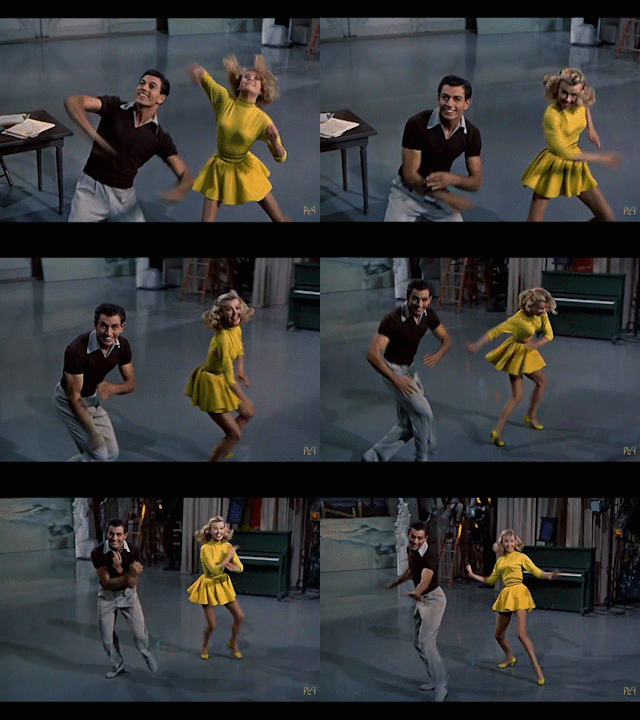
The next dance is The Best Things Happen While You're Dancing, also known as the song where Phil and Judy get "carried away." It has a lot of great things going for it. Amazing dress - check! Partner with two left feet and matching gray shoes - check! Amazing song - check! Great dancing area - check!
I was always trying to twirl and get my skirt to land this way. It never worked :(
Pole dancing. The CLASSY way.
I love the part on top of the boat!!!
What is this, The best two out of three?
I could go crazy and basically put up the whole dance in gifs but
hopefully you'll just watch the video. On repeat.
After that, the foursome are off to Vermont (it must be wonderful this time of year, all that underwear) where they put on a huge show to bring business to the inn (owned by the fella's former general). The first number we see is Mandy. It's a truly colossal number with an unforgettable entrance, background girls wearing strips of red sequins held together with fabric you can't see (courtesy of Edith Head), men in green suits and red gloves, and Judy in a fabulous outfit with a detachable skirt.
(Sorry the video zooms in and out a little weird a couple times. It was the only one on YouTube)
It is in this number you really see Vera-Ellen's talent. Just watching some of those moves makes me wince and think, how is that possible? My favorite parts: "Mandy, what a gal!" and Judy's wink to the camera ;) Not to mention Phil doing this:
Haha I never noticed Bing :)
In Choreography, we get to see Judy do some amazing tapping while dressed in hot pink. Growing up we watch the old recorded VHS (complete with old commercials!) on the square TV and it was just blurry enough that when Judy's feet come down and she starts tapping, we couldn't see her foot moving - that's how small and controlled her tap was! So when we FINALLY got it on DVD we could at last see it! Also, it was this song that made us dislike Judy's dancing partner. How dare he try to steal her from Phil!!
Judy's entrance is at 1:38.
Out of all the performances, Abraham is the only one that isn't shown in it's final form. Mandy and Choreography are full dress rehearsals and the other two numbers we see, Gee, I Wish I was Back in the Army, and White Christmas, are shown in the actual show. I wonder how it would have looked and if the filmmakers thought about showing it as a "finished" version. Of course, I wouldn't have it any other way. Judy's yellow dress and heels as well as her bouncy hair match perfectly the energetic rhythm of the song.
If you've seen Holiday Inn (1942) - on DVD - then you will recognize the tune, although this is a sped up version without lyrics. In Holiday Inn it was a blackface routine and the lyrics are all about Abraham freeing the slaves. Understandably, it is cut out when shown on television nowadays. It's been a good many years since I've seen it (I wasn't much on Astaire in that film) and I've seen it only once so I didn't even remember it. I just remember thinking I liked the White Christmas version MUCH better.
When White Christmas showed in select theaters a couple Christmas's ago, my whole family went. It was amazing how much detail we could see!
We watch them every year but aside from Frank Capra's It's a Wonderful Life (and probably Michael Curtiz's White Chirstmas and Ernst Lubitsch's The Shop Around the Corner), you may not notice or recognize the director of your favorite Christmas films. In this post I am going to tell you who directed each of the most famous Christmas films and what other major films they directed. *This is not a complete list of Christmas films, just some of the better known or my personal favorites.
As I already mentioned, Capra and Curtiz need no introduction, but did you know the director of Christmas in Connecticut (1945) was Peter Godfrey? I certainly didn't recognize his name. I looked him up and discovered he was London born and directed two other great Stanwyck films (which I will be looking at for the Barbara Stanwyck Blogathon later this month) The Two Mrs. Carrolls (1947)and Cry Wolf (1947).
George Seaton directed the much loved Miracle on 34th Street (1947) but did you know he also directed The Country Girl (1954)? He also directed 36 Hours (1964), a James Garner film I discovered this year.
The director of The Bishop's Wife (1947) was Henry Koster, born in Berlin. He directed many well-known films, including The Inspector General (1949), Harvey (1950), and The Robe (1953), to name a few.
Holiday Affair (1949) is one of the lesser known holiday films starring Robert Mitchum and Janet Leigh. It was directed by Don Hartman. He only directed five films total, but was the writer of many popular films, including quite a few for Bob Hope.
Remember the Night (1940), another Stanwyck film, was written by Preston Sturges but directed by Mitchell Leisen. His 50 credits include a couple Lombard films, Midnight (1939), and many other romantic comedies.
Bachelor Mother (1939) was directed by Garson Kanin, who directed My Favorite Wife (1940) and who wrote the Tracy/Hepburn films Adam's Rib (1949) and Pat and Mike (1952).
Lastly, Holiday Inn (1942), which introduced perhaps the most popular Christmas song of all time, "White Christmas," was directed by Mark Sandrich, who has 76 credits beginning in 1926 and ending in 1946 (his death). His name will be familiar to all who love the Astaire/Rogers films.