Showing posts with label Katharine Hepburn. Show all posts

Saturday, 23 March 2019

Marathon Blogathon - Douglas Fairbanks Jr.


Three years ago, when Virginie of The Wonderful World of Cinema and Crystal of  In the Good Old Days of Classic Hollywood hosted the first ever Marathon Stars Blogathon, I struggled to think of movie stars that I had seen less than three films in. There were of course a few stars that I, at the time, had no interest in that I could have chosen, but I wanted my marathon to be enjoyable and not a chore. And so, as a Classic Movie Fan who hadn't yet seen Gone With the Wind in its entirety, I chose Vivien Leigh.

The blogathon however had started me thinking and I made as thorough a list as possible of stars I had seen only three films are less. This is what I came up with in 2016:


Since then I have crossed off many names as well as added more stars as they came to my attention. You may notice there are few stars known primarily for Silent Movies. However, they are mostly the big name ones that have remained in the public's mind for close to a century. There are of course many more that I have never heard of but, at some point and time, surely will whenever I begin to delve more deeply into that period of filmmaking (which may be soon as I've discovered several of William Powell's and Ronald Colman's silent films online). And so, here is the list as it appears today:


When Virginie and Crystal announced the Second Annual Marathon Stars Blogathon, now also joined by Samantha of Musings of a Classic Film Addict, I pulled out my handy chart and decided who it was that I wanted to explore and whose films I had fast access too. Since I already had one Douglas Fairbanks Jr. film in my TCM queue, and since I was planning on checking out The Prisoner of Zenda (1937) for my current Ronald Colman obsession (sadly/not sadly I had already seen 4+ films of Colmans), I knew who my subject would be.

"Oh I think you'll discover that I'm much more than a pretty face!"

Douglas Fairbanks Jr. was under the 2 Films category: the classic Gunga Din (1939) and Having Wonderful Time (1938). I love Gunga Din but it is definitely Cary Grant's movie. I watched Having Wonderful Time last year and enjoyed it but it didn't make any kind of impression on me. However, from the first two films I watched for this marathon, I immediately came to appreciate the acting ability of DFJ (as I will refer to him for the rest of the post), and see him in a variety of genre's and roles. Here are the films in the order I viewed them in (I'm focusing on DFJ's performance rather than the plots):


Morning Glory (1933) - This film is really about Katharine Hepburn (she won her first Oscar for her performance) but DFJ holds his own against the new star with his tender, quiet, and thoughtful performance.

Here are some DFJ's memories of the film (from I Know Where I'm Going: Katharine Hepburn, a Personal Biography by Charlotte Chandler):
"They showed me some photos of her [Hepburn], saying she had very unconventional looks. They said it rather apologetically, because she certainly didn't look like everyone else, or even anyone else. I thought she was beautiful. I hoped it wouldn't just be an example of those touched-up pictures the studio specialized in. I hoped she would look just like those pictures when I met her. Well, she didn't look just like them. She was even more beautiful.
"The moment I met Kate, I fell madly  in love with her. In those days I fell madly in love rather easily. I found her adorable and I adored her.
"There were some people who said she wasn't beautiful. Well, they needed vision tests and new glasses.
"Adolphe Menjou and I were with her in the film, and we were asked to help her out as much as we could. She won the Oscar.
"The original script for Morning Glory, included the fantasy dream sequence in which Miss Hepburn and I would play at least two scenes, and possibly a third, of the greatest scenes between Romeo and Juliet. That certainly intrigued and tempted me. It seemed a unique opportunity for me to play Romeo, a dream part.
"She was wonderful to play with in our Romeo and Juliet scenes. Every time I tried to work my thin frame into my tights, I wasn't certain I'd make it. I tried to stop eating much. Then, I tried to stop eating at all. Unfortunately, the more I tried to stop eating, the hungrier I felt and the more I thought about not eating, the more I ate and the tighter my tights got. I tried every position to enter them, including lying on the floor with my legs in the air. There was no lock on the door, and I got caught once. Someone opened the door, but I was too busy trying to extricate myself from one leg of the tights to see who it was. The person was too embarrassed by the sight to linger.
"We did the scenes from Romeo and Juliet for small invited audiences, and we both felt we were 'of the theater.' "

Kate's memories on her favorite scene:
"a great scene in the film which no one saw because it was cut out. It's my favorite and it's Douglas's too. It was from Romeo and Juliet. Douglas was Romeo and one guess who was Juliet.
"It was done like a dream. We were both very good, but Douglas was better than I. He looked more like Romeo than I looked like Juliet.
"I like the picture, but the most wonderful thing I got out of it was Douglas, a dear, dear friend throughout my life."

I certainly wish that scene had been left in the picture! There was a scene where the two recite a few lines and it was one of the best parts of the film (see a snippet above). And the fact that DFJ was in love with Hepburn but she didn't really love him back in the same way, really came across in their scenes together in the film. My favorite moment is when Hepburn's character touches his hand and walks away, and he tenderly touches his hand where hers had been. You can watch it below.


The Prisoner of Zenda (1937) - I've already seen the shot-for-shot 1952 remake starring Stewart Granger, Deborah Kerr, and James Mason (I've never understood the appeal of Granger - most of his films I've seen were viewed for his leading ladies). While it was very good I enjoyed this one, starring Ronald Colman and Madeleine Carroll, much more.


DFJ was absolutely perfect for the role of the swashbuckling villain. He wasn't sure he wanted to be a supporting player to Colman so he sought out his famous father's advise. Douglas Fairbanks Sr. told him that ""not only is The Prisoner of Zenda one of the best romances written in a hundred years and always a success, but Rupert of Hentzau is probably one of the best villains ever written" (The Salad Days: An Autobiography, DFJ). DFJ's devil-may-care approach to the character makes his the showiest part of the film. See all my screenshots on my blog facebook page.


The Power of the Press (1928) - I wanted to make sure I covered a wider selection of DFJ's filmography so I was happy to find The Power of the Press (1928) directed by Frank Capra online. It shouldn't surprise anyone that a Capra film is set at a newspaper office. DFJ writes the weather for the paper but wants to do more. There's a humorous scene where he writes a flowery description of the weather and shows it to the editor saying, "If you change a word of it you'll ruin it." The editor then proceeds to cross out everything but the initial forecast.


DFJ's chance comes when the paper gets a call about the murder of the District Attorney and there are no other reporters in the office to send to the scene of the crime. DFJ gets a scoop and is a big man at the office until it is proven wrong. He is fired but doesn't let that stop him from solving the crime himself.


There's a fascinating sequence that shows how the front page is changed when a scoop comes through, from typewriter to printed paper. It is very Capra (as well as his last silent film). In Frank Capra: The Catastrophe of Success by Joseph McBride, it mentions that "former paperboy and Los Angeles Times stuffer" DFJ was able to "indulge vicariously his fleeting youthful ambition of becoming a reporter (201)."


A brief biography:

Born Dec. 9, 1909. Son of famous actor Douglas Fairbanks (he added narration to one of father's silent films). His stepmother was famous silent actress Mary Pickford. Pickford and Fairbanks instituted the Academy Awards. Married to Joan Crawford from 1929-1934 (divorce, no children). He held the Silver Star and the Legion of Merit with V for valor in combat device from the U.S. government for his combat service in PT boats and gunboats. Was awarded the British Distinguished Service Cross, the French Legion of Honor and Croix de Guerre with Palm for his services during World War II. Created an honorary Knight Commander of the Most Excellent Order of the British Empire in 1949. Has 100 acting credits. Died May 7, 2000 of a heart attack.

Thursday, 19 May 2016

Ten Movies on an Island: 1930s Edition


The 1930s were a time of constant change in Hollywood as the movies made the transition to sound and had to find their feet all over again. Some stars were able to make the switch smoothly, many were not. It was a time where it had to be decided what could and could not be shown, of how far was too far. With the institution of the Hays Code came the birth of the Screwball comedy and with it a new kind of zaniness, perfect for coping with the Great Depression. Animation as we know it today took it's first big step with Snow White and the Seven Dwarfs, Disney's first feature length animated picture. Then came 1939, the crème de la crème of motion pictures, with it's classics like Gone With the Wind, The Wizard of Oz, Mr. Smith Goes to Washington, and Stagecoach.

The main question is, how can I choose a mere ten films from such a diverse and amazing decade? I have 95 titles from that decade on my movie list. That means I can't choose 85 of them. Yet choose I must. As in any film list, many were left off, but here are the ones I truly could not live without:

1930s:
1. The Thin Man (1934) - William Powell & Myrna Loy
2. It Happened One Night (1934) - Clark Gable & Claudette Colbert
3. Theodora Goes Wild (1936) - Irene Dunne & Melvyn Douglas
4. Libeled Lady (1936) - William Powell & Myrna Loy, Spencer Tracy & Jean Harlow
5. Double Wedding (1937) - William Powell & Myrna Loy
6. Bringing Up Baby (1938) - Katharine Hepburn & Cary Grant
7. The Adventures of Robin Hood (1938) - Errol Flynn & Olivia de Havilland
8. Bachelor Mother (1939) - Ginger Rogers & David Niven, Charles Coburn
9. The Wizard of Oz (1939) - Judy Garland
10. Mr. Smith Goes to Washington (1939) - James Stewart & Jean Arthur

Honorable Mentions (aka didn't quite make it): Forsaking All Others (1934), Curly Top (1935), The Whole Town's Talking (1935), My Man Godfrey (1936), True Confession (1937), You Can't Take it With You (1938), Four Daughters (1938), Daughters Courageous (1939), and In Name Only (1939).

Tomorrow: My top ten from the 1940s!

Thursday, 12 May 2016

Paintings by Katharine Hepburn

The sign above the painting says "Are you Artistic [illegible]? Join us in this [illegible] adventure. Please add a brush stroke [illegible].

Everyone needs a hobby and the movie stars are no different. Just last week we looked at the childhood sketches of Audrey Hepburn and today we look at the paintings of another Hepburn - Katharine Hepburn - for The Great Katharine Hepburn Blogathon hosted by Margaret Perry.

When I first googled "Paintings by Katharine Hepburn," I got only a few results. Then I happened to go to one of the websites, Sotheby's auction website, and found the motherload! Below are more than fifty paintings that were auctioned off in 2004 that were painted by Katharine Hepburn. They range from self-portraits to still life to seascapes and reveal her travels from Cuba to Connecticut to California. Information about each painting will be below it.

Hepburn's painting table, easel, and paint box.

Hughes' yacht, the Southern Cross.

FIRST PAINTINGS

Katharine Hepburn's life-long love of painting began in 1937, during her famed relationship with Howard Hughes. It was while out on his yacht that she first picked up a paintbrush. Her first two paintings, seen below, are of Nassau Harbor, Hughes' favorite sailing spot.

We used to enjoy painting together. He asked me if I'd pose nude for him. I said, "Sure, if you'll pose nude for me." That ended the discussion (114).
I Know Where I'm Going. Charlotte Chandler. From recordings made by the author.
 

SELF-PORTRAITS

Katharine Hepburn painted many self-portraits. Never one to be vain, they often display her natural freckles prominently, which usually end up looking like chicken pox.

 
This self-portrait was painted while on location for The African Queen (1951) and given as a gift to Hepburn's wardrobe lady.

12" x 9" - Note the upturned collar.

As "Lizzie" in Rainmaker (1956).

                     
Notice the words "Baby Kate" where her left shoulder would be on the portrait on the right.

 
This sketch was done while recuperating in the hospital from a leg injury in 1969 during the time she was performing Coco on Broadway. Around a central image of Hepburn's face are her list of complaints, which read in part, "What's that noise/people talking...now what's wrong - I just/ can't believe that a/ group of able bodied men can't/ figure out how to run a turn/ table -...Where is she - its last hour/ Quiet - Shut up -..." A piece of tape affixed to the sketch reads "Jerry Don't Forget Kate." When Hepburn returned to the show, she gave this drawing to stage manager Jerry Adler. Source.

 
American Breakfast in Bed.
Self-portrait in Brisbane, Australia, 1955. 8"x6".
Pencil and Watercolor on paper. Note her trademark use of red and white.

 
Self-portrait on the beach, 7" x 10".

Most likely painted on the Isle of Jersey while visiting friend William Rose, the writer of Guess Who's Coming to Dinner (1967). Note the red bathing suit and the blue "K" on the bag.

A Matter of Gravity, 1976 - total of 5 portraits

Hepburn, as Mrs. Basil, played the grandmother of a young Christopher Reeve in his career debut in the play A Matter of Gravity. Miss Hepburn had broken her ankle, and instead of passing the part on to her understudy, she played the role convincingly in a wheelchair.
June 2, 1971 - Hepburn as Coco Chanel in the Broadway play Coco.

Coco had completed its Broadway run (Hepburn received a Tony nomination) and was on a US Tour. It was her only Stage Musical.
 
Shakespeare self-portraits
 
There are a total of 14 of these, including one from Much Ado About Nothing.
Range in size from 5.5" x 3.75" to 10" x 7".

SEASCAPES

It is obvious looking at Hepburn's paintings that she loved the sea and the New England area that had been her home for most of her life. Of the 100+ paintings that she did in her life, over 40 are seascapes.

Barrenjoey Lighthouse - 4.75" x 6.5 " 

Barrenjoey Head Lighthouse is an icon of the Sydney Northern Beaches. Sydney residents and international visitors have been walking the steep track to the summit, to be rewarded with stunning views of Broken Bay.

Built in 1881 from sandstone quarried on site, the lighthouse, oil room and cottages are unique in that they retain in their original natural stone finish.

This was painted from the perspective of Palm Beach.


Two more views of Barrenjoey Lighthouse

Watch a video about this painting here.

Stratford, CT - 12" x 18"
Note the red boat

Hepburn painted these works either in the summer of 1957 or 1960 when she lived in Stratford, Connecticut, while performing at the American Shakespeare Festival Theater.

Stratford, CT

Sailboats in Stratford, CT.

When performing at the American Shakespeare Festival Theater in 1957, Hepburn rented a home that was set on the water. She painted the spider web scene from her porch, with her own feet in view, looking out on the Housatonic River.
 
Collection of Stratford, CT seascapes

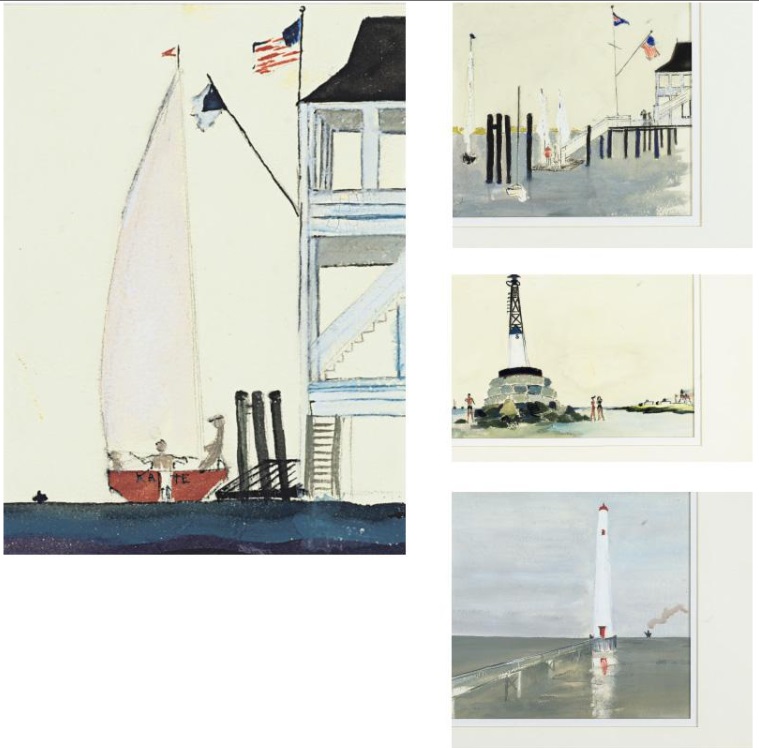
This group includes views of the Stratford lighthouses and a self-portrait of Miss Hepburn in a boat called "Kate," docked at the Housatonic Boat Club in Stratford. Hepburn would often paint from the boat that she used to travel back and forth to the theater.

Boat and Boatclub on the Housatonic River. Painted from her boat - 13" x 9"

1960 - red boat on Housatonic River, Stratford.

Sailboats at Sunset, Fenwick - 3.5" x 14.75" (this one's my favorite)
Floorplan on reverse side

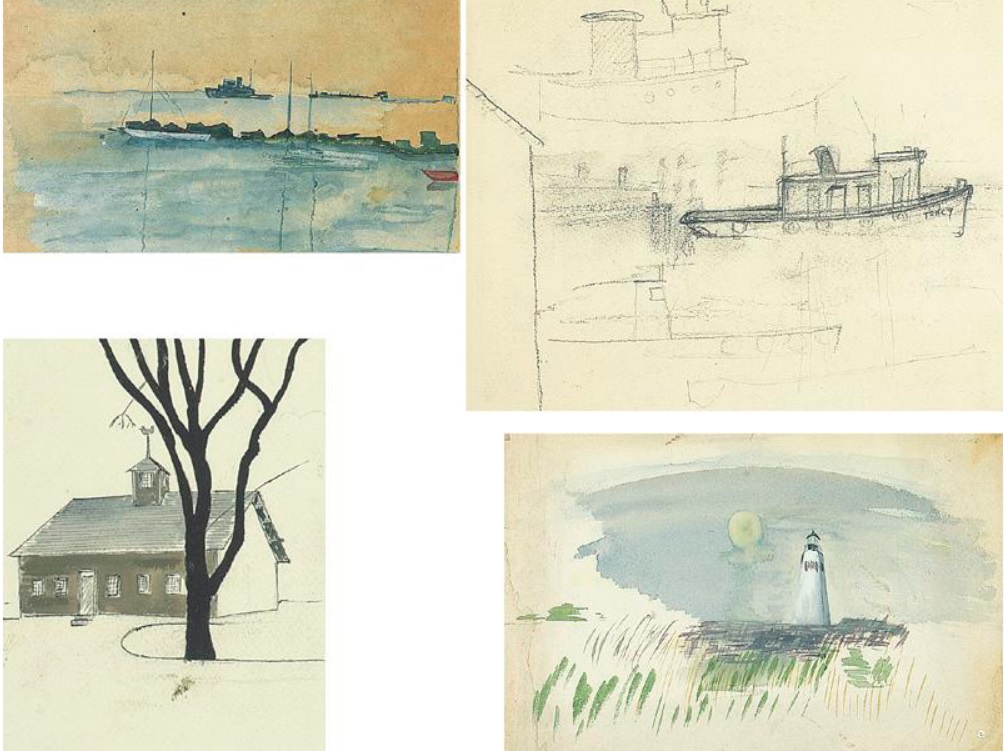
Lighthouses of Old Saybrook
Shows both inner and outer lighthouses of Fenwick on the Long Island Sound.

"Me and Phyllis"
Fenwick Gulls, 1965 - 15.75" x 20"
 
Handwritten note on the back says "The *ath / Fenwick Gulls / I consider this my / masterpiece / Katharine Hepburn."

Long Island

Figure by the Ocean - 6.25" x 9"

Two seascapes with lighthouses - 3" x 9"

Four seascapes from various locations - smallest 3 in. by 4 in., Largest 8 in. by 10 in.
 
Includes: a Venetian canal scene, painted when Miss Hepburn was making "Summertime" in 1954; a sailboat and lighthouse, painted near her Fenwick home; and a village scene, most likely painted in Australia.

Seascape and lighthouse

 
Three water scenes

Three Miscellaneous Scenes (note the figure in red - Hepburn) - 4" x 10"

Random Seascapes

From a sketchpad circa 1957 - 9" x 12"
 
A Woman by the Sea - 8" x 6"

Hepburn based this painting on a honeymoon portrait of her parents, Kit and Thomas. However, she encountered problems in rendering a likeness of her father, so she removed him from the scene.
 
Two Ladies on the Beach with Black Umbrellas - 9" x 6"
Based on Monet's painting "Woman with a Parasol"

LANDSCAPES

Connecticut Landscapes with Buildings
Not pictured is unfinished painting of church.
 
Hepburn would often take day car trips from her home, Fenwick to paint outdoor scenes.

Group of three landscapes 

Central Park scene, view from Hepburn's Paris balcony, and view
of Mount Vernon with Irene Selznick.
 
Group of six watercolors
Top Left: Long Island Sound with Queen Anne's Lace.
Middle right: Mount Vernon with Irene Selznick.
 
Landscape in CA hills, 1965

The Hill of Beverly Hills - 20" x 16"
 
This painting included a letter on Hepburn's stationary reading: "This was done in about 1960 from the hills in back of Beverly Hills. When I was in California I always lived in a house somewhere in these hills--facing southwest to the Pacific Ocean in the distance. Lovely light. Lovely view. This was done in the Barrymore house. To the west and a bit was John Gilbert's--I rented that several times--to the southwest was Charlie Boyer's house (I rented that too). You could press a button and the dining room ceiling would slide open. Fun. Below Boyer the Prince David Mdvanni House (yes, I lived there)--then to the east of Barrymore's the Edgar Bergen and Charlie McCarthy house (yes, that too.) On another hill to the west--the Jules Stein house--built by Fred Niblo with money from the silent picture Ben Hur (I lived there.) All these great houses. See their mailboxes. They intrigued me."
View of a tree - 6.75" x 5"

HOME

Hepburn loved her family home in Connecticut - Fenwick - and the surrounding area, as is apparent in her seascapes (read more about Fenwick in my post for last years K.H. blogathon). But, being an actress, she also lived in both Hollywood and New York City and many other temporary places she had to call home. Here are some of them.

House in Los Angeles, 1965

Los Angeles Bedroom on Cukor's estate


California Landscape with Lawn Chairs, circa 1965 - most likely painted while caring for Spencer Tracy in guest cottage on George Cukor's Beverly Hills estate.

LA home with clothesline - 10" x 14"

Beverly Hills patio view (most likely Cukor's) - 14" x 20"

New York Cityscape in the style of George Bellows - 20" x 16"
 
Hepburn based this painting on her own George Bellows painting representing Upper Broadway, which she purchased in the 1940's.

Various paintings of Hepburn's homes.
 
Bottom painting is Hepburn's bedroom in her New York City townhouse with a Cecil Beaton portrait over the fireplace.

ABROAD

As an actress, Hepburn traveled frequently for on-location films, such as for The African Queen (1951) and Summertime (1955). She also accompanied Spencer Tracy to Cuba, while he was filming The Old Man and the Sea (1958).
 
7 Australian Landscapes (4 not pictured) 

Hepburn painted these during the 1955 Old Vic Shakespearean tour which took her to Sydney, Melbourne, Brisbane, Adelaide and Perth. The beach scene features fellow friend and actor Robert Helpmann.

Untitled painting. Note Cuban flag.

Cuban views, 1957
 
Hepburn painted these while with Tracy in Cuba. One is a view of La Punta Fortress and one of the Plaza De Armas.
 
View from bed, Cuba.
Oil on cigar box lid. 4" x 5.5".
 
This is the room Hepburn and Tracy stayed in while Tracy was filming The Old Man and the Sea (1958).
 
5 watercolors of figures
 Beach Scenes in different locales (one with red and white umbrella's in Cuba, 1957).
 
                                    
Two paintings of Jamaica: Palm Tree & Hotel Stairs to the Beach. Painted while visiting her friend Noel Coward.

SPENCER

Hepburn's most famous love-affair, and indeed probably the most famous in all of Hollywood history, was with Spencer Tracy, with whom she made nine films. As Tracy was married, they kept their affair very quiet. In the 1960s, Hepburn took a five year break from movies to care for the ailing Tracy. They lived together in a cottage on George Cukor's Beverly Hills estate (Tracy and his wife had not lived together for years). Hepburn did not open up about her love for Tracy until after the death of his wife in 1983. Below are a few sketches she did of Tracy.

This is the only double portrait of Hepburn and Tracy known to exist. 10.75" x 8.5".

1965 - 8" x 6"
 
Tracy in his favorite chair in their guest cottage on the Cukor estate. His face is obscure by the newspaper because Hepburn couldn't get it "quite right." It was always displayed next to her bed in her NYC townhouse.
On the wall were paintings Kate had collected and some she had painted. There were also some of Tracy's.
"I won't tell you which ones Spence did,"she said. "He wouldn't like it. He didn't mind my having the pictures, but he didn't sign them. He hoped that only I would know, especially as long as he was alive.  
"He considered his paintings so very personal and private. He said the paintings were more private than being naked. 'Naked only shows your outside,' he said, 'but paintings show what's in your heart, your deepest feelings and how you see the world.'
"I can't tell you which ones are Spencer's, but they're the ones that aren't mine." Kate always signed hers (Chandler, 302).
 
10" x 7" - A Walk with Spencer, 1952. 
 
Hepburn painted this scene of Spencer Tracy walking in one of their favorite parks while appearing in George Bernard Shaw's play The Millionairess in London.

Pencil drawings on notepads, 1965. Profile of woman. Spencer Tracy on phone. Tracy's dog, Lobo.

STILL-LIFE

While caring for Tracy, Hepburn painted several still-life pictures. The red items in the painting are "symbolic self-portraits," a way of placing herself in the painting in a spiritual rather than human form.


10" x 14"

Basket of Fruit, 1964 - 4.75" x 6.25"

1965 - 11.75" x 15.75"

1960 - 8" x 12"

OTHER (sketches, portraits, etc.)

Sketchbook of assorted pictures

Phyllis Wilbourn - 20" x 12"
 
Miss Wilbourn served as Katharine Hepburn's secretary, companion and friend. Miss Hepburn speaks of her in her autobiography Me: "Phyllis Wilbourn is my right hand. She came to me in the middle fifties. Her employer, Constance Collier, had died...She has worked for me since then...She is a totally selfless person - (well, I have to say to you what just came into mind) - working for a totally selfish person...She is there to help me - to keep me company - to let me be alone - to do things for other people which I should be doing for other people...She's unique. She's an angel" (353).

http://margaretperry.org/great-katharine-hepburn-blogathon-2016-upon-us/