Showing posts with label Movie Reviews. Show all posts

Thursday, 15 June 2017

DAWN OF THE DEAD VS. LEGION

download-horz

As long time readers of this blog know, ever since I first saw the trailer for Legion all those years ago, I have taken to periodically pooping all over the movie whenever the opportunity arises. Safe to say, the passage of time has done nothing to diminish my dislike for the film. Unfortunately, I’ve been busy, and I haven’t really had the chance lately to give Legion a good bashing. Fortunately, Brett Graham Fawcett has.

Brett has a Masters in Theological Studies from Newman Theological College and is currently studying to become a teacher, which just goes to show once again that most (if not all) of my readers are way smarter than I am. So, when Brett forwarded me a piece he had written contrasting the failures of Legion with the successes of Zack Snyder’s Dawn of the Dead remake, I knew I had to share it with everyone. Enjoy.

Dawn of the Dead Vs. Legion

A guest post by Brett Graham Fawcett

I ridiculed the movie Legion for generally sucking. One of the most important factors in its suckiness was its crappy metaphysic. It should, I think, have gone for a straight dystheistic world where God is omnipotent, omniscient, and scary. Instead, it was some sort of lay Process Theology or Hollywoodized Open Theism where God means well but has fits of immoderate anger and an occasional really bad idea that his smarter angels need to reel him back from. Besides being dimwitted theology, I don't think it makes for an interesting horror movie.

Furthermore, His means of eradicating the human race, even in the context of "popcorn logic", is not only really bizarre and perplexing but not especially menacing. Plugged In's review of Legion states, "The angels in Stewart's vision are only slightly more intimidating than your average film ninja." This, I think, does a disservice to the average film ninja, who has the good sense to pull his more outlandish feats in relative invisibility, thus respecting a cardinal rule of suspense thrillers and horror movies (one which Alfred Hitchcock used to great effect): It's scarier when you don't really understand it and have to leave it to your imagination.  Legion attempts to do your imagination's work for it, and, predictably, fails.
legion2

That said, if you want an interesting contemporary contrast to Legion which in many ways hits the notes it was going for, I recommend you check out Zack Snyder's remake of Dawn of the Dead. Now, obviously (this should really go without saying, but whatever, I may as well cover my bases), it's really violent and if you aren't into that stuff you probably won't enjoy this film (or be able to discuss movies with me for more than twenty-four seconds or so). Everyone else reading this has probably seen his movie adaptations of 300 and/or Watchmen, and I don't need to tell you that, whatever you thought of those movies, Snyder is a very stylish director who can really paint a fantastic cinematographic picture. This is important for an end-of-the-world picture like this one.

I'm gonna tell you why.

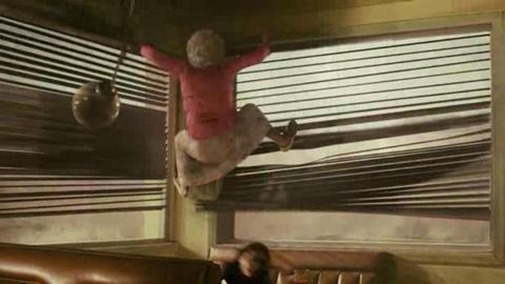
Both Legion and Dawn of the Dead take place largely in very familiar, pedestrian settings, the former being set in a diner in the middle of a desert and the latter for the most part unfolding in a boarded-up mall. In both cases the world is collapsing around them, and because communication has been severed they can only learn this information "in snippets", so to speak. This feeling of being isolated in an insulated little spot and yet still being aware of the Apocalypse is, I think, a really essential one for creating tension. Yet Legion, despite all the potential afforded by its setting, has few if any really majestic wide shots that express the scope of God's curse descending on the world.  Dawn of the Dead, on the other hand, has at least two really evocative shots to this effect in its first five minutes, one of which is a helicopter shot of a car driving down a suburban road while mayhem ensues around it. Despite, strictly speaking, only communicating information about a very small corner of the world, this is all our imagination needs to flesh the situation out and get a sense of the chaos enveloping the globe.

Two other movies that also, I think, succeed at conveying this sense that the sky is falling without showing it (in its entirety, at any rate, in the way that a movie like 2012 does) are Signs and I am Legend. I often hear both these films disparaged as being "overrated" or (and this one makes me want to yell at anyone who says it before setting them on fire) "not scary". Seriously, if you're going to castigate either Dawn of the Dead, Signs, or I am Legend for not being scary, then you've severely missed the point in every case.

dotd2

I think the problem is in the genres we use to categorize these movies, or maybe in the way they're advertised. No-one I know thinks of Signs as a science-fiction movie, even though it's about aliens (the complaint is always that the aliens aren't scary- which, considering the way the film ends, is a really stupid complaint, in my opinion), and because Dawn and Legend are about zombies, the presumption is that they're "horror" movies. I think this is really unfortunate. It would be like if someone expected Driving Miss Daisy to be an action movie and complained afterwards that the two leads weren't attractive enough. On the other hand, I have never heard There Will Be Blood described as a horror movie; it's always labeled as a historical drama, or maybe as a thriller. Yet I found There Will Be Blood way scarier than almost any "horror" movie in the last decade, since it is a portrayal of a man slowly but surely losing his soul. It is a movie about damnation far more frightening than any of these silly unintentional comedies involving creatures "from Hell". That said, don't see Dawn of the Dead expecting to be frightened. It's an action thriller that happens to be about something monstrous and creepy happening to the human race. On that level, it works marvelously.

There isn't much more to say about the film except to stress that it handles its subject matter with much more subtlety and cleverness than Legion does. The movie, for example, never explains why the dead are coming back to something approximating life and engaging in cannibalism, with their strength, speed, and agility apparently increased. Rather than have a character show up to just flat out explain everything and provide guidance, this leaves the characters to fend for themselves, which obviously is much more interesting. Nevertheless, there are a few clues scattered deliberately throughout the movie. The (extremely well-edited) opening credits depicting the unraveling of civilization are set to the last song Johnny Cash ever wrote, "When the Man Comes Around", a sober proclamation of the Second Coming of Christ that closes with his raspy recitation of Revelation 6:8a from the King James Bible: "And I looked, and behold a pale horse: and his name that sat on him was Death, and Hell followed with him." Later, while the characters prepare to escape from the mall, "The Hangman's Song" by Tyler Bates plays in the background. The song opens with these lyrics:

"Armageddon time is coming soon,
Fires will turn us all into dust,
And we will be judged one last time,
You, your son and me.
Woe, woe,
Woe is me..."

These clues in the soundtrack are not the only hints we get of what's going on; at one point, one of the characters watches a televangelist announce that this zombie apocalypse is, indeed, God's judgment on the human race. "Hell is overflowing, and Satan is sending his dead to us," he explains. "Why? Because you have sex out of wedlock, you kill unborn children, you have man on man relations- same sex marriage. How do you think your God will judge you? Well friends, now we know." The televangelist is played by Ken Foree, who appeared in the original Dawn of the Dead as Peter, a character who at one point mentions that his grandfather, a voodoo priest from Trinidad, used to warn him that "when there's no more room in Hell, the dead will walk the earth". Foree's televangelist repeats this chilling line. No archangels descend to confirm or deny this theory. The seed is planted in the imagination, and the rest of the movie waters it with gore. This, I submit, is much more effective.

dotd1

Ken Foree's role in Dawn of the Dead- the solemn bald black guy with the wise remarks- is taken up in Snyder's remake by Ving Rhames, playing a police officer named Kenneth Hall. Kenneth (note the homage in the name) is a church-goer who crosses himself when he sees corpses and at one point admonishes the film's other bald black guy (this one a shadier character who apparently steals TVs), who "saw hell yesterday" and is now "scared of going to hell for all the bad things [he's] done" to "go in the stall, say 5 Hail Marys, wipe your ass, and you and God can call it even!" Harsh, perhaps, but not as bad as the gay church organist who is openly and unashamedly atheistic.

Obviously, this isn't a film with a lot of character development (instead it has a lot of nice little performances that give these bones the flesh of relative believability and even charm) and it certainly has no philosophical pretensions, but it isn't stupid, either, and these faint suggestions that, in fact, God may finally be putting an end to His rebellious image-bearers in this grotesque fashion is enough to chill the spine a couple of degrees, if the viewer is willing to invest himself intellectually enough to pay these suggestions any mind.

I close by citing IMDb: "The DVD box text implies that the cause of the zombie plague is a virus. But in an interview on FeoAmante.com screenwriter James Gunn denies the virus theory, stating that a zombie bite is like a vampire bite. Thus the plague is supernatural, not scientific." This, I suggest, is an admission of sorts from the mind behind this story that this pestilence of zombification is a curse from some higher power, and this small revelation colours the whole film with an epic, Old Testament dimension of significance that Legion, for all its hour and half of ostentatious bloviating, was unable to achieve.

Tuesday, 17 May 2016

THE ABOMINABLE DR. PHIBES

Abominable Dr Phibes, The
THE PLOT

“Long thought dead, the victim of a horrible accident, Dr. Anton Phibes (Vincent Price) still lives, surrounded by art-deco bric-a-brac and attended by mute beauty Vulnavia (Virginia North). Outwardly normal in appearance, Phibes actually wears a rubber mask, covering his hideously deformed countenance; giving away the artifice is the fact that, when he dines, he takes his food through his neck rather than his mouth. Able to speak only when plugging a wire into his damaged vocal chords, Phibes elucidates his plan to murder the medical team whom he holds responsible for the death of his wife. Each of the killings is patterned after the ten deadly plagues. Phibes saves his worst for last: trapping chief surgeon Dr. Vesalius in his lair, Phibes forces the hapless medico into a race against time to save the life of his own son.” – AllMovie Guide

THE POINT

“Love means never having to say you’re sorry.” If you’re old enough, you probably recognize that quote from Love Story as one of the most famous movie lines ever uttered. If you’re a semi-literate person of any age, you also recognize it as one of the dumbest things to ever come out of a movie character’s mouth since the invention of celluloid. Even John Lennon once quipped, “Are you kidding, love means having to say you’re sorry every five minutes.” So, what better way to establish the dark comedic tone of The Abominable Dr. Phibes than by skewering that iconic utterance on it’s one sheet. After all, despite its Grand Guignol trappings, Phibes is still a love story, just a morbid one with its tongue set firmly in its hollowed out cheek.

And who better to carry such a mixed bag of grisly murders, gallows humor, and tortured lovers than Vincent Price. On the actor’s official website run by his family, the legendary thespian is described thusly…

“Vincent Price is widely regarded as one of the most iconic and beloved horror movie actors in the world. Any fan of classic horror movies knows the name Vincent Price as synonymous with elegance, humor, talent, worldliness, and charm. Throughout his over 60-year movie career, appearing in countless classic horror movies, as well as classic films outside the horror genre, Price established himself as one of the most popular actors--beloved among both his fans and his peers.”

phibes05

Normally such hyperbole could be written off as the loving words of an adoring family, but in the case of Vincent Price, it’s pretty much spot on. Whether delivering a performance of Shakespearean quality or just hamming it up for the fun of it, there’s very few movies that weren’t made just a little bit better by Price’s presence (yes, even Dr. Goldfoot and the Bikini Machine), and nowhere is that on better display than in The Abominable Dr. Phibes.

Of course, while the movie would suffer greatly from his absence, there’s more going for it than just Price. The reliable Joseph Cotton turns in his usual stalwart performance as Phibes’ intended final victim, Dr. Vesalius, and British film staple Peter Jeffrey is spot-on as the inept Inspector Trout. However, it’s Virginia North’s turn as Phibe’s mute assistant Vulnavia that most people remember. Unquestioningly loyal and never flinching, not even while Phibes slurps his drink through a hole in the back of his neck, the fashion model briefly turned actress adds a touch of elegant mystery to the proceedings. Although an early draft of the script hinted that she might be one of Phibes’ mechanical creations, and another script for a proposed sequel named her as a manifestation of the Greek Goddess, Athena (wha-huh?), Vulnavia’s presence is never explained. She is simply there when Phibes needs her, be it for help with a murder or just a spin around the dance floor.

phibes03

And let’s talk about that floor, why don’t we? If anyone deserves second billing to Price in the credits, it’s set designer Brian Eatwell. His work on Dr. Phibes’ lavishly ornamented lair is a master class in Art Deco excess. The aforementioned mammoth marble dance floor with its ornate geometric designs, the dieselpunk clockwork band that provides the accompanying music, the enormous  neon-gilded pipe organ that projects a slide show of Phibes’ deceased wife while Price hammers away at Mendelssohn’s War March of the Priests; there are few horror movies then or now that look as cool and interesting as the Phibes films.

Finally, are there many more memorable murders than the ones found in The Abominable Dr. Phibes? There’s death by having your skull crushed with a slowly contracting frog mask, death by extreme hypothermia from an artificial snow maker hooked up to your car, and death by having Brussel Sprout juice dripped on your sleeping face so locusts will eat the flesh off of it. Suffice to say, Phibes made killing people in overly-elaborate ways fashionable long before the Saw films were even a glint in Lions Gate’s eyes. And unlike the relentlessly morbid Jigsaw, Dr. Phibes did it all with a smile. Each death is delightfully gruesome and each one inspired by the ten plagues God rained down upon Egypt in the book of Exodus.

phibes02

Not that there were slowly contracting frog masks in the Bible, mind you. The aforementioned murders may have taken their inspiration from the plague of toads, plague of hailstones, and plague of locusts respectively, but did so very loosely. In fact, up until the final plague, most of the curses visited upon Egypt resulted in inconvenience and/or terror rather than the loss of human life. It makes you wonder why God bothered to send so many plagues rather than just skip ahead until the end to achieve what he wanted. Sure, there was the whole hardening of Pharaoh's heart thing (which, as we discussed previously, was done entirely with Pharaoh's consent), but the final plague upon the first born of Egypt put an end to that quite readily. So, why not just go straight there instead of wasting time with frogs and flies and such?

Well, there’s a theory about that (of course). Because the ancient Egyptians believed that all natural phenomena, as well as any number of abstract concepts, were actually sentient divine forces, they had a rather sizable pantheon of gods, over 2,000 by some accounts. But if you just wanted to stick to the biggies, you could knock it down to a handful or two. So the idea is that each of the plagues corresponds to one of these major Egyptian deities and their complete inability to stand up to the power of the God of the Israelites. You could easily make a few substitutions here and there, but a basic list goes something like this:

  1. Hapi, god of the Nile, couldn’t stop his river from turning to blood.
  2. Heqet, frog-goddess of fertility, couldn’t control her hopping kin.
  3. Geb, god of the earth, couldn’t prevent gnats from rising out of the dirt.
  4. Khepri, god of insects, couldn’t call off all of the biting flies.
  5. Hathor, bovine-goddess of motherhood, couldn’t save a single cow.
  6. Thoth, god of medicine, couldn’t cure a single boil.
  7. Nut, goddess of the sky, couldn’t put an end to the pummeling hail storms.
  8. Isis, goddess of nature, couldn’t save a single crop from the locusts.
  9. Ra, god of the sun, couldn’t banish the darkness.
  10. Osiris, god of the afterlife and resurrection, couldn’t prevent a single death.
phibes07

In each instance, the Egyptian pantheon was proven to be powerless before Jehovah. And on top of demonstrating the ineffectualness of their deities, the death of Pharaoh’s first born during the final plague also slapped the whole Egyptian belief in the divinity of Pharaohs right in the face. By the time it was all over, the Egyptians’ false ‘god incarnate’ was shown to be completely helpless against a wandering Jewish shepherd speaking in the name of God. Typology anyone?

Now to be honest, Dr. Phibes himself isn’t all that concerned with the deeper theological implications of the story that inspires his murderous set-pieces. Really, he’s not even all that interested in accuracy, as he replaces gnats with bats and flies with rats. Still, he gets an ‘A’ for effort because, symbolically, it all still works. Having announced (rightly or wrongly) that God is on his side, the disfigured doctor proves time and again that the authorities, the intelligentsia, and even he himself (Phibes reserves the curse of darkness for his own demise) are all powerless before divine wrath. By story’s end, the only intended victim to escape punishment is the one who is offered and accepts the challenge of redemption. Sure, redemption doesn’t usually come under the threat of having your child horribly disfigured by acid, but that’s just the kind of thing that makes Phibes so much fun, isn’t it?

THE STINGER

To be fair, the makers of The Abominable Dr. Phibes knew very well that bats and rats weren’t originally part of the ten plagues. They also knew, however, that bats and rats are typically more horrifying visually than a bunch of gnats and flies, so the decision was made to make the switch. And that’s how we ended up with that wonderful scene of Dr. Dunwoody being eaten alive… by completely harmless fruit bats.

Sunday, 17 January 2016

THE MEDUSA VS. THE SON OF HERCULES


 THE PLOT

“A retelling of the legend of Perseus and the Medusa, in which the hero is defending the besieged kingdom of Seriphos. Its people are near starvation, under siege by the army of Argus on one side, a huge dragon on another side, and the hideous Medusa on another. The king is about to give his daughter, Andromeda (Anna Ranalli), to the evil Galinor, king of Argus, as a bride for his son, in order to open up a route for trade. Perseus (Richard Harrison), the son of the murdered king of Argus, vows to avenge his father's death, stop the usurper Galinor's subjugation of Seriphos, and free both kingdoms. To do this, he must slay the dragon and then destroy the Medusa, which will restore her victims -- Seriphos' best soldiers -- who have been transformed into stone in her valley, to flesh-and-blood, so that they can defeat the army of Argus. First, however, he must defeat the evil son of Galinor in a tournament and win the trust of Andromeda's father.” – AllMovie Guide 

THE POINT

We don’t get a whole lot of gladiator movies in theaters these days, do we? Sure, there’s the occasional big budget flop like Pompeii, but that’s nothing compared to how it used to be. Back in 1958, after the international success of Hercules starring Steve Reeves, sword and sandal movies, a.k.a. peplums, became all the rage. In Italy alone, between the years 1960 and 1965, at least 130 peplums were cranked out and dumped into theaters. To put that into perspective, that amounted to one-seventh of the country’s total film output. That’s a whole lot of oiled-up guys in togas.

Which, by the way, is what caused the films came to be known as peplums in the first place. The togas, that is, not the oiled-up guys. Originally a word used to refer to an actual style of colorful dresses worn by women, peplum came to be applied to gladiator films by film critics who saw the genre as an offshoot of the historical costume dramas which had been popular in Italy since the silent movie days. What set peplums apart from their predecessors, however, was a very noticeable focus on beefcake. And it wasn’t just because people liked ogling oiled up pecs, though I suppose that didn’t hurt with certain audiences. As Louis Bayman noted in his book, Popular Italian Cinema, “The peplum foregrounded the muscular male body as an instrument of self-reliance, liberation, and moral authority. This celebration of male physical strength struck a chord with both Italian and international audiences, not least because the peplum reaffirmed the worth of individual male power – and potency – at a time when radical social, economic, and political transformation, in Italy and elsewhere, was generating a sense of instability and corresponding anxiety.” So, the peplums possibly served a sociological function beyond just providing some visceral thrills.


But whatever the reason, peplums were super popular, as were their heroes, many of whom appeared in multiple standalone films. Including Reeves’ seminal outing, there were a total of 19 Hercules movies made in Italy in the late 50s and early 60s. These were joined by 5 films featuring Samson, 8 starring Goliath, and 9 with Ursus as the lead. The undisputed champion, though, was Maciste, one of the longest running characters in Italian cinema. In addition to his already impressive 24 silent films, Maciste went on to appear in 25 more movies during the peplum craze.

The only thing was, monikers like Maciste weren’t very meaningful to audiences in the U.S., so when it came time to redub peplums for American consumption, names were often changed to something with a bit more brand recognition. That’s why, when Embassy Pictures put together a package of 14 peplums for syndication on American television, they decided to tie all of them to Hercules. The problem was, if they renamed all of the characters Hercules, they would have to pay to redub the films a second time, which would sort of defeat the point of buying a bunch of cheapo peplums to begin with. Their solution was simplicity itself, just insert a narration identifying the main character in each film as one of Hercules’ kids. It didn’t even matter how many there were because everybody knows how those Greek gods got around. And so, The Sons of Hercules, complete with a catchy theme song, made its debut.


The Medusa Vs. The Son of Hercules, as noted above, is really just another take on the legend of Perseus, the most famous version of which was, of course, Ray Harryhausen’s Clash Of The Titans. Well, Harryhausen this ain’t. Still, the early work by special effects wizard Carlo Rambaldi (Close Encounters, E.T.) featured in this flick has its own low budget charms. In fact, Rambaldi’s Medusa, which eshews the traditional serpent-haired femme fatale in favor of a one-eyed tree-like creature with floppy snake branches, is downright creepy the first time it appears lumbering out of the fog. On the other hand, the life sized, nearly immobile dragon our hero has to fight… not so much. It’s still fun whenever it shows up, though. Add these creatures to the other changes in the story, such as the trap-laden tournament of champions Perseus partakes in, and the whole affair is a fairly enjoyable way to kill some time.

Be that as it may, The Medusa Vs. The Son of Hercules is still the story of Perseus who, as anyone who ever browsed Bullfinch as a child can tell you, was only connected to Hercules by the fact that they were both illegimate offspring of Zeus (you know how those Greek gods got around). I suppose they could have called the show The Half-Brothers of Hercules, but then the theme song probably wouldn’t have been as catchy. Embassy adroitly sidestepped this obstacle by having its opening narration explain that not all of the “sons” of Hercules were actually sired by the big guy. Rather, the demigod declared them his sons in name and spirit due to their dedication to upholding Herc’s heroic virtues. Basically, if you were willing to go out and fight hideous bone-crunching flesh-rending monsters, you stood a pretty good chance of becoming a son of Hercules.


Fortunately, we don’t have quite the same requirements to become sons and daughters of our God. As noted in The Council of Trent’s Sixth Session Decree on Justification, God allows us the opportunity to pass “from that state wherein man is born a child of the first Adam, to the state of grace, and of the adoption of the sons of God, through the second Adam, Jesus Christ, our Saviour. And this translation, since the promulgation of the Gospel, cannot be effected, without the laver of regeneration, or the desire thereof, as it is written; unless a man be born again of water and the Holy Ghost, he cannot enter into the Kingdom of God.” Or to put it less technically, anyone who has been baptized, either physically or through the desire of their heart, is a child of God. Period.

And not only is becoming a child of God a bit easier than becoming a son of Hercules, the benefits are a little bit better as well. As the Catechism tells us, “as an ‘adopted son’ he can henceforth call God ‘Father,’ in union with the only Son. He receives the life of the Spirit who breathes charity into him and who forms the Church.” So while the sons of Hercules first had to demonstrate such virtues as self-reliance, liberation, and moral authority before being named his children, our God actually claims us as his own children first and then “breathes” into us the power necessary to attain such virtues. Monster fighting and wearing togas optional. Overall that’s a pretty good deal.

THE STINGER

Oddly enough, while the moster fighting and togas are optional for God’s children, the oiling up isn’t. Ancient athletes often rubbed oil onto their bodies under the belief that it kept muscles limber and protected the skin from the elements. Likewise, during baptism, the priest annoints those about to receive the sacrament with The Oil of Catechumens as a form of exorcism to help break the hold of the evil one and to strengthen the spirit. Lovers of weird analogies rejoice!

Sunday, 30 August 2015

NINJA III: THE DOMINATION

Ninja III The Domination

THE PLOT

“In this slick exploitation, martial arts fantasy from schlockmeisters Menahem Golan and Yoram Globus, an evil ninja is killed off in a sandtrap on a golf course in Phoenix -- the police riddle him with bullets, foolishly thinking that is the end of it. But as he is dying, the ninja throws a smoke bomb and, hidden by the dark cloud, he crawls into a phone-company van driven by the acrobatic Christie (Lucinda Dickey of Breakin'). As he dies there, his soul possesses her body, much to the consternation of her boyfriend, Secord (Jordan Bennett). Christie periodically uses exotic Eastern skills to slaughter the evil ninja's foes until good ninja Yamada (Sho Kosugi) comes to her rescue.” ~ AllMovie Guide

THE POINT

When trying to decide just which of the countless motion pictures out there is most representative of the decade that was the 1980s, you have to give Ninja III : The Domination its just consideration. First off,  the movie has the word 'ninja' right there in the title. I assure you,  there are few things that say 80s more than ninjas. In fact, the ninja craze during the 80s was so omnipresent that, even though the town we lived in could only charitably be called mid-sized, I still had a good friend in high school who used to wear those two-toed ninja boots out in public. Now, I’m  99.9% positive my friend was not actually a ninja, but I suppose one can never be entirely sure since ninjas are known to be pretty sneaky.

Well, they're sneaky most of the time, anyway. In Ninja III : The Domination, however, the film opens with an extended sequence in which a lone mascara-wearing ninja shows up in broad daylight and assaults a public golf course. Trust me, it's even more perfect than it sounds. Before it's all over, the evil martial artist has used his awesome arsenal of ninjatos, shurikens, and fukiyas to lay waste to some preppies, knock off over thirty policeman, and kill a helicopter. Yes,  you heard me, a ninja takes down a helicopter which, naturally, explodes for no other discernable reason than this a Golan Globus production. Did I forget to mention that? Is it even possible to get more 80s than Golan Globus era Cannon Films, the same folks who introduced the world to such enduring classics as Invasion USA and Breakin' 2: Electric Boogaloo?

image

Speaking of which, the main star of Ninja III : The Domination, besides the inevitable Sho Kosugi, is none other than Breakin's own Lucinda Dickey. And once her character is introduced, the movie really goes into 80s overload. How so? Well, let's tick off a few points. As in Flashdance, she's a young woman working a "man's job" as a lineman (ding), but what she really wants to do is become a full-time aerobics instructor (ding). So, right after being possessed (ding) by the spirit of the evil ninja, she returns to her flat full of Patrick Nagel art (ding), dons her tights and leg warmers (ding), and preps herself for class by playing an arcade game (ding), one that later shoots lasers out of its screen (ding ding ding). I know, right? I don't think VH-1's I Love The 80s had that much concentrated 80s in it.

Let's not kid ourselves, though. Despite all of that 80s goodness, its the ninjas that are still the main draw for this movie. Now, why exactly ninjas became such a big deal in the 1980s isn't precisely clear. After all, martial arts as a form of entertainment had been around a long time before that. According to the Encyclopedia of Contemporary Chinese Culture, "The genre of martial arts films has cultural origins in an earlier tradition of 'knights errant' novels, opera and street performance, and was represented in the earliest days of Chinese cinema by such films as Burning of Red Lotus Monastery (1928). However... the martial arts genre came into prominence with the explosion of films produced in Hong Kong during the 1960s and 1970s. Throughout these two decades, major studios, most notably the Shaw Brothers studios, fed a growing kung-fu craze with classic films such as The Drunken Master and Enter the Dragon, launching the careers of Jackie Chan, Sammo Hung, David Chiang and international superstar Bruce Lee."

image

As popular as martial arts films were overseas during the 60s and 70s, though, in the States they were still considered primarily B-movie fodder (not that there’s anything wrong with that, mind you), earning for themselves the derisive term of chop-socky films. Bruce Lee managed to become something of a breakout star in America, but everyone else pretty much stayed confined to grindhouses and drive-ins. That all changed in the 1980s, however, when the Sho Kosugi vehicle Enter The Ninja hit movie screens and something about the secretive warriors struck a chord with the general public. Soon, ninjas could be found just about everywhere, in movies fighting Chuck Norris, in comics tangling with Daredevil, in cartoons helping out G. I. Joe or training turtles; you name it, they were there. For a group that was supposed to stay hidden in the shadows, ninjas were fairly ubiquitous throughout the decade. 

Well, at least Hollywood’s version of them were at any rate. As you might imagine, real life ninjas were nothing like the superhuman beings we saw in films such as Ninja III : The Domination. Call me a skeptic, but I have my doubts that even the most skilled of ninjas could actually lift a golf cart into the air or crush a pool ball. Still, by all accounts, they were really good at the things they could do. As described by Stephen Turnbull in his book, Ninja AD 1460-1650,  ninja as a job description first popped up around the mid-15th century, where such trained individuals were employed by warlords to carry out acts of espionage, intelligence gathering, and assassination, the kind of work that your typical samurai wouldn’t touch because it conflicted with his knight-like moral code.

image

It’s that last point which author Joel Levy, in his book Ninja: The Shadow Warrior, posits is where the appeal of the Hollywood ninja actually lies. He writes,

“If the ninja skeptics are correct and the ninja as they are generally understood today did not really exist, how can we account for the evolution of this cultural archetype, its endurance, and its abiding popularity? One explanation is that the ninja should be viewed as a manifestation of an even older and more universal archetype: the trickster. The trickster is a form of cultural hero found in the myths, legends, and folklore of every society and culture in history and around the world. He uses tricks and ruses to outwit the strong and the powerful—the establishment—and to assert the power of the individual. Often he acts in decidedly non-heroic fashion to accomplish these ends: he is not a hero in the moral or virtuous sense… The use of shinobi techniques by ninja characters and their forebears (such as Prince Yamato) is a way of challenging and subverting the traditional Japanese virtues such as manliness, open combat, force of arms and death before dishonor. By contrast with these virtues, we see ninja characters dressing as women, using stealth to secretly infiltrate strongholds, killing from the shadows, pretending to be other people, using poisons, etc… In summary, perhaps it is the correspondence between the ninja and the trickster archetype that accounts for his cultural resonance, his origin, and his enduring popularity.”

image

Now, personally, I think Mr. Levy overlooks the simple delight the American psyche takes in watching a single individual, ninja or otherwise, open a can of whup-ass on hundreds of adversaries at one time, a concept that 80s action movies capitalized on in spades. But, for the sake of argument, let’s play along with the trickster angle and assume that it is indeed one of the (possibly unconscious) reasons folks in the 1980s liked ninjas so much. If that’s true, then tricksters of all types should be equally appealing, right? Well, it turns out that’s just the argument that arose when Religion News Service interviewed post-modern theologian (their description) Peter Rollins. Mr. Rollins stated,

“Tricksters are revolutionary figures that challenge the natural order. They poke holes in what everyone takes for granted and fight systems that oppress. They work within a given religious or political system, but they wrestle with it, challenge it and transform it. In Jesus, we see a trickster figure, one who respects the beliefs and traditions of real people, yet also questions them, challenges them and subverts them for the sake of political and religious transformation. Consider the example of Jesus supplementing the greatest commandment with a description of a second commandment that is just like the first, namely to love ones neighbor. Here we see that Jesus respects the common belief of the day—the existence of God and the need to love God—but also ruptures it by saying that one knows one loves God when one loves ones neighbors. This is not some atheistic critique of belief in which a person says, ‘forget God, love people.’ It represents a type of working from within.”

image

If he had stopped right there, Rollins would probably have been okay. His notion that Jesus and his followers were tricksters in the sense that they were both part of the system, as well as a transformative element within it, matches up fairly well with the description of early Christians found in the document knowns as The Epistle to Diognetes, c. AD 130…

“They dwell in their own countries, but simply as sojourners. As citizens, they share in all things with others and yet endure all things as if foreigners. Every foreign land is to them as their native country, and every land of their birth as a land of strangers. They marry, as do all others; they beget children; but they do not destroy their offspring. They have a common table, but not a common bed. They are in the flesh, but they do not live after the flesh. They pass their days on earth, but they are citizens of heaven. They obey the prescribed laws, and at the same time surpass the laws by their lives. They love all men and are persecuted by all. They are unknown and condemned; they are put to death and restored to life. They are poor yet make many rich; they are in lack of all things and yet abound in all; they are dishonored and yet in their very dishonor are glorified. They are evil spoken of and yet are justified; they are reviled and bless; they are insulted and repay the insult with honor; they do good yet are punished as evildoers. When punished, they rejoice as if quickened into life; they are assailed by the Jews as foreigners and are persecuted by the Greeks; yet those who hate them are unable to assign any reason for their hatred. To sum it all up in one word -- what the soul is to the body, that are Christians in the world.”

image

So, yes, if we accept the above definitions of a trickster, Rollins is basically correct in his assumption that there appears to have been something of a trickster element to Christianity from the very beginning, though obviously not one that embraced any of the immoral methods like those Levy attributed to the ninjas. Sadly though, Rollins doesn’t stop there. He goes on in his book, The Divine Magician, to reach the tired and completely predictable for our times conclusion that in order to maintain the effectiveness of its trickster elements, modern Christianity should abandon all of its organized systems because, well… those systems are old and they hurt peoples’ feelings and we’re all just more enlightened now anyway, so there.

I think most ninjas would disagree with Rollins, however. You see, if ninjas are tricksters, one of the reasons they are so effective at it is precisely because of the organized systems which allowed them to develop the skills necessary to do the job. We see this in Ninja III: The Domination when the obligatory flashbacks reveal that both the good and evil ninja had spent years honing their craft together at the same temple. At some point, though, the evil ninja turned his back on his teachers and abandoned their ways. Now, if Rollins’ philosophy is correct, the evil ninja should have gone on to become a more evolved version of himself, an even better ninja than before because he was no longer constrained by ritual or organization. Instead, even though he maintains his martial skill level, the evil ninja becomes a yuppie-killing madman. Obviously, something went wrong.

image

As noted in Adam Hsu’s The Sword Polisher's Record: The Way of Kung-Fu, the Chinese define all exercise, including the martial arts, by the term ‘yun dong,’ which can roughly be translated as ‘to apply action.’ Under this concept, for any exercise to reap its fullest expression, it must contain both an internal component (yun) as well as an external one (dong). And, as Hsu puts it, the “internal and external must be balanced and the exercise must be complete, if we are to really benefit ourselves and others.” Basically, in terms of yun dong, when the evil ninja broke from the spiritual guidance of his the temple, it threw his craft out of whack and he subsequently lost his way.

It kind of works the same with organized religion. What folks like Rollins so oddly overlook is that while the early Christians were carrying out their trickster ways as described in The Epistle to Diognetes, the Book of Acts unambiguously shows they were simultaneously working overtime to establish a centralized religion. Despite modern protestations, spirituality and religion goes hand in hand. Yes, you can be spiritual without organized religion, but without the guidance and safeguards organized religion provides, that spirituality inevitably goes off the rails, usually veering into some form of self-worship. That doesn’t mean everyone who abandons organized religion will end up becoming a whack job and attacking public golf courses, but it does mean they are missing a necessary component for a healthy spirituality. Or to put it another way, being spiritual without being religious is like putting on ninja boots without all the years of study that’s supposed to accompany them. You may look the part, but when it comes time to prove yourself, you’re not going to have the skills to pull it off. 

THE STINGER

There’s a reason Jesus said, “Do not think that I have come to abolish the law or the prophets. I have come not to abolish but to fulfill.” He understood the need for organized religion because, as God, he’s the one who instituted it in the first place.

Friday, 17 April 2015

REVELATION ROAD 3: THE BLACK RIDER

Revelation Road 3 The Black Rider

THE PLOT

When the rapture occurred, traveling salesman and former government assassin Josh McManus was one of those unfortunate sinners left behind. His saintly wife and daughter, on the other hand, were not. Determined now to serve God so that he can one day see his family again in Heaven, Josh travels the cruel new world protecting the newly repentant from the likes of the warhammer wielding Hawg and his motorcycle gang, The Barbarians. After two years as a wandering Christian warrior, Josh’s reputation as the unstoppable Black Rider now  precedes him. So, it’s no surprise that when he shows up in a small town seeking medical aid for a wounded girl, the local mayor only agrees to help if Josh will undertake a dangerous mission for him. It seems that the ominous organization known as the ULC desires a man known only as the Shepherd be brought to them and has ordered the mayor to do so. Until now, however, no one has been able to locate the mysterious figure. For the sake of the injured girl, Josh sets out with the mayor’s bible-curious daughter, Sofia, to find the Shepherd and bring him in. The problem is that to get to the Shepherd, Josh and Sofia must confront the hordes of godless heathens who now populate the American wasteland, as well as survive the notorious battle pit of the imperious Honcho. With time, and possibly his faith, running out, Josh must bring all his deadly skills to bear, but will even they be enough to thwart the forces of evil intent on taking over the world?

THE POINT

I know, I know, I’ve been pretty hard on faith-based films in the past, but that’s only because, well, most of them haven’t been very good. And yet, if you’ve been keeping up with my stuff at Aleteia, such as my recent review of Do You Believe?, you’ve probably noticed I’ve started to lighten up on them quite a bit. That’s for a couple of reasons. One is that, thankfully, the people who make faith-based films are finally starting to show some technical competence. Believe me, these types of things used to be a lot harder to sit through back when they displayed the same production values as your average Vine video. The other reason, though, is that I’ve taken a page from Roger Ebert and started approaching faith-based films the same way he did Infra Man.

What’s that you say, you’ve never heard of the movie Infra-Man? Don’t worry if it’s slipped your mind, I assure you, most everybody else has forgotten it by now as well. Even those who were around in 1978 when Infra-Man first opened in theaters were probably too busy going to see Star Wars for the gazillionth time to even notice it was playing next door. In a nutshell, Infra-Man was a Hong Kong produced B-movie full of dodgy wire-fu, rubber monster suits that looked like they were borrowed from a theme park, and hilariously histrionic bad dialog. Basically, it was the Power Rangers long before there was ever such a thing as the Power Rangers.

rider01

If by some odd chance you do recall the film, it's probably due to Roger Ebert's ecstatic reaction to it. "I'm a pushover for monster movies anyway," America's premier critic wrote in his gushing review of one the 70’s dumbest movies, "but Infra-Man has it all." And it wasn’t just a fleeting moment of temporary insanity. Looking back on Infra-Man decades later, Ebert reiterated his love for the undeniably silly thing, exclaiming "I'll bet a month hasn't gone by since that I haven't thought of that film." Now, it's not like Ebert considered Infra-Man to be on the same level as Citizen Kane or anything. He was well aware the film was no masterpiece, or even very good for that matter. It's just that he also understood that Infra-Man was made for a very particular type of viewer, and being a self-proclaimed member of that demographic himself, Ebert knew the movie admirably delivered just what its intended audience wanted.

Which brings us, in a roundabout way, to the post-apocalyptic faith-based film, Revelation Road 3: The Black Rider, the latest installment in the ongoing Revelation Road movie series released by Pure Flix Entertainment. You might recall Pure Flix, they’re the same folks who not only gave us the aforementioned Do You Believe?, but also films like last year's surprise hit, God's Not Dead, as well as the recent Christian mommy-blogger opus, Mom’s Night Out. And just like those films, Revelation Road 3: The Black Rider is almost guaranteed to draw the ire of mainstream audiences and critics, not solely because it’s a Christian film, but because by most artistic measures, it’s pretty average fare. Of course, in a year that's already seen the release of dreck like Fifty Shades of Grey and Unfinished Business, average isn't really an insult, but you get the point.

rider04

The thing is, much like Roger Ebert’s beloved Infra-Man, Revelation Road 3: The Black Rider is also a movie with a very specific audience in mind. And that target audience might just find Revelation Road 3: The Black Rider to be, as Roger Ebert once did with Infra-Man, a movie that has all that they are looking for. It speaks their particular dialect of modern protestant Christianese, it directly addresses their premillennialist concerns about the rapture, and it doesn't venture too far outside their comfort zone as far as subject matter goes. In short, it’s a movie made by evangelicals to entertain and uplift other evangelicals, and in that respect, it has to be said that Revelation Road 3: The Black Rider is an absolute success. Yes, compared to a deeply spiritual film like Calvary, it’s dreck. But it’s dreck that does exactly what it’s supposed to do.

Besides, Revelation Road 3: The Black Rider has something else going for it that makes its artistic lackings doubly forgivable. You see, not only does it successfully cater to faith-based film fans, but it also just happens to be aimed squarely at folks who grew up watching a lot of low budget rip offs of Mad Max 2: The Road Warrior. And by low budget, I mean the entire cost to produce Revelation Road 3: The Black Rider was probably about the same as what they spent on hair gel for The Road Warrior. And yet, the movie still manages to squeeze in a lot of the tropes associated with the genre.

rider06

Don’t believe me? Well, let’s take a look at some of the conventions associated with Mad Max noted over at tvtropes.org. Without even trying very hard, I found at least twenty of them in Revelation Road 3: The Black Rider …

  1. After the End – Well, duh, it’s post-rapture.
  2. All Bikers Are Hells Angels – Hawg and the Barbarians from the first two movies more than satisfy this requirement.
  3. The Apunkalypse/Post-Apunkalyptic Armor – There’s not a whole lot of leather and spikes on display (too sexual?), but plenty of fur to go around.
  4. Badass Driver – Josh’s car plays a big part in this installment.
  5. Barbarian Longhair – A lot of Honcho’s subjects could use a haircut.
  6. Early Installment Weirdness – In the first movie, rather than float up into the sky to meet Jesus, the raptured are instead transformed into glowing orbs which shoot up into Heaven.
  7. Fallen Hero – Well, if Josh weren’t fallen, he’d have been turned into a glowing orb himself, right?
  8. Heartbroken Badass – And since Josh wasn’t orbified with the rest of his family, he’s pretty sad.
  9. Heroic Sacrifice – This is a Christian series, so naturally there’s a few of these along the way.
  10. Iconic Outfit – By the latest installment, Josh has gotten himself a pretty nifty black ensemble.
  11. Ineffectual Loner – Josh just can’t stop getting involved.
  12. Made of Iron – Some of the bad guys in these movies take an inhuman amount of beatings without flinching.
  13. Malevolent Masked Men – Along with their hair-metal hairdos, some of Honcho’s fighters like to wear masks as well. Again, nothing like the gimp-style fashions to be found in Mad Max, but masks just the same.
  14. New Old West – Everything about the mayor and his little town screams western. The only thing missing is a saloon, but you know how it is with Baptists and liquor.
  15. Only Known by Their Nickname – Hawg, Honcho, The Black Rider, nuff said.
  16. Scavenger World – The world hasn’t quite reached the depths of The Walking Dead just yet, but resources are definitely scarce.
  17. Tranquil Fury – Josh always tries to talk his way out of situations first. Then he pummels everybody.
  18. Walk the Earth – Pretty self explanatory.
  19. Wasteland Elder – Both the mayor and the Prophet could fill this spot.
  20. Wounded Gazelle Gambit – Well, that would be spoiling things, wouldn’t it?

Sadly there’s no Post-Apocalyptic Dog to be found, but I think I’ve proved my point. There’s plenty enough tropes to place Revelation Road 3: The Black Rider squarely in the Mad Max knock-off category. Now, obviously, this being an evangelical production, everything is a little tamer than in other Mad Max inspired films. Everybody is a little too clean looking, there’s certainly no gore or nudity or profanity, and, of course, there’s a lot more sermonizing than you’re likely to find in other post-apocalyptic flicks.

rider07

Given the scenario, though, the preaching is a little more organic to the story than it normally is in other faith-based films. I mean, in the world of Revelation Road it’s pretty obvious that the rapture has occurred, so it’s natural that folks would talk about it. From a Catholic standpoint, of course, the whole premillenial rapture scenario is a bit shaky. As I noted way back in my review of Phase IV, about all the Bible really says about the end times is that there will be wars and rumors of wars, some natural disasters, and that the Church will be persecuted, undergoing a trial that will shake the faith of many believers. If you think about it, that’s pretty much been the story of the Church since it began. It’s as Jesus proclaimed in Mark 1:15, "THIS is the time of fulfillment. The kingdom of God is at hand. Repent, and believe in the gospel." That’s why the Church teaches that we’ve been living in the end times ever since Jesus ascended into Heaven almost 2,000+ years ago, and it could remain the end times for who knows how much longer. The rapture, if you want to call it that, won’t come until the very end when it’s time to put a kibosh on Satan once and for all.

But what does it really matter when this rapture occurs? Well, as Fr. John Echert writes over at EWTN, “one of the sad side-effects of a ‘rapture’ view held by many is that it fails to recognize the present reality of the Kingdom of God as it is even now.” As the old Catholic Encyclopedia explains, “As men grew to understand the Divinity of Christ they grew to see that the kingdom of God was also that of Christ… So, too, as men realized that this kingdom stood for a certain tone of mind… The kingdom of God means, then, the ruling of God in our hearts; it means those principles which separate us off from the kingdom of the world and the devil; it means the benign sway of grace.” As always, there’s a lot more too it, but the main idea is simple. The kingdom of God is not something to come later after some post-rapture thousand years of suffering, it’s here now, in us, and we should be living in a way that demonstrates that present reality to the rest of the world.

rider08

Still, even though I’ve got a theological disagreement with the film’s main conceit, I have to admit that the Revelation Road series remains something of a guilty pleasure for this one-time evangelical turned good ol’ Catholic boy. The saving grace of Christ’s message remains true no matter what view of the rapture the movie holds, and the Mad Max inspired goofiness on display is just too irresistible to my B-movie tastes. So I say fire up Netflix and give the Revelation Road movies a try. Just remember to judge them for what they are rather than what they’re not. If Ebert could do it with something like Infra Man, then certainly we can do it with these films.

THE STINGER

Like a lot of Pure Flix productions, the Revelation Road series has appearances by some faces familiar to the discerning B-movie fan. James Denton, Bruce Marchiano, Sting (the wrestler), Eric Roberts, Brian Bosworth, Kevin Sorbo, they all show up at various points throughout the films. The unstoppable main character of the movies, however, is played by none other than the co-founder of Pure Flix himself, David A.R. White. It’s good to be the king, I guess.

Friday, 9 August 2013

ELYSIUM

THE PLOT

“In a future in which the privileged reside on an Earth-orbiting space station named Elysium and the less fortunate live on the surface of the blighted, overpopulated planet below, one man dares to defy the strict anti-immigration laws that separate the two disparate worlds in order to save all of mankind in this visceral sci-fi action thriller from District 9 director Neill Blomkamp. The year is 2154, and the division between social classes has grown wider than ever before. As the rich enjoy a life of luxury and access to cutting-edge medical technology on Elysium, the rest of the human race contend with poverty, crime, and disease on the surface of planet Earth. Meanwhile, hard-line immigration laws ensure that only those who have been explicitly approved will ever set foot on the elusive paradise in the stars. 36-year-old Max (Matt Damon) lives in an L.A. shantytown and earns his living by working on an Armadyne assembly line. He's had a rough past, but he's struggling to stay on the right side of the law when he realizes that his only hope for survival after being exposed to deadly radiation is to reach Elysium. Should Max succeed, he will strike a major blow for equality in the eyes of his fellow surface dwellers; should he fail, it will mean certain death. In his quest to become the hero who can restore the balance between the rich and the poor, however, Max must first do battle with Elysium's hawkish Secretary of Defense Delacourt (Jodie Foster), who has devoted her entire career to maintaining that division, and whose key enforcer Kruger (Sharlto Copley) is notorious for his brutal tactics in driving out illegals. With the fates of millions hanging in the balance, Max sets his sights on Elysium and never looks back. Alice Braga, Diego Luna, William Fichtner, and Faran Tahir co-star.” ~ Rovi’s AllMovie Guide

THE POINT

Back in April of 1927, the New York Times published a review of Fritz Lang’s newly released film Metropolis written by none other than famed science fiction author H. G. Wells himself. To say that “The Man Who Invented Tomorrow” was no fan of Lang’s own unique take on the future of humanity would be the epitome of understatement. Wells despised the film. Now sitting here 86 years after the fact, that may strike some people as a bit odd. After all, while no movie ever receives universal acclaim, Lang’s Metropolis is one of those that comes pretty darn close (a 99% rating on Rotten Tomatoes is about as near to a perfect score as a film can hope for). Many adore it and rank it among cinema’s finest achievements, while most of those who don’t still admit to the film’s artistry and recognize Metropolis’ influence on every movie that followed. But not Wells, he hated it with a passion.

2013-08-09_010332

Why? Well, in his article, Mr. Wells wrote that Metropolis, “gives in one eddying concentration almost every possible foolishness, cliché, platitude, and muddlement about mechanical progress and progress in general served up with a sauce of sentimentality that is all its own… The 'sons of the rich' are seen disporting themselves, with underclad ladies in a sort of joy conservatory, rather like the 'winter garden' of an enterprising 1890 hotel during an orgy. The rest of the population is in a state of abject slavery, working in 'shifts' of ten hours in some mysteriously divided twenty-four hours, and with no money to spend or property or freedom. The machines make wealth. How, is not stated… There is some rather good swishing about in water, after the best film traditions, some violent and unconvincing machine-breaking and rioting and wreckage, and then, rather confusedly, one gathers that Masterman has learnt a lesson, and that workers and employers are now to be reconciled by 'Love… Now far away in the dear old 1897 it may have been excusable to symbolize social relations in this way, but that was thirty years ago, and a lot of thinking and some experience intervene.”

So, yeah, Wells didn’t have many nice things to say about Metropolis. Apparently the movie so offended his political and scientific worldview that Wells could hardly tolerate its existence. But was the movie really at fault, or was it Wells himself who was the problem? As G. K. Chesterton once wrote of his friend (and frequent debate opponent), one of H. G. Wells’ shortcomings was his seeming inability to free himself from “the narrower scientific outlook to see that there are some things which actually ought not to be scientific. He is still slightly affected with the great scientific fallacy; I mean the habit of beginning not with the human soul, which is the first thing a man learns about, but with some such thing as protoplasm, which is about the last.” In short, having rejected religion and philosophy, Wells tended to filter everything through science and politics. And the reason that was a problem in this instance is because Metropolis doesn’t really operate on those levels. With its heavily stylized expressionistic art design, its almost fairytale like setting, and its characters who function more as metaphors than they do as real people, Metropolis is all about philosophy, not day to day politics. The ultimate solution to the dystopia presented in Metropolis is not to change laws, but to change people’s hearts. That being the case, it’s no wonder Wells’ predilections towards scientism kept him from finding anything worthwhile in the film.

2013-08-09_010434

But why, you’re probably asking by now, am I bothering to bring all this stuff up about H. G. Wells and Metropolis when I’m supposed to be reviewing Elysium? Well, given the reasons Wells stated for despising the earlier film, it would be interesting to see how he would have responded to this latest one, because despite the fact that the setup is the same (the rich party above while the poor toil below), Elysium is no Metropolis. Now that’s not because the film is poorly made, it’s quite the opposite in fact. With Elysium, director Neill Blomkamp proves that his previous effort, the critically acclaimed District 9, was no fluke. It’s nowhere near as stylized as Metropolis, of course, but Elysium still looks great, from the titular orbiting paradise to the perfectly realized wasteland of future Los Angeles. I don’t know how much time Blomkamp has actually spent walking around the ghettos of his home country of South Africa, but man, nobody films realistic looking blight as well as he does. And as for how he handles all of the sci-fi stuff (space ships, armored suits, exoskeletons, healing machines even more magical than a vial of Khan’s blood), I would have to imagine that after viewing Elysium, gamers around the world will be wailing and gnashing their teeth that Blomkamp gave up on his plans to make that Halo movie.

On top of that, the movie is well acted… for the most part. Make all the Matt Damon/Team America jokes you want to (please do, cause that still cracks me up), but when the man is on, he’s really on. And Damon’s pretty good here as Max, a basically selfish ex-con forced by circumstances into being a reluctant savior to the oppressed masses. Also on hand is Sharlto Copley, Blomkamp’s leading man from District 9, whose bizarre bounty hunter Kruger pretty much steals every scene he’s in. And it’s always nice to have William Fichtner show up to play an utter creep (hey, everybody’s good at something, right). Surprisingly, the only actor off their game a bit is the usually reliable Jodie Foster who doesn’t quite manage to pull off whatever accent it is she’s trying to use. You would have thought that after Nell she would have learned her lesson about trying to talk funny, but alas, that doesn’t seem to be the case. Still, overall, the acting is fine.

2013-08-09_011908

So it’s not really an issue of quality that separates Elysium from Metropolis. Rather, it’s a matter of vision. You see, as it turns out, Elysium does exactly what Wells claimed he wanted from Lang’s film. That is, right from the start, Elysium abandons philosophy in favor of straight ahead politics. It begins with onscreen captions explaining how after the Earth became over-polluted and overpopulated, all of the wealthy folks took their toys and left for Elysium. Now the environmental angle is a common staple in sci-fi, one we’ve already seen pop up a couple of times this year in movies like After Earth and Oblivion, so it’s no big deal. After all, nobody wants a dirty Earth. But the choice to include overpopulation as a cause for the planet turning into a hell-hole is an overtly political decision on the part of the screenwriters, one that sets the tone for the rest of the movie which follows. I don’t want to get into the whole overpopulation debate here (though I’d be remiss if I didn’t at least mention that those with teaching authority in the Church believe the whole theory to be junk science at best and unmitigated evil at worst.), I’m just pointing out that Elysium sets up Earth’s problems as primarily political ones, with the film going out of its way to take a number of thinly-veiled potshots at one particular political party’s current stands on welfare, immigration, and healthcare.

Now let’s be clear, as a Catholic, I‘ve got axes to grind with both major parties mucking things up in my country, so I could care less that the movie picks a side in a political debate. Heck, movies like They Live wouldn’t be half as much fun without all the political subtext. The problem is that Elysium seems to think politics is the ultimate solution to everything that ails the planet, including poverty. This flies in the face of the Catechism which tells us that “in its various forms - material deprivation, unjust oppression, physical and psychological illness and death - human misery is the obvious sign of the inherited condition of frailty and need for salvation in which man finds himself as a consequence of original sin. This misery elicited the compassion of Christ the Savior, who willingly took it upon himself and identified himself with the least of his brethren. Hence, those who are oppressed by poverty are the object of a preferential love on the part of the Church which, since her origin and in spite of the failings of many of her members, has not ceased to work for their relief, defense, and liberation through numerous works of charity which remain indispensable always and everywhere.” In short, the drive to aid the impoverished must start in the hearts of individuals and their willingness to see the face of Jesus in the poor. Free their hearts, and their wallets will follow.

2013-08-09_010935

That’s not what happens in this movie. At the film’s conclusion (which I’m not going to spoil in depth, don’t worry) not one single person who lives in Elysium has had a change of heart towards the poor on Earth, they simply have to go along with the outcome because it’s been forced on them by the political coup carried out by Max and his pals. So even if the film’s denouement made economic sense (and once you see it, you’ll probably have serious doubts about that), it’s hard to believe charity by coercion would really be a long term sustainable solution. As much as it might disgust H. G. Wells, what Lang’s film “served up with a sauce of sentimentality” was fundamentally correct, “The mediator between head and hands must be the heart!”, not the ballot box. And that simple truth is why Elysium, as well made and enjoyable as it is, will never find itself sitting atop the lists of classics next to Metropolis.

THE STINGER

To be fair to Elysium, this year’s Man of Steel also used overpopulation as one of the reasons the planet Krypton was in trouble. But that was a blink-and-you’ll-miss-it kind of thing, not as integral to the plot as it is in Blomkamp’s film. In fact, given Clark and Lois’ liplock in what was left of downtown Metropolis (DC’s version, not Lang’s) at the end of Man of Steel, I would imagine adding to the world’s population was very much on Kal-El’s mind.

Friday, 5 July 2013

FREEJACK

Freejack

THE PLOT

“Geoff Murphy directed this time-travel chase movie. Emilio Estevez stars as Alex Furlong, a racecar driver from 1991, who is just about to experience a deadly crash in his Formula Atlantic. But at the last moment Alex finds himself transported to the streets of New York in 2009. He is saved from certain death and zapped into the future by 21st-century bounty hunter Vacendak (Mick Jagger), who wants to take over Alex's body. Alex escapes Vacendak's clutches and decides to look up an old girlfriend. When he locates Julie (Rene Russo), he enlists her support to help him from being captured by Vacendak. Much to Alex's surprise, he discovers that Julie now works as a top executive for a giant corporation presided over by McCandless (Anthony Hopkins). Julie, separated from Alex for almost twenty years, must decide whether to renew their relationship. But there is not much time for thought by either party, since Vacendak is still coming after Alex.” – Rovi’s AllMovie Guide

THE POINT

“The year 2009 will be recreated on Hollywood Boulevard in an extravaganza featuring eight futuristic vehicles… These will include a 75-foot people mover, a supersonic limousine along with 21st century taxis and motorcycles, which will parade down Hollywood Boulevard.” So exclaimed the press release for the 1992 world premier of Freejack. “Emerging from these will be some of the real-life characters from the film as well as a cast of 45 extras posing as the film's ‘bone-jackers’ (futuristic bounty hunters) and Peace Police. This will be followed by the star-studded arrivals of the film's stars as well as other top stars from all phases of film, television and the music industry… Stars expected include Sting, Madonna, Bruce Willis, Demi Moore, Paula Abdul, Andrew Dice Clay, Brian Wilson, Harry Shearer and Spinal Tap, Stevie Nicks, Poison, the Red Hot Chili Peppers, Julian Lennon, David Byrne, Pat Benatar and many more.” So what did Freejack have that managed to attract such a luminous list of rock royalty (for 1992 anyway)? Why Mick Jagger and David Johansen in starring roles of course.

I guess it’s nice all those fine folks got to watch their forefathers on the big screen, but really, couldn’t somebody have warned the rest of us that the future was going to be populated almost entirely by haggard aging rock stars? At least then we would have had time to hide all the liquor. Of course, given the future depicted in Freejack it kind of makes sense that rock stars would survive. After all, besides the rats and cockroaches, who else besides rock stars would have an immune system already accustomed to the ravages of pollution and drug abuse which has left most of the rest of the population in Freejack in a constant state of deteriorating health. Oh wait, Rene Russo and Jerry Hall were once fashion models, weren’t they? Chances are they probably didn’t even notice when things changed.

free06

Of course, since we’re only talking about the far flung future of 2009, I don’t suppose there was that many changes to begin with. I mean, sure they have the technology to kidnap somebody utilizing time travel, but they still have to use fax machines. And yes, everybody drives around in cute Skittle-colored tanks, but they haven’t quite got around to inventing palm sized cell phones or the Internet yet. And despite the fact that they can transfer a person’s soul into a computer (wait for it), people are still having to eat river rats to survive. What, you mean you’ve never had homemade rat jerky before?

Fine, if you’d prefer to avoid that dubious pleasure, then I suppose it’s a good thing not everybody in the future is required to be rundown, diseased, and living off vermin. All you have to do to avoid munching on mice is to be rich. Yes, as is often the case even today, the wealthy in the future get to eat well and maintain a healthy appearance. They get to wear clean clothes and live in spacious apartments within pristine towers. And when they start to near death, they can pay to have their “souls” stored in digital format until it’s able to be transferred into the body of someone who was kidnapped from the past at the moment of their own death. Oh wait, you mean the rich can’t do that yet? Well, don’t worry, they’re working on it.

free13

An article in The Daily Mail notes that Ray Kurzweil, author, inventor, and director of engineering at Google, recently made the claim that in less than 40 years, humans actually will have the means to upload their entire minds to computers and effectively become digitally immortal. “We're going to become increasingly non-biological to the point where the non-biological part dominates and the biological part is not important any more.” Kurzwell predicts. Still, he believes humans won’t be willing to give up on corporal existence so quickly. “We do need a body.” he postulates, “Our intelligence is directed towards a body, but it doesn't have to be this frail, biological body that is subject to all kinds of failure modes… So we'll be routinely able to change our bodies very quickly as well as our environments. If we had radical life extension only, we would get profoundly bored and we would run out of thing to do and new ideas.” In other words, Kurzwell thinks that within a couple of generations, at least part of the future predicted in Freejack will come to pass. The primary difference is that in Kurzwell’s digital utopia, rather than using a spiritual switchboard to hop inside Emilio Estevez, we’ll be jumping in and out of various robotic containers instead. 

But just what is it exactly that we would be transferring back and forth? In Freejack they use the term ‘souls’, but Kurzwell refers instead to the ‘mind’. Are these terms interchangeable? The shotgun wielding, crotch kicking, potty mouthed nun Alex Furlong meets in the future sure thinks it’s the latter, claiming that what Vacendak and his bosses are up to is anything but spiritual. And as far as the Church is concerned, she would be right, because the mind and the soul are not the same thing in Christian philosophy. While it would probably take no more than five seconds on the Internet to find a different definition, the ‘mind’ is usually regarded by scientists these days as that informational part of the human thought process which can be separated from the bio-physical components of the brain. If that’s too technical (it was for me), Psychologist Gregg Henriques suggests thinking of a novel as an analogy, with the physical book representing the organic brain and the story it communicates as the non-physical mind.

free03

In contrast, the old 1917 Catholic Encyclopedia explains, “The soul may be defined as the ultimate internal principle by which we think, feel, and will, and by which our bodies are animated. The term ‘mind’ usually denotes this principle as the subject of our conscious states, while ‘soul’ denotes the source of our vegetative activities as well… [so] if we define the soul as the principle within me, by which I feel, think, will, and by which my body is animated, we may provide a definition of mind of fairly wide acceptance by merely omitting the last clause.” In short, the mind is only a faculty of the soul, not the whole shebang. That’s why the Church has such an interest in things like the Terry Schiavo case from a few years back, because even if the mind is not functioning (as far as we can measure), the soul, the animating principle, is still present for as long as life remains in the body. The other catch is that the Church believes, as the glossary at the back of the U.S. Version of the Catechism of the Catholic Church explains, that the “soul and body together form one unique human nature. Each human soul is individual and immortal, immediately created by God. The soul does not die with the body, from which it is separated by death, and with which it will be reunited in the final resurrection.” Basically, the body and soul are a package deal, one unique set for each person, no trade-ins allowed.

Now if I’m interpreting all of this correctly (you should always check my math before relying on my conclusions), this has some interesting ramifications for the events depicted in Freejack. Based on how the characters describe the spiritual switchboard process, the implication is that McCandless’ mind will be moved into Alex’s body, thereby turning Alex into McCandless. But according to Catholic teaching, that’s not really what would occur because Alex’s soul, that which animates his body, would still be present. So, if Alex’s soul and Alex’s body are both still there after the mind transfer, then it’s still Alex, just with a bunch of false mental data gumming up the works. A technicality, perhaps, since the Alex his friends and loved ones knew probably wouldn’t act or think the same after the process, but an important technicality still. And even if the process did somehow involve the transference of souls, the result still wouldn’t be a new McCandless because Alex’s body would still have been uniquely created for Alex. At best (or worst, as the case may be), the result would be akin to a demonic possession, with McCandless’ soul cohabiting Alex’s body and exerting its will over that of its host.

free15

But so what, right? After all, aren’t we just talking about a silly science fiction movie? Maybe, but folks like Kurzwell think there might be some fact mixed in there as well, and this presents some important ethical considerations for our real world future. If Kurzwell turns out to be correct and scientists somehow develop a process that allows them to make a digital copy of a person’s mind and download it into a synthetic container, just what the heck is it that they are creating? It won’t be a person, because it won’t have a soul, just a mind. Or to put it another way, it may walk and talk and act like your Aunt Gertie, but it won’t be your Aunt Gertie. Her soul would have moved on with the death of the organic body that was hers and hers alone.

Call me old fashioned, but I think that’s something which should be taken into consideration when you’re going around promising people the “immortality” of mind transference, because it won’t really be them continuing on at all, just some soulless simulation. Of course, none of this will matter to those who don’t believe in the existence of a soul to begin with, but it’s the truth, and we have an obligation to state the truth even when nobody will listen. "You don't need a new body, you need a new soul” claims Alex Furlong as they strap him to the spiritual switchboard, “and your machine can't give you that!” I wonder if he knew just how right he was.

free12

THE STINGER

After Freejack crashed at the box office, you’d think Hollywood would have learned its lessons about mixing mind trips, music stars, and models. But no, just a few later the world was treated to Johnny Mnemonic featuring Ice-T, Henry Rollins, and Dina Meyer. It bombed too. Do we really want the minds of these kinds of decision makers sticking around for eternity?