Showing posts with label Short Takes. Show all posts

Friday, 14 September 2018

SHORT TAKE: THE PREDATOR

Predator, The

Remember all of those meaningful moments of character development in the original Predator from 1987? Sure you do. How can help you but recall all of those deep, revealing conversations between Arnold Schwarzenegger and Carl Weathers? And when Jesse Ventura joined in, it was almost enough to make the heart melt, wasn’t it? Oh, and that plot! The mind boggles at the labyrinthine intricacies of the storyline, doesn’t it? Who to this day isn’t still trying to unravel all of the twists and turns the narrative took? And, oh my Lord, the eternal existential truths contained in the Predator’s final words, “What are you?” That’s stuck with you your entire life, hasn’t it? Hasn’t it !?!

Okay, that’s enough. You get the point. Almost every man alive with an ounce of testosterone in their body loved Predator when it came out and I can’t think of one who cared about its lack of artistic merit. So, as I exited the recent screening for 2018’s The Predator and listened to my fellow critics bemoan the film’s lack of defined characters and its overly simple narrative, I’m not sure what movie they came to see. I mean, come on, you know how they defined characters in the original Predator? One guy was Arnold, one guy carried a big knife, one guy incessantly shaved his dry face with a disposable razor, and one guy was a girl. That’s it!

Apparently, Shane Black and I are the only ones who remember this. To that effect, Mr. Black has crafted a sequel that defines characters the same way its progenitor did. One guy is Boyd Holbrook, one guy is a psycho who likes ‘yo mama’ jokes, one guy has Tourette’s, and one guy is a girl. The only difference is that it’s 2018, so the girl is a scientist. Also there’s a kid with Asperger’s who’s smarter than everybody else, even the girl if you can believe that. But that’s almost all you get to know about these characters because Shane Black actually watched the original Predator and understands nobody cared about those character’s motivations or childhood traumas or whatever else my fellow critics would have shoehorned into the story.

Similarly simple, the plot of The Predator is as follows. The world’s best covert soldier runs across an alien hunter and takes some of its equipment as proof the encounter happened. Naturally, the alien hunter wants his stuff back and comes looking for it. So does an evil government agency and a much larger second alien hunter and his alien hunting dogs. Intent on staying alive, the soldier teams up with a band of Section 8 misfits, a girl scientist, and his own autistic son to put the hurt on everyone who would do them harm. Much bloody destruction ensues.

If you need more than that, avoid The Predator like the plague. If you can handle intentionally dumb fun with all the character and plot development of a cheaply made Saturday morning cartoon, then by all means buy a bag of popcorn and have a seat. But please, if you do, don’t go on afterwards about how you expected anything else other than what the movie delivers. Don’t become the kind of critic G.K. Chesterton derided in his Defense of Penny Dreadfuls. Instead, recognize as Chesterton did that simple, stupid, and sometimes even vulgar pulp stories more often than not “express the sanguine and heroic truisms on which civilisation is built; for it is clear that unless civilisation is built on truisms, it is not built at all.”

The Predator is pulp trash, but it’s fun pulp trash wherein the good guys, with some necessary sacrifice, beat the bad guys and have a happy ending. Sometimes, that’s enough, at least for G.K. Chesterton and the rest of us peons. Let us enjoy it please.

Friday, 18 May 2018

DEADPOOL 2

Deadpool 2

As a moviegoer, one is eventually faced with the inevitable choice; do you laugh at the fart joke or don’t you? If you wish to be the kind of viewer who concentrates solely on film as an art form, then you probably can’t, at which point it’s best to not even bother with the Deadpool franchise. If, on the other hand, you’re not the least bit perturbed by the lowest common denominator, then come prepared to laugh your derriere off.

That’s not to say Deadpool 2 is nothing but an endless stream of fart jokes. In fact, if memory serves, there aren’t any actual gags about gassiness. Trouser browning, groin punching, and tons of penis related material, absolutely, but no actual fart jokes. Still, you get the idea. Any film where defeating one of the villains involves exposing his bare bottom and shoving something up it isn’t one that takes the high ground.

Now, let’s give Deadpool his due. The first movie actually had a few touching moments involving our hero’s undying devotion to his wife. Even amongst all the chaos and blue humor, this nod to normality (which always tends to reassert itself in these types of movies no matter how hard they try to be shocking) gave the first film an unexpected heart. That trend continues in Deadpool 2, though this time around the sentimentality is centered on the notion of the necessity of family.

It begins with an unexpected tragedy which causes Deadpool to seek solace with the X-Men. Very reluctantly, the world’s premier mutant super-group agrees take the merc with a mouth on as a trainee under the condition that he not kill anyone ever again. Naturally, Deadpool abides by this restriction for all of ten minutes into his first mission, at which point he opens fire in an attempt to stop a portly foul-mouthed young mutant with the regrettable name of Firefist from being arrested.

Disowned, depowered, and detained, Deadpool and Firefist become easy targets for Cable, a soldier from the future who has traveled back in time to execute Firefist before the boy can go full supervillain. Thanks to Deadpool’s intervention, Cable’s first attempt fails spectacularly. Unfortunately, the whole sorry episode convinces Firefist to team up with an unexpected, but much welcome classic X-Men villain. In a last ditch effort to save Firefist from a life of crime and/or death by Cable, Deadpool assembles his own team, X-Force, comprised of second-rate losers such as Domino, Shatterstar, and The Vanisher. Imagine their surprise when Cable himself shows up and wants to join.

Deadpool 2 is comic book simple and, thankfully, it never pretends to be anything else. The extra bloody action is appropriately unrealistic and over the top, the character development is as thin as the paper these heroes originally appeared on, and the jokes… well, it’s a Deadpool movie, isn’t it? This a film which features the most cringe inducing Basic Instinct parody ever. There’s nothing here that comes anywhere close to being highbrow. But that’s fine, especially if you’re the type of moviegoer who has decided that, yes, you actually can laugh at the fart joke.

Ah, but what if you’re a Christian moviegoer? Then the question becomes SHOULD you laugh at the fart joke? Simply falling back on WWJD isn’t really much help. The Bible doesn’t tell us anything about what Jesus found humorous for the simple fact that it doesn’t matter. The Bible relates only what we need to know for our salvation, and whether or not Jesus would have guffawed over the campfire scene in Blazing Saddles is of little consequence when it comes to saving our souls.

That leaves the Church to help out, and as usual, she puts most of the burden of the decision right on us as individuals. As we’ve mentioned often before, Pope Pius XII wrote in his encyclical Miranda Prorsus that those involved in the motion picture industry are “forbidden in conscience to present motion pictures that are contrary to faith and sound morals.” But when Hollywood lets us down and does produce such a movie (imagine that), then we as Christians shouldn’t go see it.

So, is Deadpool 2 contrary to faith and sound morals? Well, if you take Deadpool as the voice of moral authority in the film, then yes, no question. However, the movie itself never does that. The film is full of characters who continuously point out that (1) Deadpool is insane and (2) nobody in their right mind would, or should, do or say some of the things he does, especially if they want to get into Heaven (Spoilers: that’s actually a plot point). In its own way, the film really does have a moral center. It just also has the sense of humor of a bunch of thirteen year boys hanging out and telling each other to pull their fingers. If you find that kind of thing funny (and God help me, sometimes I do), then Deadpool 2 just might be for you.

Thursday, 29 March 2018

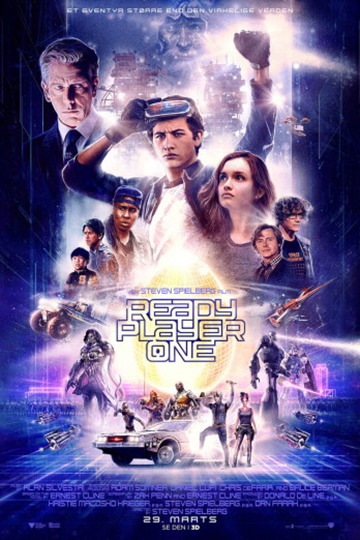
SHORT TAKE: READY PLAYER ONE

Ready Player One

Reviews of Ready Player One are already emerging analyzing the film as either a commentary on over-commercialization and pop culture obsessiveness, or the inevitable outcome of such. That's understandable. This is a Spielberg film after all, and given that he is one of the premiere filmmakers of our age, surely any work of his must be worth picking apart. Right?

Eh, maybe not. As illuminating as such intellectual explorations of the movie may be, they might be missing the point. Simply put, Ready Player One is just Spielberg having some fun. This is the type of film where a bunch of folks got together and said, "Hey, wouldn't it be neat if Batman and Hello Kitty walked by each other on the street?" And you know what? It is pretty darn neat.

Sure, that's about all there is to it. The story of a poor kid who has to solve a virtual reality riddle before the obligatory big evil corporation does in order to save the world’s favorite MMPOG is dirt-simple. It never really gets more complex than the video games upon which it is modelled. In fact, the narrative pretty much plays out just about the way you expect it will after watching one trailer. And as for the characters, both in their real world and digital forms, they are not what you would call deep. Not even a little.

Not much of that matters, though. In the end, it's all just Spielberg and his crew having a blast, and it's contagious. Anytime the story drags, there's plenty going on at the edges of the frame to keep your mind busy. Come on, you know you want to see Marty McFly's Delorean race Kaneda's motorcycle and the Bigfoot monster truck as much as the next person. However, if that just doesn’t sound artsy enough for you, don’t worry. There's an amazing Kubrick-centric centerpiece that's worth the price of a ticket all by itself.

You know, there’s a cool old story about about St. Teresa of Avila regarding having fun. She and her fellow nuns were assembled for their daily recreation time when one of the sisters spoke up and criticized the whole relaxation thing as a waste of time. They should be in their rooms doing something more productive like praying, the nun insisted. “Go to your cell and contemplate then,” St. Teresa retorted, “and we will make merry with the Lord here.”

Ready Player One has much that same attitude. “All work and no play makes Jack a dull boy” isn’t just another reference the movie drops, it’s a guiding philosophy. If you want serious adult Spielberg, he’s still out there in Schindler’s List, Munich, and any number of other films, and no doubt he’ll show up again in the future. For this movie, though, the old auteur just wants to make merry. You can either stay in the theater and make merry with him, or you can go back to your cell and attend to more serious matters. Go ahead, I’ll join you there when fun-time is over.

(NOTE: I have not read the book, have no intentions of reading the book, and so have no vested interest in how much the film differs from the book. If you have read the book, your mileage may vary.)

Tuesday, 13 March 2018

SHORT TAKE: GEHARA: THE DARK AND LONG-HAIRED MONSTER

Geharha The Dark and Long Hair Monster

See, this is why you need friends. I had never heard of Gehara: The Dark and Long-Haired Monster until long-time pal of the blog, Rocket Scientist, brought it to my attention. I’m not sure how such an oversight happened, but that injustice has now been corrected.

Produced in 2009 for the Japanese television show Tere Asobi Pafoo!, Gehara is a 20-minute short film that both celebrates and parodies the giant monster genre. It begins with two fishermen witnessing the rising of the very hairy behemoth, an incident that leaves one dead and the other completely bald for some reason. Curious about the survivor’s story, a newspaperman tracks down a shrine/tomb dedicated to the legendary beast, Gehara, only to find it empty.

It isn’t long before the hirsute horror stomps its way into Tokyo, where it proves unstoppable. That is until a mysterious American shows up with a newly developed secret weapon, a giant oscillating fan. Using the device, the army blows Gehara’s hair away from its face, exposing the creature’s weak spot. Gehara appears doomed… until the evil extraterrestrials show up!

Gehara is a work of pure fan service. Casual viewers probably won’t get all the inside jokes, but those who’ve sat through 60+ years worth of Godzilla movies more than a few times will likely recognize the loving details. There’s the lost tribe that worships the creature, the gratuitous tacked-on environmental message, and the homeless aliens hell-bent on world domination. And, of course, there’s the obligatory scene where the authorities try to hash out just what kind of monster it is they’re dealing with.

Among the possible explanations are some rather odd choices. Possibly they’re up against a Keukegen spectre, one of those small dog-like spirits whose hair can cause disease that were dreamed up by artist Toriyama Sekien in the 1780s. Or maybe it’s a Seaman, a freakish fish with a humanoid face found in a Tamagachi style video game for the old Sega Dreamcast. One government representative even suggests it could be one of the elder gods, the Koto·ama·tsu·kami, who created the earth and has now come back to reclaim their handiwork.

Inherent in all these speculations is the notion that something old is trying to reassert itself, a common thread in Japanese giant monster movies. Many experts see this as a commentary on Shintoism in post-war Japan following its dissolution as the state religion by Allied occupation forces. In his piece for the book Giant Creatures in Our World: Essays on Kaiju and American Popular Culture, Professor Se Young Kim discusses Shinto, noting that “its connection to kaiju cinema is in the fact that it loses favor as a cultural practice beginning in the middle of the twentieth century.” He goes on to point out the fact that “Godzilla appears at exactly the moment that Shintoism recedes.”

While many Shinto customs continue unabated in Japan, the religious aspects of the practices have slowly been deemphasized. With that change has come an apparent decline in the respect for the traditional family, the sacredness of nature, the need for spiritual and physical cleanliness, and the honoring of the gods and ancestral spirits. As a result, many experts suggest Japan is suffering. So basically, in these kinds of movies, the idea is that all of these crazy kaiju running around are a manifestation of the cultural rot brought on by the abandonment of traditional religion and the values contained therein.

With that being the case, one wonders why there aren’t more giant monsters running around the United States. Of course, we have plenty of homegrown horrors to reflect our own cultural decline, don’t we? After all, there’s a reason exorcism and zombie movies remain so popular.

Sunday, 30 April 2017

SHORT TAKE: THE WASP WOMAN

Wasp Woman, The

Vanity, thy name is woman…

…is something William Shakespeare never wrote; he actually used the word frailty. Still, that hasn’t stopped people from using the misquoted ‘vanity’ line to disparage women for ages now. And that’s despite a rash of recent studies which have shown that men care more about their appearance than women do, take more selfies of themselves than women do, and look at themselves in the mirror more than women do.

All that’s minor league stuff, though. As we learn in The Wasp Woman, only a female has the testicular fortitude to go so far as to steal a scientist’s untested youth potion made from the jelly of a queen wasp and inject herself with it on the off chance it might make her look a few years younger.

Now, to be fair, there’s a little more to Janice Starlin’s choice to risk becoming a wasp-headed monster than just seeing some crow’s feet and frown lines in the mirror. You see, Janice also happens to be the head of a cosmetic empire whose success, in part, has been based on having her image plastered all over its products’ packaging. But now that Janice has the ravaged face of a woman in her forties (really?), it was considered necessary to remove her ancient visage from all advertising. Unfortunately, doing so turned out to be just as bad for sales as having a hag on the box, so profits are sagging anyway.

The film seems to imply that, along with all of the usual stuff, society places an extra burden on women to maintain their physical attractiveness more so than it does men. if they don’t, there will be emotional and financial consequences. Because of this, a number of reviewers have heralded The Wasp Woman as one of the first feminist monster movies.

I suppose if we view Janice as symbolic of all women, then there is something to that notion. But on a more individual level, what Janice is going through is pretty common to just about everyone, man or woman. Writing for The Atlantic, Joseph Burgo, Ph.D., a psychotherapist and the author of Cinderella: A Tale of Narcissism and Self-Harm, Why Do I Do That?, notes…

“In his [eight] stages of psychosocial development, the psychologist Erik Erikson identifies the ‘crisis’ of middle age as a conflict between generativity and self-doubt. Generativity means we come to place increasing value on guiding the next generation—as parents, educators, artists, or social activists. A person who instead remains self-centered, unable to accept the changing of the generational guard, grows increasingly dissatisfied and stagnant.  People who make contributions to the younger generation and to society at large tend to feel good about themselves at this stage and find it a consolation for the loss of top billing. They will grow old with a sense of grace and acceptance. Those who can’t bear the shift to a supporting role may become increasingly narcissistic in the unhealthy sense of the word. Even adults who haven’t seemed particularly narcissistic for most of their lives may become so as they age. They will ape the behaviors, clothing, and attitudes of the young, trying to preserve their sexual appeal. They may opt for plastic surgery. Socially, they become more self-absorbed and insensitive, demanding to remain the center of attention.”

In other words, people who live their lives in service to others tend to be happier as they age, while those who remain self-centered become increasingly miserable as time goes on. Heck, they may even start making stupid decisions such as injecting themselves with wasp queen jelly and turning into homicidal monsters. You know, it’s almost as if all those times the Pope has harped on the necessity of serving others (like here, here, and here, for example), he might have actually been on to something.

Sunday, 2 April 2017

SHORT TAKE: AMITYVILLE EXORCISM

Amityville Exorcism, The

Last year it was announced that the 19th motion picture to bear the Amityville name would soon make its way to theaters. Produced by the unstoppable Blumhouse Productions, the creative force behind the Paranormal Activities and Conjuring franchises, and featuring such recognizable faces as Jennifer Jason Leigh, Bella Thorne, and Kurtwood Smith, it was hoped the movie would be the one to reinvigorate the Amityville brand.

This is not that movie.

This is Amityville Exorcism, the 18th movie to bear the Amityville name. It’s produced by Polonia Brothers Entertainment, the creative minds behind such films as Triclops, Muckman, Peter Rottentail, and Splatter Farm, and features Marie DeLorenzo and Jeff Kirkendall, actors you would only recognize if you’ve watched movies like Empire of the Apes, Sharkenstein, or Bigfoot Vs. Zombies (and Lord help me, I have).

You see, producers of low budget schlock learned long ago that the name Amityville can’t be trademarked. So, not only do we get high profile productions like the original The Amityville Horror and the supposedly upcoming Amityville: The Awakening, but we also get tons of slipshod knock-offs like The Amityville Asylum and The Amityville Playhouse (not to be confused with the slightly superior The Amityville Dollhouse).

All I can say is that it’s a good thing for such movies that Amityville is a town and not a person, otherwise they would definitely be guilty of breaking The Eighth Commandment. That’s the one which forbids any falsehood that does injury to one's neighbor, including unjustly ruining their good name. Heck, despoiling someone’s reputation is considered so loathsome that some of the Church Fathers have even likened it to being akin to murder. Watch something like Amityville Death House and you’ll understand what they mean (Oh, Eric Roberts, why?).

But anyway, back to Amityville Exorcism. The story is a simple one. Cursed lumber from the original Amityville house has been used to construct another residence, and it isn’t long before the young(ish) woman residing there becomes possessed by a demon dressed in red and develops a bad skin complexion. Fortunately, the somewhat frumpy Father Benna has been tracking down the cursed wood ever since his brother, also a priest, died while fighting the Amityville demon. The good father arrives just in the nick of time and, aided by the girl’s pickled paterfamilias, attempts an exorcism to drive off the evil Amityville spirit once and for all.

Now, it would be easy to criticize Amityville Exorcism for being cheap, poorly acted, and barely scripted. Easy, because it is all those things, in spades. For example, every ‘special’ effect in the film was obviously picked up at Party City, from the zombie makeup kit used to create the girl’s possessed look, to the red plastic masquerade mask worn by the demon. I looked it up. You can get both those items for $8.98 plus tax. Throw in another 20 bucks for the priest shirt and you’re ready to go.

Ultimately, though, such criticisms are futile. Director Mark Polonia has been churning out these kind of no-budget homemade films since the mid-80s, and everything in them that appalls the average movie viewer is exactly what Polonia’s long-time fans clamor for. If you count yourself among them, Amityville Exorcism is more of what you’ve crave. If you don’t, you’ve been warned.

Thursday, 23 March 2017

SHORT TAKE: DON’T KILL IT

As mentioned in my previous post, my day job is severely limiting my writing time here at the ol’ B-Movie Catechism. That’s regrettable because as much as I enjoy reviewing films for Aleteia and Scenes, I don’t often get to cover the kinds of movies over there that I do here. Apparently, long-winded ruminations on stuff like  Reptilicus and Hard Rock Zombies just don’t generate the same number of page views a review of Logan does. That’s fine, but I still miss discussing low budget and cult cinema. So, until I can get back into full swing here, I’m going to start putting up the occasional short take on movies tailor made for this site, a sort of B-Movie Catechism lite, if you will. Let’s start with…

Don't Kill It

Did you ever watch Fallen and wonder if it wouldn’t be just a little bit better if they replaced Denzel Washington with Dolph Lundgren and added lots and lots of head trauma? If so, then have we got a movie for you!

Don’t Kill It features everybody’s favorite chemical engineer turned beefcake bad boy (it’s true, look it up) as Jebediah Woodley, a deep-south demon hunter on the trail of a body hopping baddie. It seems Jebediah has been after one particular fiend ever since he was a little demon hunter in training and witnessed it cause his father’s death. Now, at last, Jebediah has the hellion in his sights and can exact some sweet revenge. The catch is, anytime this particular demon’s host body is killed, it immediately jumps into the body of the person who did the killing. What’s a guy to do in a situation like that?

Not to worry, as over the decades Jebediah has developed an impressive arsenal of non-lethal weapons for just this situation. Unfortunately, nobody else has, and since no one believes a word of Jebediah’s warnings, everyone tends to immediately open fire anytime one of the possessed goes on a killing rampage. You’d think after the first few massacres, everyone would learn their lesson, but no, skepticism rules the day. Who cares that just about every religion on the planet since the dawn of time has recognized the existence of malevolent spirits, let’s just ignore that possibility because a few drunk atheists have written best selling books saying such things are make believe. Just keep turning a blind eye to the obvious even as you’re having your face bashed in.

Which happens a lot in this movie! Don’t Kill It is a gleeful throwback to all those late 80s/early 90s direct-to-video action romps which were short on plot, but long on carnage. I can’t recall the last time I’ve seen a movie with this many head wounds in it. It’s all cartoonish fun, though, which is just what you would expect from the director of Big Ass Spider! and Lavalantula. In fact, given the vibe this movie gives off, it makes me wish some studio would throw some money their way and give Mike Mendez and Dolph Lundgren a shot at adapting Larry Correia’s Monster Hunter International series. Since that will probably never happen, though, Don’t Kill It will have to suffice. It’s cheap, silly, and fun, and you can’t ask for much more than that.