Showing posts with label Twilight Binge. Show all posts

Thursday, 11 January 2018

THE TWILIGHT BINGE #019: THE PURPLE TESTAMENT

vlcsnap-00001

S01E19 – The Purple Testament

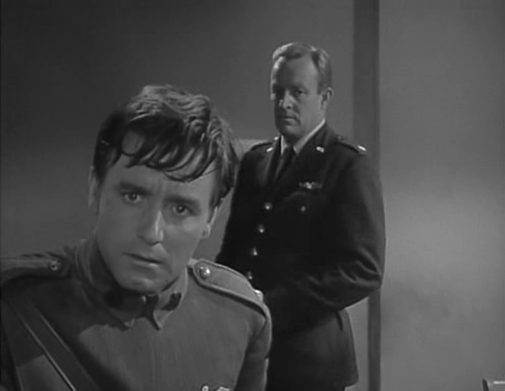
“Lt. Fitzgerald has found his own special wartime hell. Looking into the faces of his men prior to battle, he has the disquieting ability to see who is about to die.”

Like many a lad in the early 1940s, Rod Serling wanted to go to war. As detailed in Dave Thompson’s book, The Twilight Zone FAQ: All That's Left to Know About the Fifth Dimension, “His initial intention was simply to drop out of high school and sign up on the spot.” However, teachers convinced him to wait until after graduation, after which he enlisted and was deployed to the Philippines. There, Serling eventually participated in the march on Manilla, one of the bloodiest conflicts in the Pacific. Over time, Serling’s outfit suffered a 50% casualty rate, and Serling himself was seriously injured by antiaircraft fire.

Despite his own sufferings, however, perhaps the most devastating moment Serling experienced during the war came not on the battlefield, but as he and the rest of his platoon were relaxing under some palm trees. As one of Serling’s fellow soldiers stood in front of the rest entertaining everyone with some tall tale, a food crate dropped from an American supply plane landed squarely on the man, decapitating him on the spot.

Such things leave their mark on a person, and Serling was no exception. Thompson explains, “He survived the campaign, but he was not unscathed. Physically wounded twice, Serling was to bear the emotional scars for the remainder of his life; indeed, many commentators have since pinpointed Leyte and Manilla as the crucial events in Serling’s development as a writer – and perhaps even its genesis.”

vlcsnap-00003

Little wonder then that warfare, or more accurately the effects of warfare on the human psyche, would become a recurring theme on The Twilight Zone. Episode 19, The Purple Testament, is one of the earliest examples. Though set during the conflict in the Philippines, no skirmishes are ever shown. Instead, the focus remains on the soldiers outside of battle, allowing us to see how the war is wearing them down.

Knowing a bit of Serling’s service history, it’s easy to see a little of the writer in the main character, Lt. Fitzgerald, a man who literally sees death everywhere he looks. Even were he to survive the episode, he would never be the same again, not after the horrors he has endured. In an article for the Journal of the Catholic Health Association of the United States, Edward Tick, Ph.D. writes of the difficulties many such soldiers face upon returning home form combat…

“We cannot cure PTSD; it does not go away… From the perspective of the soul, a person with PTSD is stuck in hell and awash in destruction and death. Anyone in this condition needs rebirth… Healing for PTSD requires a spiritual approach because PTSD is a sacred wound to both the soul and society. It requires a different psycho-spiritual approach because the identity must be recreated and meaning discovered. It requires a communal approach because it is a social disorder resulting from isolating the warrior from civilian classes. Healing PTSD requires moving beyond conventional therapeutic practices to restore the proper relationships between veterans and communities, to provide veterans with all they need in order to return from hell and to discover the personal and socially useful dimensions of PTSD.”

Alas, as could be expected, Fitzgerald doesn’t make it to the end, so he never gets a chance at such spiritual healing. Therein lies the one criticism this episode often receives, that the patented Serling twist can be seen coming in the first few minutes of the show. Once it’s revealed that Fitzgerald can see who is going to die next, is there ever any doubt he will soon recognize death in his own face? Maybe that’s on purpose though. With the anticipation of the twist removed, all that’s left to give our attention to is the characters and what they are feeling. You have to think that’s what Serling wanted from this particular story all along.

Twilight Tidbits: The titular “purple testament of bleeding war,” a line which Serling borrowed from Shakespeare, is a reference not only to the sanguine color of blood, but to the historic practice of wealthy patrons commissioning illuminated manuscripts made from parchment dyed purple and lettered in gold. Not a fan of ostentatiousness, Saint Jerome reportedly penned a letter condemning the vanity of such purchases.

Tuesday, 9 May 2017

THE TWILIGHT BINGE #018: THE LAST FLIGHT

vlcsnap-00001

S01E18 – The Last Flight

“A World War I flying ace flies through a mysterious cloud - and lands at a modern U.S. air base in the year 1959!”

Although Rod Serling had previously adapted one of Richard Mathieson’s stories for the Twilight Zone episode And When The Sky Was Open, The Last Flight represents the acclaimed (and for good reason) author’s first self-penned screenplay for the show. It also happens to be the first episode to take the show’s title somewhat literally.

According to the Twilight Zone Archives…

The original phrase "twilight zone," came from the early 1900's, used to describe a distinct condition between fantasy and reality. The phrase then evolved into a term used to define the lowest level of the ocean that light can reach, and then as an aeronautical term used by the U.S. Air Force. When Rod Serling was asked how he came up with the title The Twilight Zone, he replied, "I thought I'd made it up, but I've heard since that there is an Air Force term relating to a moment when a plane is coming down on approach and it cannot see the horizon. It's called the twilight zone, but it's an obscure term which I had not heard before."

So, while not exactly in sync with the USAF’s use of the term “twilight zone,” this tale of a strange cloud in the sky that disorientates pilots is pretty close. Of course, said cloud doesn’t just discombobulate them. There’s a bit of time travel involved as well, a component which (unless they’re not telling us something) is not included in the Air Force’s definition. But while the time-hopping aspect of this episode might not apply to real life servicemen, the fear of dying during combat displayed by the main character certainly does.

vlcsnap-00003

The military does its best to prepare their troops for the stress of combat, but even seasoned soldiers can have moments of panic, extreme anxiety, or utter indecision. This type of short-term behavioral disorganization is officially referred to as Combat Stress Reaction (CSR), though ‘combat fatigue’ is the more common moniker amongst the rank and file. So it’s hard to completely fault Flight Lieutenant Decker when he momentarily freaks out and abandons his fellow airman in the middle of a dogfight. It could happen to anybody.

However, the fact that Decker’s done it more than once and keeps covering it up so that no one will look down on him, that’s a problem. As Walter Farrell, O.P notes in his Companion to the Summa Theologica…

It is not, of course, wrong to feel fear. A good ghost story should cause goose flesh and shivers; a mysterious noise at night might well make our knees knock and our teeth chatter. There are things that should be feared, things like snakes, broken legs and tornadoes; but we should fear those things reasonably, not suffering damnation in an attempt to escape snakes. For if, feeling fear as every man does, we allow that fear to take command of our action, then we are cowards.

Decker knows that each time he enters combat he is going to turn tail and run, thereby increasing the odds that his comrades will die. And yet he keeps doing it, excusing his actions because there was a good chance those who perished were going to do so anyway. It is war, after all. But his little jaunt to the future shows Decker that his cowardly actions have ramifications far beyond the battlefield, that untold numbers of people who would otherwise have lived will now die prematurely because of Decker’s continued cowardice. No person’s choices rarely affect only themselves. This lesson learned, Decker is finally able to choose the path of courage and do what is necessary. He dies a hero. More importantly, as Farrell might put it, he doesn’t suffer damnation in an attempt to escape snakes.

Overall, The Last Flight is a solid episode and a strong debut for Mathieson, though his best are yet to come. It’s also an interesting one because Mathieson, despite his Christian Scientist upbringing, is usually considered much less of a moralist than Serling was. Maybe so, but you couldn’t tell it from The Last Flight.

Twilight Tidbits: The 1918 Nieuport biplane used in this episode was something of a star itself, having previously appeared in such films as The Dawn Patrol, Men With Wings, Lafayette Escadrille, and The Last Squadron.

Saturday, 7 January 2017

THE TWILIGHT BINGE #017: THE FEVER

vlcsnap-00001

S01E16 – The Fever

“Tight fisted Franklin Gibbs is not pleased when his wife Flora wins a trip for two to Las Vegas. Franklin detests gambling, but his wife is excited about their vacation. Things change when Frank falls under the spell of a slot machine that calls his name.”

There’s an oft repeated adage that if ones scratches an atheist, they’ll find a fundamentalist. It’s some folk’s shorthand way of saying that many skeptics are just as rigid and dogmatic in their non-belief as the most fervent of fundamentalists are in their faith. Really, though, you could substitute just about any quasi-religious viewpoint into the formula with the same results. Scratch a vegan, scratch a social justice warrior, scratch a policy wonk… you get the idea. But have you ever wondered what happens if you flip the functions? What happens if you scratch a fundamentalist?

Apparently you get Frank Gibbs, at least if The Fever is any indication. Frank rolls into Vegas wearing an expression like William Bell Riley strolling through the evolution section at a library. You think the guy would at least appreciate all the free food and entertainment that comes with his wife’s prize. I mean, for crying out loud, the Rat Pack was headlining the “Summit at the Sands” the year The Fever aired, so you know the shows had to be good. But no, Frank has an aversion to gambling that makes the Southern Baptist Convention’s resolution on the subject seem tame by comparison, so there’s no way he can enjoy even a single second on the Strip. That is, until that demonic slot machine scratches an itch Frank didn’t even know he had.

vlcsnap-00003

And one scratch is all it seems to take to turn Frank from a hardliner to a high roller. Once that first coin drops in the slot, it’s all over. It isn’t long before Frank actually hears the machine talking to him. Actually, the talking one-armed bandit that menaces Frank is kind of silly when you get down to it, but Robert Florey’s stalwart directing and Everett Sloane’s performance as the haunted gambler manage to sell the whole scenario. It also helps that there’s a nugget of truth in the tale. As Rod Serling relates it, after CBS picked up The Twilight Zone as a series, he decided to celebrate the deal in Vegas. Unfortunately, he became obsessed with winning the jackpot from one particular slots, and spent most of his weekend pumping coins into the uncooperative machine. Like any good author, Serling immediately seized upon the episode as fodder for a story about the potential dangers of gambling.

Unlike some of the protestant denominations, the Catholic Church has always taught that “games of chance (card games, etc.) or wagers are not in themselves contrary to justice.” However, “they become morally unacceptable when they deprive someone of what is necessary to provide for his needs and those of others.” But as long as that’s not the case, and as long as the person participates freely, the earnings aren’t used for illicit means, and the games aren’t rigged, dropping a few bucks on gambling has always been held to be morally neutral. Well, as long as you know when to stop, that is. You see, the Catechism also warns that “the passion for gambling risks becoming an enslavement.” Once you surrender conscience to any activity, then you’re knee-deep in sin. And the last time I checked, the wages of sin were still death. Poor Frank learns that the hard way, right on the street in front of the casino. Some itches, it seems, are best left unscratched.

Twilight Tidbits: At the time of filming, slot machines were illegal in California. The show was able to obtain impounded slots from the police for the shoot, but only under the condition that officers were on hand at all times to ensure no one absconded with any of the devices.

Thursday, 6 October 2016

THE TWILIGHT BINGE #016: THE HITCH HIKER

hitch01

S01E16 – The Hitch Hiker

“A young woman driving cross-country keeps seeing the same hitchhiker on the roadside and, unaware she has bigger worries, fears he wants to kill her.”

In a twist worthy of the series, while the Twilight Zone generally stuck to science fiction and fantasy, some of its more memorable episodes were actually the ones that cranked up the creep factor. Take The Hitch Hiker for example, which consistently ranks among the top ten episodes of all time in just about every poll you can pull up. Adapted from a radio play (the only episode to bear that distinction) originally starring Orson Wells, The Hitch Hiker is a terror tale perfectly suited for the Halloween season.

It seems almost a modern miracle in this age of CGI, but director Alvin Ganzer manages to squeeze every ounce of tension possible out of nothing more than a few well placed cameras. The titular hitch hiker, played mostly silent by dependable character actor Leonard Strong, is always sliding into frame, showing up over Nan’s shoulder or in the reflection of the car’s mirrors. He never makes a menacing move or utters a threatening word, but the fact that you never quite know where he is going to appear is enough to keep things on edge.

Ganzer’s clever camera placement almost led to disaster though, at least according to Marc Scott Ziree’s Twilight Zone Companion. For the scene in which Nan’s car stalls on the railroad tracks, the budget didn’t allow for the show to actually rent a train. Instead, they simply set up the shot and waited for one to come along, not realizing just how fast the local locomotives passed through this particular crossing. Go back and rewatch the episode and decide for yourself whether it looks like the car barely makes it off the tracks or not before the train comes barreling through. Ah well, nobody was hurt, and the scene definitely adds to the growing sense of peril for poor Nan as the episode progresses.

hitch02

Most of what I could say about The Hitch Hiker’s twist ending I have already discussed in my review of Carnival of Souls, a movie I adore, but one which blatantly rips off this episode for everything it can. One big difference in the stories denouements, however, is the way in which the two women confront their final fates. In Carnival of Souls, Mary goes down kicking and screaming, whereas in The Hitch Hiker, once Nan realizes what is happening, their is almost a sense of relief on her face. Nan is ready for death, while Mary is not.

Perhaps this is because in Carnival of Souls, Mary is shown to be something of a wild child at the beginning of the film, getting plastered with her girlfriends and engaging in dangerous drag races. Nan, on the other hand, is just a hard worker enjoying a well deserved vacation before her tire blows out. At the risk of over-simplifying, the narratives give us enough clues to suggest Nan is a good girl, while Mary, if not necessarily bad, is at least living in some grey areas. This is important because, as the old Catholic Encyclopedia notes, “spiritual writers are as one in declaring that ordinarily the only adequate preparation for death is a righteous life.”

Nobody in their right mind is in any rush to die, but a Christian with a clear conscience doesn’t shy away from the experience when they know the time is nigh. Heck, we even have a prayer ready for the occasion…

O Lord, my God, from this moment on I accept with a good will, as something coming from your hand, whatever kind of death you want to send me, with all its anguish, pain, and sorrow.  Jesus, Mary, and Joseph, I give you my heart and my soul.  Jesus, Mary, and Joseph, assist me in my last agony.  Jesus, Mary, and Joseph, may I sleep and take my rest in peace with you.

It’s a good prayer. May it be a long time before you ever have to use it.

Twilight Tidbits: When Nan goes to the gas station, the pumps are branded with the name of the Magnum Oil Company. This is the same name which appears on the gas truck in the biplane attack sequence in North by Northwest. While probably a coincidence (Magnum was a real company after all), one can’t help but wonder if this was a subtle dig at Alfred Hitchcock, who had been trying to buy the rights to The Hitch Hiker for his own show before Serling snapped them up.

Saturday, 6 August 2016

THE TWILIGHT BINGE #015: I SHOT AN ARROW INTO THE AIR

tz arrow 01

S01E15 – I Shot An Arrow Into The Sky

“The world's first manned space mission goes awry, stranding the crew on an apparent asteroid that is desolate and waterless. One man ruthlessly grasps for survival before a peculiar symbol reveals the group's true location.”

One thing The Twilight Zone rarely had a shortage of was ideas. In fact, with the likes of Ray Bradbury, George Clayton Johnson, Richard Matheson, and Charles Beaumont contributing on a regular basis, one would imagine the show’s creative font was constantly running over. At the beginning, though, that wasn’t the case. As detailed in Don Presnell & Marty McGee’s book, A Critical History of Television's The Twilight Zone, Serling and his wife Carol were dining one evening with another couple, John and Madelon Champion, when  Serling brought up how CBS was pressuring him to deliver a large amount of finished teleplays before they would begin production on the show. Off the cuff, Mrs. Champion suggested Serling should do a story about astronauts who think they’ve landed on an asteroid, but who in reality were just walking around outside Las Vegas. Serling wrote her a check for $500 on the spot and I Shot An Arrow Into The Sky was born. Why don’t these kinds of things ever happen to me?

Anyway, the title of the episode is an obvious reference to the opening lines of Henry Wadsworth Longfellow's poem, The Arrow and the Song. However, since that particular work is generally considered to be a rumination on the long-lasting and often unintended consequences of harsh words, the poem doesn’t actually have much relevance to this episode’s story. I guess Serling could have referenced some other sonnet, but there’s really not that large of a selection dealing with cowardly murderers to choose from.

tz arrow 04

When you think about it, it’s pretty amazing how quickly the character of crewman Corey goes from believing he’s stranded on an asteroid to deciding he has to bump off his fellow castaways in order to get their water and prolong his own life. I suppose if he cared enough to do so, Corey could attempt to justify himself under the principle outlined in the old Catholic Encyclopedia “that in extreme necessity every man has a right to appropriate whatever is necessary to preserve his life. The starving man who snatches a meal is not an unjust aggressor.” Based on his ramblings, this does appear to be Corey’s basic rationale for doing what he does.

The problem with Corey using this line of reasoning is threefold. One, he isn’t starving yet, so the theft isn’t necessary. Two, even if Corey was starving, this principle falls under the larger category of self defense which also allows for “a thief [to] be slain in the act of carrying away stolen property provided that it cannot be recovered from him by any other means.” Self defense, it turns out, also applies to defense of property because certain material goods are necessary for life and should be protected. And three, Corey isn’t just stealing to survive, he’s flat out killing his friends to get their stuff. This is a big no-no because in no way are Corey’s fellow crewmen showing the slightest indication that they mean Corey any mortal harm. Sure, they want to punch the guy in the mouth, who wouldn’t, but that kind of thing won’t kill him. Without a mortal threat, Corey really has no justification for his actions. In the end, Corey is just a selfish S.O.B. who puts his own self-preservation before all moral concerns. Fortunately, whether he’s on an asteroid or on Earth, he’s still in the Twilight Zone, so we can be sure he’ll get what’s coming to him.

Twilight Tidbits: A good portion of this episode was filmed in Death Valley National Monument, a location which has been utilized in many a movie, including a little one by the name of Star Wars where it served as the planet Tatooine.

Tuesday, 31 May 2016

THE TWILIGHT BINGE #014: THIRD FROM THE SUN

third from sun 01

S01E14 – Third From The Sun

“Certain that a nuclear war is imminent, a scientist plots to escape with his family and closest friends in an experimental spaceship to a planet eleven million miles away.”

I’ve lost count of the number of movies and comics I’ve seen over the years that contain the same twist ending as Third From The Sun. Let’s just say it’s a pretty sizeable number. And since this episode is based on a short story by Richard Matheson published some 10 years before this adaptation hit the small screen, it’s safe to say the twist didn’t originate with the Twilight Zone either. Still, the big reveal of what planet our harried heroes are actually escaping TO and not FROM had to be relatively new to most people at the time Third From The Sun aired, so one can only imagine the impact it had.

The funny thing is, even though it’s supposed to be a surprise, director Richard L. Bare took great effort to plant visual clues that the story might not be taking place exactly where we think it is. As noted in Marc Scott Zicree’s Twilight Zone Companion, Bare shot every scene with an extremely wide angle lens, even on close-ups, which was atypical for television productions. He also kept the camera in odd places, such as behind flashlights or underneath glass tables. Bare pulled every trick he could think of to make the viewer feel as if something was off about the whole setting. Pretty clever for a guy whose main claim to fame was directing all but four episodes of Green Acres during its 170 episode run. (I guess it really was the place to be.)

third from sun 02

Of course, even without the twist at the end, viewers who caught Third From The Sun when it originally aired would likely still have been riveted by the subject matter. With the Bay of Pigs fiasco just over one year away, Cold War concerns were at an all-time high, so a show dealing with two couples trying to find a way to survive an impending nuclear holocaust probably touched a few nerves. I imagine audiences found it especially chilling to listen to the character of Sturka (a rather Russian sounding name for an American, don’t you think) coldly explain that by striking first, America could limit it’s own civilian casualties to a mere 35 million or so. Given the population of the U.S. in 1960, that suggested our government considered the death of 1 out of every 5 people to be acceptable losses.

Um, how about no. While it’s nearly impossible to conduct a war, even a just one, with no collateral damages, the Catechism is pretty explicit in its instruction that “the use of arms must not produce evils and disorders graver than the evil to be eliminated. The power of modern means of destruction weighs very heavily in evaluating this condition.” Sure, we can bomb each other out of existence, but that doesn’t mean we should. Sometimes, letting a war drag on for awhile can actually be the more moral choice if it results in fewer casualties in the long run. That’s not to say body count is the only measure. The Church recognizes that other concerns such as regional stabilization, political alliances, and economic burdens must also be taken into consideration when deciding a course of action during wartime. But civilian casualties must be in the forefront. As Archbishop Wilton D. Gregory noted during the Iraq war, “The use of anti-personnel landmines, cluster bombs and other weapons that cannot distinguish between soldiers and civilians, or between times of war and times of peace, ought to be avoided.” Perhaps that’s something to keep in mind during this age of drone warfare.

Twilight Tidbits: If the spaceship our intrepid travelers intend to use to make their escape looks a bit familiar, that’s because you’ve probably seen it every time you watch the 1956 classic, Forbidden Planet.

Tuesday, 12 April 2016

THE TWILIGHT BINGE #013: THE FOUR OF US ARE DYING

The Four Of Us 1

S01E13 – The Four Of Us Are Dying

“Arch Hammer is a penny-ante con man with a unique talent—he can change his face to look exactly like men he's seen in photographs. Using this skill, he impersonates a dead trumpet player in order to seduce the man's girlfriend, then duplicates a murdered hood to extort money from the gangster who had him killed. Later, to elude some pursuers, he imitates the face of a boxer from a weathered fight poster. But Hammer hasn't counted on the fact that wearing other people's faces can lead to walking in their shoes…”

You have to hand it to Rod Serling, when he wanted to make sure you knew a character was a no good louse, he didn’t mince words. Take his introduction for Arch Hammer at the beginning of The Four Of Us Are Dying for example. “This is a cheap man,” Serling intoned in his familiar baritone, “a nickel and dime man, with a cheapness that goes past the suit and the shirt; a cheapness of mind, a cheapness of taste, a tawdry little shine on the seat of his conscience, and a dark-room squint at a world whose sunlight has never gotten through to him.” No ambiguity there, huh?

No misdirection either. Arch Hammer is about as slimy a character as they come. With his ability to take on the appearance (and apparently the voice and mannerisms as well) of any person he sees, you would think he could have had a lucrative career as a spy or an actor. Instead, he just uses his gift to run petty cons, taking advantage not only of other criminals like the mob boss Penell, but of innocents like the lovesick Maggie. Unfortunately for Hammer, he’s in the Twilight Zone, so justice eventually catches up to him in the most ironic way possible; the man with the ability to take on the appearance of anyone he desires dies because he loses focus and can’t remember his own true self.

The Four Of Us 2

Truth be told, you don’t necessarily have to be a shape shifter to face such a dilemma. As Bishop Robert Barron explains, “Any number of Catholic mystics and spiritual masters over the centuries have spoken of the ‘false self,’ with its tendencies toward attachment, violence, and pride. And they have urged… the discovery of the true self, grounded in love, connection to others, and the transcendence of egotistic preoccupations.” Now, as Peter Kreeft once explained, we can’t really know our full ‘true self’ until we go to live in the presence of God…

“All my life I search for this unique, individual self—my true self—and yet I never fully find it. Only God knows it fully, for he designed it. And only God can give it to me because he created it and is creating it right now, sculpting it with all the tools of heredity and environment that make up my life. None of us knows who we really are once we stop fooling ourselves. That knowledge and that destiny await us in our home. Our home is in heaven because our true identity as individuals is waiting for us there. The character's identity is found in the author's mind and nowhere else.”

Still, it’s not a futile effort to search for our true self in the here and now. As the Compendium of the Social Doctrine of the Church suggests, a bit of contemplation on the Holy Trinity can put us on the true path of self discovery…

“In the communion of love that is God, and in which the Three Divine Persons mutually love one another and are the One God, the human person is called to discover the origin and goal of his existence and of history. The Council Fathers, in the Pastoral Constitution Gaudium et Spes, teach that the Lord Jesus Christ, when praying to the Father that ‘they may all be one ... as we are one’ (Jn 17:21-22), has opened up new horizons closed to human reason by implying that there is a certain parallel between the union existing among the divine Persons and the union of the children of God in truth and love. It follows, then, that if man is the only creature on earth that God has willed for its own sake, man can fully discover his true self only in a sincere giving of himself (cf. Lk 17:33)”

So, if self giving is the key to discovering our true face, it’s no wonder Arch Hammer was doomed. He was constantly putting on false selves for personal gain and never once gave an ounce of himself to anyone. Losing his true self forever was only a matter of time.

Twilight Tidbits: Serling’s screenplay for The Four Of Us Are Dying was based loosely on an unpublished short story by George Clayton Johnson, who would not only go on to become a regular contributor to The Twilight Zone, but also for a little show called Star Trek, beginning with its premiere episode, The Man Trap.

Friday, 1 April 2016

THE TWILIGHT BINGE #012: WHAT YOU NEED

tz-01_thumb2

S01E12 – What You Need

“Pedott is an enigmatic sidewalk peddler with the uncanny ability to give people the item they will soon desperately need—before they even know why they'll need it. He gives Lefty, a washed-up ballplayer, a ticket to Scranton moments before Lefty gets a call offering him a coaching job in Scranton. Fred Renard, a violent, bitter failure of a man, demands Pedott give him what he needs. Frightened, Pedott produces a pair of scissors. Renard is mystified...until a hotel elevator door closes on his tie and scissors prove very handy. But Renard wants much more.”

“You can't always get what you want,” sang Mick Jagger back in 1969, before going on to add, “but if you try sometime, you find, you get what you need.” It’s kind of hard not to hear that tune playing in the back of your mind every time this episode rolls around. Of course, What You Need appeared a decade before The Rolling Stones warbled out their similarly themed hit, so maybe they actually had Serling’s story playing in the back of their own minds while writing the lyrics. Hey, it’s the Twilight Zone; stranger things have happened.

Airing on December 25, 1959 (Rod Serling’s 35th birthday by the way), What You Need is a holiday-appropriate morality tale about those who give freely and those who take by demand, mixed with a dash of the old monkey’s paw for good measure. The taker, in this instance, is the noirish no-goodnik Fred Renard, a man who thinks life owes him everything and hasn’t gotten around to paying up yet. The giver is the mysterious peddler Mr. Pedott who, much like Henry J. Fate from Mr. Denton on Doomsday, seems to have a little bit of everything in his magic case. Well, almost. As Pedott tells the increasingly belligerent Renard, “The things you need most I can't supply. Serenity, peace of mind, humor, the ability to laugh at yourself… patience.”

The Twilight Zone - s01e09 - Perchance to Dream 003

With dialogue like that, it’s obvious What You Need isn’t trying to be clever and bury its message in subtext. Although it’s got another one of Serling’s patented twists at the end involving a pair of slippery shoes, overall the episode is a pretty straight forward tale about the need to find solace in interior peace rather than to keep vainly seeking the fleeting comforts of this world. Of course, the call to seek inner peace is a platitude easier placed on self-help book shelves than it is to actually put into practice. That’s why Saint Leonard of Port Maurice, a 16th century Franciscan friar remembered primarily for his evangelistic preaching (which is probably why he doesn’t get a lot of attention these days), offered a few suggestions on how to obtain peace of soul. 

1. Form no attachments to anything but God. Everything else should be viewed as to how it relates (or doesn’t) to the creator.

2. Trust in Divine Providence. God’s “mind” is bigger than the universe so there’s a good chance he knows what he’s doing. Have faith in that.

3. Welcome suffering when it comes. Not a popular suggestion, for sure, but hard times are probably the best opportunity to experience solidarity with Christ. 

4. Don’t try to do more than your situation allows. You don’t have to single-handedly run the church council, feed the city’s poor, visit every prisoner, etc. etc.

Okay, so a lot of that isn’t easy either. It’s admittedly much more expedient to try and find contentment in earthly things. But seeing how that approach worked out for Renard in tonight’s episode, maybe trying things Saint Leonard’s way is the better method in the long run.

Twilight Tidbits: At one point, Renard opens up a newspaper and lays it out on the floor. Blink and you might miss the ominous headline which reads, “H-BOMB CAPABLE OF TOTAL DESTRUCTION.” We last saw that exact same paper being read by one Mr. Henry Bemis in Time Enough At Last.

Thursday, 24 March 2016

THE TWILIGHT BINGE #011: AND WHEN THE SKY WAS OPENED

tz-01_thumb2

S01E11 – And When The Sky Was Open

“During man's first flight into space, the X-20 disappears from radar then crashes in the desert. Major Gart is laid up with a broken leg, but Colonels Harrington and Forbes go out for a night of revelry. Suddenly getting a strange feeling, Harrington calls his parents—and finds they have no son! Abruptly, he disappears, and no one but Forbes remembers him. Forbes is desperate to find out what's going on—for whatever yanked Harrington away may not be satisfied with just one.”

We’ve finally come to  that inevitable point in our Twilight Zone binge which I have been dreading. Much to my shame, I must confess there are episodes of the show (this one at the very least) which I either have no memory of or just plain old haven’t seen at all. Mea culpa, mea culpa, mea maxima culpa.

What assures me that I haven’t seen And When The Sky Was Open before is that I would definitely remember an episode this strange. Very, very loosely based on a short story by Richard Matheson, the narrative follows a pair of astronauts as they try to figure out what force is slowly erasing them from existence. Not killing them, mind you, but rather altering reality so it’s as if they never existed in the first place. Is it the result of some freak accident of nature they encountered while in orbit? Is it aliens who mean to keep humans from venturing into space? Is it God punishing mankind for the hubris of reaching for the stars in their rocket propelled Tower of Babel? No explanation is ever given, and the episode comes to an end with just as many questions as when it began.

The Twilight Zone - s01e09 - Perchance to Dream 003

“The worst fear of all is the fear of the unknown working on you, which you cannot share with others.” claimed Rod Serling, “To me, that’s the most nightmarish of stimuli.” In a way, you can kind of see where Serling is coming from. After all, at every mass we profess a belief not only in the visible, but in the invisible as well. And in the Catechism, we’re told that some of the less than benign inhabitants of the invisible have been allowed by God “to exercise a limited influence in the world, pursuing evil intentions and seeking to induce human beings to make a choice against God similar to their own.” So the “unknown” really is out to get us. But does that mean we should necessarily walk around in fear of it?

St Anthony of Egypt didn’t seem to think so. One tale has it that after being accosted by a vison of numerous demons seeking to do him no good, the Saint scoffed and said something along the lines of, "If you were capable of harming me, it would require only one of you". What St Anthony likely understood was that, in the end, the only real fear we need to cultivate is that of God himself. In his book on the Catechism, Fr. John Hardon wrote that the fear of God is a gift because it “confirms the virtue of hope and impels a man to a profound respect for the majesty of God. It’s correlative effects are protection from sin through dread of offending the Lord, and a strong confidence in the power of his help… Consequently, the gift of fear gives us the power to sublimate all lesser fears, including the salutary and much-needed dread of God’s justice.” Based on that, it would seem the best way to overcome Serling’s worst kind of fear is to develop the best kind of fear instead. That’s a twist worthy of the Twilight Zone itself.

Twilight Tidbits: This was the first of nine episodes helmed by prolific television director Douglas Heyes, whom many consider to be the Alfred Hitchcock of the series. Sadly, Heyes was not quite as successful on the big screen, though many MSTies out there will forever treasure his work on the Ann Margaret opus, Kitten With A Whip.

Thursday, 10 March 2016

THE TWILIGHT BINGE #010: JUDGEMENT NIGHT

tz 01

“An unseen, unfriendly periscope keeps a steely watch over the S.S. Queen of Glasgow as fog and sea whip across the freighter's docks. On board the Glasgow a German passenger, Carl Lanser, wanders about in confusion as the boat rocks to and fro in the black night. He doesn't know how he got aboard or what he's doing there, but strangely all the passengers are familiar. The only thing Carl Lanser knows for certain is that at 1:15 a.m., something horrible is going to happen. Suddenly, a Nazi U-boat surfaces. Lanser zooms in on the sub with his binoculars and begins to understand a horrible truth about himself...the S.S. Queen of Glasgow...and the terrible reality that lies ahead on this raw, ugly night.”

S01E10 – Judgement Night

From January 1943 to January 1945, Rod Serling served as a paratrooper and demolitions expert in the U. S. Army’s 11th Airborne Division. While wounds in his wrist and knee would earn Serling both the Purple Heart and the Bronze Star, other wartime memories, such as seeing his best friend crushed to death by a supply crate parachuted onto the battlefield, would provide Serling with a lifetime’s worth of nightmares and flashbacks. He dealt with these the way many a writer has, by channeling them into his work. Judgement Night would be just the first of many Twilight Zones episodes informed by Serling’s wartime experiences.

While the story is a bit slow moving, Serling tries to keep the tension up by using Hitchcock’s ticking bomb trick. We know from the outset that something awful is going to happen at a specified time, we just don’t know exactly what or to whom. Serling also switches things up a bit by having Lanser, the eventual villain of the piece, be the audience’s surrogate for most of the story, a neat trick considering the guy turns out to be a mass murdering Nazi. And veteran director John Brahm (who coincidently fled Germany when Hitler came to power) does his best to keep things interesting visually. The scene in the hallway where Lanser’s victims stare mutely at their killer is particularly effective.

tz 03

The central theme of the episode, that the experience of Hell will be personalized to the individual, goes back at least to the ancient Greeks. Their concept of the afterlife included Tartarus, an abyss in which the wicked suffered punishments which reflected their crimes. King Tantalus, for example, was forced to forever try and snatch fruit from a tree which pulled its branches away just as his fingers neared it. This eternal hunger was his fate for daring to chop up his own son and feed the boy to his dinner guests.

Obviously, the most common image of Hell among Christians has been that of a lake of fire, but over the centuries, personalized tortures have also contemplated. Dante’s Inferno included sinners being stung by wasps and frozen in ice, while the paintings of Hieronymus Bosch depicted punishments so bizarre that they’re best seen rather than described (what’s up with all those flowers shoved up butts?). For Lanser, Hell is to forever experience the terror that his victims did. As his lieutenant envisions it, “Perhaps there is a special kind of hell for people like us. Perhaps to be damned is to have a fate like the people on that ship, to suffer as they suffer and to die as they die… We'll ride the ghost of that ship every night. Every night, Kapitan, for eternity. They could die only once, just once, but we could die a hundred million times.”

And so they do, all because of the decision to push a button. And in the end, that’s what really matters. Whatever the experience of Hell may turn out to be, the most important thing to keep in mind is that God doesn’t choose for us to go there. We do.

Twilight Tidbits: Even the Twilight Zone had to pay the bills, so when General Foods balked at all the tea drinking in the script, quick changes were made to ensure that all the British aboard the S.S. Queen of Glasgow looked forward to a nice coffee break instead.

Tuesday, 1 March 2016

THE TWILIGHT BINGE #009: PERCHANCE TO DREAM

The Twilight Zone - s01e09 - Perchance to Dream 1

S01E09 – Perchance To Dream

“Edward Hall has a bad heart —and a [terrible] problem. Desperate, he barges into the office of Dr. Rathmann, a psychiatrist, and explains that each night, he’s been dreaming in chapters, as in a movie serial. The setting is always the same: an amusement park, in which Maya, an alluring carnival dancer, entices him into a funhouse and onto a rollercoaster…with the intention of scaring him to death. He knows if he goes to sleep again, he’ll suffer a fatal heart attack - and yet, if he stays awake much longer, he feels sure his heart won’t stand the strain. Whatever choice Hall makes… he’s brought a one-way ticket into the Twilight Zone.”

When CBS agreed to produce the Twilight Zone, it was under the condition that Rod Serling script a minimum of eighty percent of the episodes. That was a mostly unheard of practice back in those days, but it served as a testament to Serling’s status as a writer. According to The Twilight Zone Companion, to fill in the remaining twenty percent, an open call for submissions was issued. However, after fourteen thousand(!) manuscripts proved unusable, Serling invited a number of established authors to a screening of the pilot to see if any would be a good fit. Out of all those who attended Serling chose only two; Charles Beaumont and Richard Matheson. Apparently the man had an eye for legendary talent.

Perchance To Dream became the first of Beaumont’s twenty-two contributions as a screenwriter to air and it’s a heckuva start to his Twilight Zone career. Everything in this episode clicks, from Richard Conte’s harried characterization of the doomed Edward Hall to director Robert Florey’s imaginative use of expressionistic set design. And the story of a man who visits a psychiatrist because he’s afraid he’ll die if he goes to sleep, only for the audience to discover at the end that the whole visit had been the dying man’s dream all along… that’s pure Twilight Zone.

The Twilight Zone - s01e09 - Perchance to Dream 3

In addition to all that, Beaumont’s story also has a number of Easter eggs, most notably the title’s reference to Hamlet’s famous soliloquy. One of the more obscure shout outs, though, is found in the name of the predatory woman from Edward’s dreams, Maya. Though its meaning has been fluid throughout the history of Eastern philosophy, the modern understanding of the word Maya typically refers to the delusional state people fall into when they confuse the illusory physical world created from their own perceptions with what is actually real. Edward himself seems to reference this state of mind when he relates to the psychiatrist how he envisioned Maya in the back seat of his car. “I knew intellectually that I was alone,” he explained, “but I also knew that my imagination could make me see something if I thought about it long enough.”

Basically, Beaumont was using a Buddhist concept to drop a clue as to what was really happening in the story. So, while on the surface Beaumont’s first script for the Twilight Zone doesn’t appear to be quite as moralistic as Serling’s episodes had been so far, there are still some metaphysical musings in it if you dig deep enough. And as the series would progress, Beaumont’s Christian existentialism (as one of his biographers coined it) would come more and more to the forefront. A good fit for the Twilight Zone indeed.

Twilight Tidbits: According to Beaumont’s pal William F. Nolan (no slouch in the writing department himself), the author often drew inspiration from his own fears. Nolan recounts a trip the two took through an amusement park fun house during which Beaumont became convinced the ride attendant had entered the ride and planned to kill them both.

Saturday, 13 February 2016

THE TWILIGHT BINGE #008: TIME ENOUGH AT LAST

The Twilight Zone - s01e08 - Time Enough at Last 1

S01E08

"Henry Bemis, a bookish little man with thick horn-rimmed glasses wants only one thing out of life; the time to read. Reading is his only passion in an otherwise mundane existence...yet, it's almost an impossibility due to a shrewish wife who deems reading silly...a boss at the bank who's interested in efficiency not education...and the unrelenting hands of the clock. Now all that is about to change. As he does everyday, Bemis sneaks down to the vault to read during his lunch hour, but today when he emerges from his private sanctuary , he will enter a new world. A world that might or might not fulfill his life-long dream."

Well, here it is. When Twilight Zone magazine polled their readers and asked them to name the series’ most memorable episode, Time Enough At Last won by a landslide. TV Guide’s writers were so impressed with the episode that they chose it as the 25th most memorable moment in television history. And if that’s not enough acclaim, Rod Serling himself declared Time Enough At Last as one of his two personal favorites out of the entire series. Not too shabby for a story which many consider to have one of the cruelest endings ever crafted.

And really, it’s that ending we most remember, isn’t it? How could your heart not go out to poor old bookworm Henry Bemis (masterfully portrayed by Burgess Meredith) as he sits on those library steps, broken glasses in hand, lamenting, “It’s not fair. It’s not fair.”? How could you not feel sympathy for this poor man against whom the entire world has apparently conspired to deny him the time to enjoy a good book? I’m willing to wager that’s a dilemma which resonates with quite a few of you out there just as much as it does with myself.

And yet, the Twilight Zone, if it is anything, is a moralistic show, so punishing the innocent doesn’t really fit in with the tone of the series. Perhaps then, Henry isn’t quite the innocent victim of fate that he appears to be at first.

The Twilight Zone - s01e08 - Time Enough at Last 2

While they’re hard to catch because Henry’s wife comes across as such a domineering monster, there are hints in Helen’s dialog that suggest she only became that way after years of neglect from her husband. And Henry’s boss, though not a sweetheart by any measure, does actually have a legitimate complaint about Henry’s obsession interfering with his work. The fact is, every chance he gets, Henry isolates himself from his fellow human beings and buries himself in his books. He avoids human interaction whenever possible, content to live in the imaginary world of the written page.

While this obviously isn’t on the same level as robbery or murder, the fact is such an obssesive avoidance of other people isn’t healthy for the soul. As the Catechism reminds us, “The human person needs to live in society. Society is not for him an extraneous addition but a requirement of his nature. Through the exchange with others, mutual service and dialogue with his brethren, man develops his potential; he thus responds to his vocation.” Me-time is fine, but complete isolation is not. Heck, even Carthusian monks leave their cells for daily group prayer and a weekly walk together.

The sad thing is that Henry seems to realize the error of his ways at first, even going so far as to contemplate suicide when he finally comprehends just how truly alone he is in the post-apocalyptic world. But his remorse quickly evaporates once he stumbles upon the library and he quickly returns to his self-centered mindset. So, is Henry sympathetic? Absolutely. But is he an innocent victim of the Twilight Zone? Not by a long shot.

Twilight Tidbits: So iconic is the character of Henry Bemis that when Bif Bang Pow! decided to release a series of action figures based on the Twilight Zone, there amongst the wing-riding gremlins and man-serving aliens was none other than Mr. Bemis himself, books and all.

Monday, 8 February 2016

THE TWILIGHT BINGE #007: THE LONELY

The Twilight Zone - s01e07 - The Lonely 1

S01E07 - The Lonely

"For inmate James A. Corry, solitary confinement means life on an asteroid nine million miles from Earth. Corry craves human contact — so much so that he counts the minutes until a roving ship makes its annual drop-off of provisions. Corry may well be the loneliest man in the universe. But all of that is about to change. Because the supply ship is on its way, this time carrying a special package for Corry that will help him to forget his problems… and present him with a whole new dilemma."

In our look at Episode 1 of the Twilight Zone, we noted how the theme of coping with loneliness was one Serling would return to multiple times over the course of the series. Well, here we are just six episodes later and here it returns in spades. Some sources indicate The Lonely was the next to be produced after the pilot, so perhaps the idea of isolation was weighing heavy on Serling’s mind for some reason as he was getting the show up and running. In fact, the themes of the two episodes are similar enough that an alternate, unused opening narration Serling had penned for Where Is Everybody? would actually have worked just as well for this episode…

“The barrier of loneliness: the palpable, desperate need of the human animal to be with his fellow man. Up there, up there in the vastness of space, in the void that is sky, up there is an enemy known as isolation. It sits there in the stars waiting, waiting with the patience of eons, forever waiting... in the Twilight Zone.”

If that doesn’t fit a story about a man imprisoned by himself on an asteroid for fifty years, I don’t know what does.

Watching this episode at the beginning of 2016 when both Ex Machina and The Martian are up for Academy Awards only accentuates just how much the subject matter Serling was dealing with still resonates today. Jean Marsh’s sympathetic android, Alicia, is a clear forerunner of Alicia Vikander’s Ava as both leave the viewer with questions about just how “human” their artificial intelligences really are. And Jack Warden’s hopelessly lonely prisoner can’t help but make you think of Matt Damon’s Mars-stranded astronaut. Warden is particularly excellent in this episode, turning in perhaps the best acting of the series so far. His desperation for even a simple game of checkers with another human being is palpable.

The Twilight Zone - s01e07 - The Lonely 2

Warden’s performance is also pretty accurate to those real life prisoners in long term solitary confinement, at least if some mental health specialists are to be believed. As an article from Wired notes, “The human brain is ill-adapted to [solitary confinement], and activists and some psychologists equate it to torture. Solitary confinement isn’t merely uncomfortable, they say, but such an anathema to human needs that it often drives prisoners mad. In isolation, people become anxious and angry, prone to hallucinations and wild mood swings, and unable to control their impulses. The problems are even worse in people predisposed to mental illness, and can wreak long-lasting changes in prisoners’ minds.” If that’s all true, then it should be no surprise to find that Pope Francis has condemned the practice.

Still, understanding the anguishes of such isolation does shed some light on the Catehchism’s description of Hell, which is basically “eternal separation from God.” If solitary confinement in an earthly prison can be enough to drive some mad, then just imagine the horror of eternal isolation. As Prof. Peter Kreeft explains it, “The images for hell in Scripture are horrible, but they're only symbols… The pain of loss - the loss of God, who is the source of all joy - is infinitely more horrible than any torture could ever be.” I think Warden’s character would agree.

Twilight Tidbits: While it would be another decade before the character of pompous newsman Ted Baxter would make Ted Knight a household name, he makes an uncredited appearance here as (surprise, surprise) an arrogant jerk of a spaceman.

Saturday, 6 February 2016

THE TWILIGHT BINGE #006: ESCAPE CLAUSE

The Twilight Zone - s01e06 - Escape Clause 2

S01E06 - Escape Clause

"Forty-four-year-old Walter Bedecker (David Wayne) is a hypocondriac par excellence. So when the Devil in the form of fat, jolly Mr. Cadwallader (Thomas Gomez) appears and offers him immortality and indestructability in exchange for his soul, Bedecker jumps at the chance. He insists on an escape clause, however: if at any time he tires of life, all he need do is summon Cadwallader. Soon, Bedecker is delighted to find that nothing can harm him - steaming radiators can't burn him and throwing himself in front of speeding subway trains only rips his clothes. Insurance agents are lining up to pay off handsomely for all his little "accidents." And yet, something is missing… life lacks a certain zip. Bedacker has a nasty feeling Cadwallader has pulled a fast one. And, in his quest for bigger and better thrills, Bedecker is setting himself up for a nasty shock… courtesy of the Twilight Zone. "

To the bewilderment of many a secular sci-fi fan, it turns out the devil is quite real in Rod Serling’s Twilight Zone. He’s also inexplicably Welsh, or at least that’s what his given name of Cadwallader would lead us to believe anyway. Whatever his actual nationality may be, though, here in the first of his many appearances in the Twilight Zone, Old Scratch is up to his favorite pasttime of trading services for souls.

This Faustian tale marks the series’ first foray into comedic territory, though with a decidedly Twilight Zone spin. At breakneck speed, the narrative transitions from the sitcom setup of a hyper-hypochondriac Walter refusing to leave his bed, through the black comedy of his repeated “accidents,” and ultimately into the (literal) gallows humor of his life imprisonment. Depending on your taste, you’ll either find this episode to be a master class in compressed storytelling or a completely rushed mess. Either way, it’s a lot of fun.

Depsite its comedic overtones, however, there is still a darkness at the heart of the story, or to be more precise, in the heart of Walter Bedeker. As Seling points out in his opening narration, Walter has "one preoccupation, the life and well-being of Walter Bedeker. One abiding concern about society, that if Walter Bedeker should die how will it survive without him?" Waler is a self-absorbed to an infinite degree.

The Twilight Zone - s01e06 - Escape Clause 4

It takes a special kind of narcissist to come face to face with the devil (Walter unhesitatingly accepts that’s who Cadwallader is with no requirement of proof) and do anything but immediately call out to God for help. After all, if Satan is real, then the whole kit and kaboodle, Heaven and Hell, must be real as well. And yet these Faust types inevitably trust themselves to be able to handle the devil on their own, always sure they can outwit the guy who wrote the book on tricking us poor humans. We’re taking about the entity John described in his gospel as “a murderer from the beginning and [who] does not stand in truth, because there is no truth in him. When he tells a lie, he speaks in character, because he is a liar and the father of lies.” Yeah, that’s the guy people like Walter try to outsmart.

Even Popes don’t have such high opinions of themselves. Back in 1884, Pope Leo XIII had a vision of evil spirits trying to carry out Satan’s plan to destroy the Church within the next one-hundred years. Now, being the Pope and all, Leo could have just made some pronouncements and maybe wrote a homily or two. Instead, he called for help by writing a little prayer to St. Michael the Archangel and demanding it be said at every low mass throughout the world. Maybe you’ve heard it before…

Saint Michael the Archangel,
defend us in battle.
Be our protection against the wickedness and snares of the devil.
May God rebuke him, we humbly pray;
and do Thou, O Prince of the Heavenly Host,
by the Divine Power of God,
cast into hell Satan and all the evil spirits
who roam throughout the world seeking the ruin of souls.

Vatican II put the kibosh on the low mass, but that doesn’t mean we can’t say the St. Michael ourselves, or call on any of the other Saints for that matter. The main thing is not to be so full of ourselves that we don’t reach out for help in dealing with the forces alligned against us. Walter’s fate shows us what happens when we do that.

Monday, 1 February 2016

THE TWILIGHT BINGE #005: WALKING DISTANCE

The Twilight Zone - s01e05 - Walking Distance1
S01E05 - Walking Distance
“Advertising executive Martin Sloan (Gig Young), age thirty-six, is exhausted by the hectic pace of life in New York City. One day, while in an especially disgruntled mood, Martin goes for a drive in the country and winds up not far from his old home town. He stops, leaves his car at a gas station and sets off on foot to the town. Mysteriously, he arrives to find things exactly as they were when he was a child. Then reality sets in. His short walk has taken him a long, long way...much farther than he thought...all the way to The Twilight Zone.”
YOLO, short for "you only live once", was a pretty ubiquitous phrase on the Internet for a while there. At it’s best, the motto meant one should live their life to the fullest even if there were risks involved. At it’s worst, it was used as an excuse to justify whatever reckless behavior a person might wish to engage in. Or as one guy on the Urban Dictionary put it, YOLO was basically “carpe diem” for stupid people. 

But perhaps there’s another way of looking at the sentiment of “you only live once,” and it’s to be found in Walking Distance. This is one of the more beloved episodes of the whole series, named by CBS itself as one of the top ten ever produced. It’s the wistful story of one Martin Sloan, who walks into his old home town only to find that he’s traveled not just miles, but years as well. And once he realizes what is going on, he attempts to do that thing we’ve all dreamed of at one time or another, which is to find his younger self and warn him about all the mistakes he’s going to make as he grows older so that he can avoid them. 

The Twilight Zone - s01e05 - Walking Distance3

But, this being the Twilight Zone, things don’t quite go the way Martin hoped. Even though his younger self is within arm’s reach, Martin finds there’s simply no way to impart his knowledge of the future so that he can avoid how things turned out in his adult life. And maybe that’s for the best. As Martin’s father tells his mysteriously older son, “Maybe when you go back, Martin, you'll find that there are merry-go-rounds and band concerts where you are. Maybe you haven't been looking in the right place. You've been looking behind you, Martin. Try looking ahead.”

It would seem Martin’s father understands a few things about regret. You see, it’s okay to feel remorse for our past mistakes. As Father John Hardon wrote, “Sorrow for past mistakes answers to the gift of knowledge.” But we only live once, as the saying goes, so we shouldn’t simply dwell on those mistakes to the extent that our regret cripples our present, as Martin’s does in this episode. We should instead see those feelings as an opportunity to open ourselves up to the future as God would have us live it. We approach our regrets as a doorway to conversion, Hardon wrote, then consolation will surely follow.

Twilight Tidbits: Movie and television fans alike will surely recognize a four year old Ron Howard in one of his first-ever roles. Aparently he went on to do a few things later in life.


Saturday, 30 January 2016

THE TWILIGHT BINGE #004: THE SIXTEEN MILLIMETER SHRINE

The Twilight Zone - s01e04 - The Sixteen-Millimeter Shrine 01 
S01E04 - The Sixteen-Millimeter Shrine
"Barbara Jean Trenton (Ida Lupino) is an actress past her prime, a once-brilliant star who sequesters herself in her private screening room where she can relive the flickering moments of a fleeting fame played out on the silver screen. Watching her old films drives her deeper into another world...a world beyond space and time...one step away from The Twilight Zone."
Back in September 2015, Forbes ran an article with the rather eye-catching headline, “At Age 32, Is Anne Hathaway Already Too Old To Be A Movie Star?” During the interview, the Academy Award winning actress lamented, “When I was in my early twenties, parts would be written for women in their fifties and I would get them. And now I’m in my early thirties and I’m like, ‘Why did that 24 year old get that part?’” Hathaway’s basic premise was that women in Hollywood have a relatively short shelf life and once they reach a certain age, it pretty much over. Apparently, it’s an old sentiment, going back at least to 1950 and the release of Sunset Boulevard, the classic tale of an aging silent film star who slowly goes mad while trying to stage a comeback.

There can be no doubt Rod Serling had Sunset Boulevard on his mind while scripting The Sixteen Millimeter Shrine as he went so far as to secure that film’s composer, Franz Waxman, to handle the music for the episode. And of course, there are the similarities in the main character of Barbara Jean Trenton, a retired actress who spends her days locked up in her mansion, drinking and watching her old films. This is The Twilight Zone, though, so the story begins to veer into the strange when Barabara actually receives an offer from her former studio to appear in a film. The catch is that hers would not be the role of the romantic lead, but rather the supporting one of the lead’s mother. Too vain to let go of her past glories, Barabara refuses to play the role and chooses instead to immerse herself (literally) inside her fantasy world. 

The Twilight Zone - s01e04 - The Sixteen-Millimeter Shrine 02

I wonder if Russell Crowe ever saw The Sixteen Millimeter Shrine, because it sure sounds like it in an interview he gave where he said, “I think you'll find that the woman who is saying that [the roles have dried up] is the woman who at 40, 45, 48, still wants to play the ingénue, and can't understand why she's not being cast as the 21 year-old… Meryl Streep will give you 10,000 examples and arguments as to why that's bulls***, so will Helen Mirren, or whoever it happens to be… If you are willing to live in your own skin, you can work as an actor. If you are trying to pretend that you're still the young buck when you're my age, it just doesn't work.”

Alas, some folks just never look past the external, even those who should know better. Pope Francis noted this very thing in a 2014 homily when he said…
”How many Christians live for appearances? Their life seems like a soap bubble. The soap bubble is beautiful, with all its colours! But it lasts only a second, and then what? Even when we look at some funeral monuments, we feel it’s vanity, because the truth is returning to the bare earth, as the Servant of God Paul VI said. The bare earth awaits us, this is our final truth. In the meantime, do I boast or do I do something? Do I do good? Do I seek God? Do I pray? Substantial things. And vanity is a liar, a fantasist, it deceives itself, it deceives the vain, because in the beginning he pretends to be [something], but in the end he really believes himself to be that, he believes. He believes it. Poor thing!”
Hmm, I wonder if the Pope saw this episode as well?

Saturday, 23 January 2016

THE TWILIGHT BINGE #003: MR. DENTON ON DOOMSDAY

The Twilight Zone - s01e03 - Mr. Denton on Doomsday 1

S01E03 - Mr. Denton on Doomsday

"Town drunk Al Denton (Dan Duryea), once a feared gunslinger but now an object of pity and scorn is forced to draw against a sadistic bully (Martin Landau). A glance from mysterious peddler Mr. Fate (Malcolm Atterbury) allows Denton to get off two miraculous shots, saving his life. Now a town hero, Denton regains his self-respect and swears off liquor. But soon, the routine that drove him to the bottle in the first place begins again -Denton is challenged to a shootout by a young hotshot (Doug McClure). Practicing, Denton finds his ability with a gun is long gone, In desperation, he turns to Fate for more magic. What Fate provides might just save Debton from a bullet...or it might do much, much more.."

A quick perusal of Wikipedia indicates there were at least 26 oaters (TV series set in the old west) airing on prime time American television during the year 1959. They ranged from the biggies like Bonanza and Gunsmoke to cult faves such as Maverick and Bat Masterton to the quickly forgotten like Sugarfoot and The Man From Blackhawk. And the proliferation of oaters wasn’t just because people liked watching tough guys on horses shoot at each other. As Stephen Kiss, Sr. Librarian for the New York Public Library system, mused, “Early TV western series helped define America as a nation. Westerns sought to teach the good values of honesty and integrity, of hard work, of racial tolerance, of determination to succeed, and of justice for all. They were, in a sense, modern morality plays where heroes, strong, reliable, clear-headed and decent, fought their adversaries in the name of justice. At the show's end, moral lessons had been taught and learned.”

Given all that, it shouldn’t be any surprise to find that the third episode of The Twilight Zone, which aired in October 1959, would feature an old west setting. Of course, this being The Twilight Zone, it’s not just another horse opera. Sure, it has the requisite gunslingers (including an oily Martin Landau and future B-movie demigod Doug McClure) calling each other out in saloons. But it also has two things going for it that most of its contemporaries didn’t. First is Serling’s writing style, which really began to hit its lyrical stride with this episode. Just listen to his intro for the main character…

“Portrait of a town drunk named Al Denton. This is a man who's begun his dying early—a long agonizing route through a maze of bottles. Al Denton, who would probably give an arm or a leg or a part of his soul to have another chance, to be able to rise up and shake the dirt from his body and the bad dreams that infest his consciousness.”

They’d probably laugh that kind of stuff off the TV if it was written today, but for my tastes, it’s still a joy to the ears.

The Twilight Zone - s01e03 - Mr. Denton on Doomsday 3

The second thing the episode has in its favor is the twist near the end of the story, a narrative technique which Serling would soon become ackowledged as a master of in the grand tradition of O. Henry. Twist endings, when done correctly, can cause an audience to reevaluate everything that’s come before and see the whole story in a new light. In this instance, the twist comes in the form of two small bottles handed out by Mr. Fate which take the tragedy the tale was inevitably headed towards and turns it into one of second chances. “Fate can work that way...in the Twilight Zone." Serling declares at the end.

It can work that way in the real word, as well. As explained by St. Thomas Aquinas, while God, who exists outside of time, may have foreknowlege of everything that is gong to happen, He does not will everything to happen, instead allowing us the free choice of our own actions within linear time. Fate, from a Catholic view, is never absolute. As Mr. Denton discovers in this episode, as long as one draws breath, there is always the opportunity for a second chance.

Twilight Tidbits: The first TV series Serling would script after the demise of The Twilight Zone was actually a western by the name of The Loner starring Lloyd Bridges. Sadly, it lasted only one season, with TV Guide declaring that while the show was “obviously intended to be a realistic, adult Western… [it was] either too real for a public grown used to the unreal Western or too adult for juvenile Easterners.” I wonder how it would do today?

Thursday, 21 January 2016

THE TWILIGHT BINGE #002: ONE FOR THE ANGELS

The Twilight Zone - s01e01 - Where Is Everybody (Pilot II) 

S01E02 - One For The Angels

“Lew Bookman (Ed Wynn) is an unremarkable, sixtyish salesman who works the city streets. Life passes without incident, until one July afternoon when Mr. Death informs him that he is to die at midnight. Faced with the problem of finding a replacement for his elusive subject, Death arranges for little Maggie, a neighborhood child, to die in a traffic accident. Bookman, now determined to save the girl, has no choice but to confront Mr. Death and deliver the toughest sales pitch of his career”

The Twilight Zones’ second episode marks the series’ first foray into fantasy rather than pure speculative fiction, but I would imagine only the most unfeeling of sci-fi fans would complain. With this story of a good natured saleman trying to con his way into just a wee bit more time before death claims him, Serling proved he was capable of warming hearts just as quickly as he could chill spines. You know, thanks to his legendary status in the annals of sci-fi, it’s easy to forget Sterling was an Emmy Award winning writer of dramas before he created The Twlight Zone. Episodes like this one, however, are a quick reminder that one of the reasons for the success of the series was Serling’s ability to script recognizably real people who found themselves in fantastic situations.

On that front, Lew Bookman is probably one of the most endearing characters to ever stumble into The Twilight Zone, thanks in no small part to Ed Wynn’s charming performance. From his gentleness with children to his good-natured attempts to outwit Mr. Death to his ultimate act of self-sacrafice, he’s the portrait of a decent fellow. That’s why, when Mr. Death smiles and informs the old man that his final destination is "Up there, Mr. Bookman. You made it.", all we can think is, “Well, of course he did.”

The Twilight Zone - s01e02 - One for the Angels 2

As much as Serling’s ability to tug at the heartstrings, it’s probably also surprising to some just how often traditional Judaeo-Christian concepts such as “up there” permeated his writing on The Twilight Zone. But the fact is, Serling was a Jew born on Christmas Day who eventually drifted into Unitarianism. So, even though he developed some strong secular humanistic notions over the years, God was never completely absent from his mind or his pen. As Marc Scott Zicree explained in The Twilight Zone Companion, “Virtually all the better episodes had running through them a sense of cosmic justice, of people getting their just desserts, often with a full helping of irony. The fantastic element that was the Twilight Zone was there for a reason: if the main character was a rotter, it would give him his comeuppance; if he was a decent sort it would give him a second chance, a magical opportunity to set his life right ... A moral code was being applied.” And the show was all that much the better for it.

Twilight Tidbits: Genre fans will immediately spot the cameo by Robby The Robot as one of the toys Bookman sells to the kids.