Showing posts with label Austria. Show all posts

Tuesday, 14 April 2015

The Sound of Music: Filming Locations

The Sound of Music was filmed on Soundstage 15 at 20th Century Fox and on location in Austria and Germany. The principal cast and crew were in Austria for a total of 11 weeks - it was supposed to be 6 but the rainy weather delayed the film. Luckily it more than made up for the extra costs.
 
Here's the best tour site I can find with additional information for those who are actually traveling to Salzburg, Austria. Here's a map of all the locations. This site has a step-by-step walk-through if you want to get really technical. Also, on the Blu-ray special features disc of the 45th and 50th anniversary sets is a fantastic interactive map of all of the locations used with film clips, additional facts, and photos. I highly recommend looking at it.
 
Anif Castle, Salzburg - seen in the opening aerial shots

Schloss Fuschl, seen in opening aerial shots. Located about 40 minutes outside of Salzburg.
 
The field, which is private property, is located in Mehlweg, Germany, about 6 miles from Salzburg.
 

The stream and birch trees were brought in for the scene. An angry farmer, on whose property it was built on, punctured holes in the stream with his pitchfork, halting production while it was fixed.
 
 
The abbey gate seen in the film is from the Nonnberg Abbey where the real Maria Von Trap was a postulant. The nuns there allowed it to be used for the film.
 
Another exterior shot of Nonnberg Abbey (you can see the changing heights of the children here as they grew).
 
source
Schloss Frohnburg Palace, used for the front and  back of the Von Trapp Home

source
It is located just off of Hellbrunner Allee, an alleyway that connects the Hellbrun Palace with Salzburg.
 
Hellbrun Palace is also where the original gazebo from "16 Going on 17" is located. It was built at Leopoldskron specifically for the film. It was moved to Hellbrunn so that tourists could visit it. The interior shots of the gazebo were filmed on a sound stage, as the real gazebo was too small for the dance scene. No one is now allowed to go inside because some old lady tried to do the dance and hurt herself... yeah.
 
The front of the movie house, Schloss Frohnburg Palace (belonged to actress Hedy Lamarr at the time).
 
The real Von Trapp home. It was taken over by the Nazi's and used as offices during WWII. It is now a hotel.
 
The Mirror Room inside Schloss Leopoldskron in Salzburg, which was copied and used as the ballroom.
 
Schloss Leopoldskron, Salzburg, Austria. Used as the back yard of the von Trapp house (actually they built a replica of this on the lot next door for filming).
 
The terrace at Scloss Leopoldskron where Uncle Max has pink lemonade. 
 
The "Do-Re-Mi" sequence was shot in nine different locations:
 

The Mozart Footbridge (Mozartsteg crossing the Salzach River)
 
The hills of Werfen (Untersberg Peak can be seen from their terrace). Also the meadow beneath the Untersberg.
 
Winkler Terrece
 
Mirabell Gardens

The Pegasus Fountain in Mirabell Gardens

 
Mirabell Gardens Tunnel

 
Mirabell Garden steps, from a different angle.
 
Statues in Mirabell Gardens
 
St. Wolfgang Schafbergbahn Mountain Railway (the final scene filmed with the children on location).
 
Pferdschwemme (Horse Pond), Karajan Square - a scene that was cut from the movie was shot here, more about that in the post on Charmian Carr's book, Forever Liesl.
 
I think this is where the children climbed the trees but I can't find where I found the photo.
 
Bertelsmann on Leopoldskron Lake, where the children were filmed boating.
 
Bertelsmann from the air - I think it's also in the aerial shots at the beginning.
 
Mondsee Church (mond-say), where the movie couple were married. It is located  in the village of Mondsee, which is situated in the middle of a lake at the base of sheer cliffs. It is about 20 minutes from Salzburg. The real Maria was married at Nonnberg Abbey.
 
The exterior of the church.
 
The Residenz Platz (Residence Square), where the Nazi soldiers are seen marching. When that scene was filmed, the town did not allow the public to watch. Also where Maria sings "I Have Confidence" near the beginning of the film.
 
 
Felsenreitschule (Rock Riding School), Salzburg - film location for the final performance of the von Trapps. This is the stage that the real Salzburg Festival takes place on every year.
 
St. Peter's Cemetery


Though not actually filmed here, the St. Peter's Cemetery was recreated on the sound stage at Fox so it's still a cool place to visit. It's located in the St. Peter's District of Salzburg.
 
The final scene of the movie shows the von Trapps hiking over the mountains into Switzerland (which is geographically and historically inaccurate - they really just drove a few minutes to the border). This scene was filmed at Mount Obersalzburg in Rossfeld, just a little ways from where Hitler's "Eagle's Nest" at Berchteschgaden, was located, giving the cast and crew a chilling reminder of how near the danger really was. It is a mere 12 miles from Salzburg.


Sources:
The Sound of Music Companion by Lauence Maslon, 2006.
Forever Liesl: A Memoir of 'The Sound of Music' by Charmian Carr, 2000.
Sound-of-Music.com
Images found via Pinterest

More Travel Links:
Panorama Tours
BigBoyTravel - SoM Movie Locations - Map
Salzburg Official Site
Map of Locations

Friday, 27 February 2015

Before Sunrise (1995)

Genre


Director


Country


Cast

Ethan Hawke, Julie Delpy, Andrea Eckert, Hanno Pöschl, Karl Bruckschwaiger, Tex Rubinowitz, Erni Mangold, Dominik Castell, Haymon Maria Buttinger, Bilge Jeschim, Adam Goldberg

Plot

American tourist Jesse (Ethan Hawke) and French student Celine (Julie Delpy) meet by chance on the train from Budapest to Vienna.
Sensing that they are developing a connection, Jesse asks Celine to spend the day with him in Vienna, and she agrees. Unfortunately, both know that this will probably be their only night together.

Opinion

Before Sunrise is pure cinematic gold, yet one of the most underrated films ever made. Richard Linklater delights us with a honest look at relationship. The absolute beauty of this film is the dialogues, because, although they are ordinary conversation between two people who just met, they really fascinated me. This film teaches us love is never absurd, and after watching it, you will realize falling in love with someone in just one night doesn't sound that stupid after all.
Ethan Hawke and Julie Delpy bring to life two unforgettable characters, and they are the pillars of the film, contributing in making of it one of the best romance films of all the times.

Buy on Amazon.com | Buy/Rent on Amazon Instant Video

Quotes

Jesse: I always think that I'm still this thirteen-year-old boy, you know, who just doesn't really know how to be an adult, pretending live my life, taking notes for when, you know, I'll really have to do it.

Street Poet: Daydream delusion, limousine eyelash / Oh baby with your pretty face / Drop a tear in my wineglass / Look at those big eyes / See what you mean to me / Sweet-cakes and milkshakes / I'm a delusion angel / I'm a fantasy parade / I want you to know what I think / Don't want you to guess anymore / You have no idea where I came from / We have no idea where we're going / Lodged in life / Like branches in a river/ Flowing downstream / Caught in the current / I carry you / You'll carry me / That's how it could be / Don't you know me? / Don't you know me by now?

Jesse: I kind of see this all love as this, escape for two people who don't know how to be alone. People always talk about how love is this totally unselfish, giving thing, but if you think about it, there's nothing more selfish.

Celine: I used to think that if none of your family or friends knew you were dead, it was like not really being dead. People can invent the best and the worst for you.

Rating

9.0/10

Sunday, 23 December 2012

Amour (Love)

First and foremost this is a Michael Haneke film, a 100% Haneke film very similar in almost every sense to his previous films. Yes there is love in this film but also there is illness and death. It's an extremely hard-to-watch magnificent oeuvre and know that as happens with all Haneke's films, each viewer will see what they want to see. The difference seems to be that this time many coincide in seeing love with some saying that is expressed with detachment and coldness. What all seem to agree is that is a great movie. I say no different, but then by now many of you know that I'm a HUGE admirer of master filmmaker Michael Haneke.

A very intense experience that crushed me into tears, exploded all kind of emotions in me and made me think about old age, illness and death, my own. After watching I experienced an intense sadness and took me days to overcome the feeling; but I'm grateful as was able to do an introspection into subjects that you tend to not think about, that tend to avoid. Yes, also saw love, the most realistic love I have seen in film, the one that celebrates qualities and defects, the one that exists when you are partners.

I'm so tempted to really dissect film but will stay out of it by saying that Haneke is as controversial as always with his excellent exploration on human dignity in the most difficult moments a person can live, when everyone wants to help the helpless, when outsiders have to help in the caring but for them is just work, when you see the person you have spend your whole life becoming ... a different being, but you still see that the person is still there, suffering. And all of the above applies to the ill and the caretaker.

This is a film so perfect that is impossible to talk about film as a film as you are absolutely overcome by what you saw, you felt and you are still thinking. You are overcome by images, performances, story and Haneke's mastery in filmmaking and storytelling. Still film is crafted very careful as much as a musician has to carefully interpret a masterpiece, with much work, much detail, much technique, much brain and at the same time with much feeling, much brilliance, and much emotion so those that hear the performance are moved beyond their self consciousness.

Some are talking about Haneke's rigorous, liberating unsentimental world view which I clearly understand what they are saying but absolutely disagree. I believe there is nothing unsentimental (or cold) in this and other Haneke's films as his work always make people feel something, make them think and make them to have "sentiments". Maybe he is very objective, his camera surely is, but unsentimental, no.

Subtle and moving performances by French cinema icons Jean Louis Trintignant and Emmanuelle Riva are breathless perfection with face expressions that say a lot more than what words say and sometimes contradict what they are talking reflecting the truth of the situation. Impressive. I am a huge follower of Trintignant and have seen almost all his movies, he has many where his performances are exquisite but in this "comeback" his performance has become one of the few that excel. Isabelle Huppert is magnificent as always in a role that is not like the ones she usually performs as she is not often only emotional in the screen.

Story is about Anne (Riva) and Georges (Trintignant), retired music teachers in their 80s, living in a handsomely furnished, book-lined Paris apartment; they are happy, affectionate, loving, active and content. We can hardly see them when they attend a concert (a magnificent scene where the concert audience is actually the film audience of unknowns) and see them coming back home to his life. One day Anne suffers a stroke, has a 95% success surgery and becomes one of the 5% unsuccessful cases. Everything changes for them and you know the end of the story as is the opening scene.

Filmmakers live from seeing his ideas materialized in the screen, perhaps that's their ultimate reward but they also live from recognition and viewers seeing their films. I believe this is Haneke's year and even when he already was honored with his second Cannes Palm d'Or for this film plus collected many more honors, is time the American Industry recognizes his immeasurable talent. This film deserves an Oscar (is Austria submission to foreign language category) and even a nomination in the Best Film category. Still, you never know with Academy members and its powerful influencers.

Truly believe that Haneke has to be seen in a very special mood, you have to prepare yourself to be surprised by whatever he selects to explore. No matter what you have read about story I strongly urge you to NOT skip this film, you only have to find the right moment to see it and you will have one of the most intense cinematic experiences of your life.

BIG ENJOY!!! PERFECTION!!!

Watch trailer @MOC

Sunday, 16 December 2012

Paradies: Liebe (Paradise: Love)

A movie that polarized audiences after the premiere in competition at 2012 Cannes with some highly disliking film and others highly liking film; but seems that no matter whether they like/dislike it, all agree that film is grotesque.

Was a bit concern about watching this film as Ulrich Seidl's previous film Import/Export was one that I stopped watching when couldn't take anymore whatever was happening in the screen. But to my surprise, this time his film was engaging and easier to watch even when I also consider film to be grotesque. Why? Mainly because he portraits "something" not often seen in any cinema.

Because of the story many relate this film to Laurent Cantet's Vers Le Sud (Heading South) but in my opinion films have the same story essence, sex tourism, however they are two very different films; so different that have to remind you that I did not liked much Cantet's film while I liked Seidl's "ugly" portrait more than whatever I imagined.

In this "ugly" sense I relate this film to Carlos Reygadas' Batalla en el Cielo (Battle in Heaven) that has some very "ugly" and grotesque scenes; the basic difference is that Reygadas shows us a man with a younger woman while Seidl shows a woman with younger men. The not often seen "something" that Seidl shows in an almost documentary style are the many scenes with naked older, overweight women, which obviously many tend to consider "ugly" as doesn't fit contemporary and mainly cinema standards of "beauty". So perhaps now you will understand better when I say that this is not an easy to watch film for most general audiences as they are not used to watch "ugliness" in the screen.

There you have it, I said it as clear as I can. So with this issue out of the way, let's talk about the movie.

On the surface Paradise: Love tells the story of a flabby, divorced, lonely 50-year-old woman, Teresa, that for her milestone birthday goes to a beach paradise in Kenya looking forward to indulge in what a friend told her she will find there: sex. But with what seems like naiveté she was expecting more love than sex, more caring about her than plain physical contact, which obviously she will not find at a place with young men living out from the "white mamas". She was expecting love and was not able to play the sex-game. But film is more complex and layered than the surface story mainly because Seidl's storytelling/filmmaking style that show us scenes that contain what could be considered as humiliating, racist, blur between exploited/exploitation which recalls colonialism and more.

Film is visually outstanding, especially in indoor scenes, with fantastic use of color, light and very detailed static compositions; some definitively inspired by paintings, like one scene that absolutely recalls Manet's Olympia. Fantastic as absolutely eases whatever we are watching in screen. Then narrative is rooted in improvisation which along with some camera takes gives film the almost documentary style where film purpose is to document situations more than telling a story. But let me be clearer, there is a story here; a story that deals with complex emotional truths about sadness, cruelty and the search of happiness. Last, this is the best example I have seen that clearly illustrates the now famous "Ulrich Seidl Method".

Film tells only Teresa's perspective, so don't expect to see development in any other character played by actors and non-actors; but Margarete Tiesel (Teresa) performance is outstanding in every sense, from carrying on the entire film to what many non-European viewers/critics comment, daring to undress in the screen. The last comment I consider very superfluous and tied to their "beauty" and/or what is acceptable to be shown in the screen concepts; but include it as yes, I was caught off guard the first time she was in any state of undressing, but honestly soon enough I forgot about it. That's how good Tiesel performance is.

Absolutely understand why this film was in competition at 2012 Cannes, understand why audiences are polarized and definitively understand that film is NOT for general audiences. My best reference to recommend watching the film is that if you saw Reygadas' Battle in Heaven and the grotesque scenes did not bothered you, then maybe you will enjoy this film as much as I did.

Film is the first installment of a trilogy called Paradies (Paradise) about three women form one family (you will see them together at the beginning of this movie) with one exploring Love, another Faith and the last one Hope. Paradise: Faith, the second installment about Teresa's sister, was premiered in 2012 Biennale to "better" reviews and the last one, Paradise: Hope is about Teresa's daughter that somehow I imagine will premier at a major 2013 festival. Yes, I'm looking forward to the next installments but truth is that the first is a film that I could watch only once, so no Paradise marathons for me.

Enjoy!!!

Watch trailer @MOC

Saturday, 22 September 2012

Lemminge, Teil 1 Arkadien (Lemmings, Part 1: Arcadia)

Fascinating early work by Michael Haneke that fast will grab your attention, hold it and won't release you until the very end. Most impressive is that this was about the fourth Haneke film and is a made for TV movie! Yes a TV movie. But never before have seen a made for TV movie like this one, and have seen my good share of old TV movies from Europe.

To be brief I'll do a comparison as reference and because there has to be a relationship. This 1979 movie feels like Haneke's 1997 Funny Games as has similar storytelling style that magnificently introduces us to characters and slowly their downturn begins. It does not look like the mentioned movie as here I believe he goes darker, very darker, disturbingly darker. Not only with narrative but also with the use of light. Yes I believe this is darker than Funny Games that was strictly violent, disturbingly violent.

Written by Haneke tells a story of five teenagers, a slice of their lives that begin at one point and end at another point; nothing much is said about before and you have to imagine what follows after the end. But obviously that's not what movie is about. This is a strong exploration of post-war youth and how damaged they are thanks to living in a morally very restrictive society. As in many of Haneke's films story is set in the past but is truly impressive how current they are, even today, 33 years after first was screened on Austrian TV.

Even if is told in movie, let me share a definition of Lemmings, one that is not about the rodent: a member of any large group following an unthinking course towards mass destruction. That's exactly what movie is all about.

Never is too late to discover Michael Haneke's early work and my purpose is to eventually watch all his TV movies that seem have his very distinctive mark. This movie has a second part, Lemminge, Teil 2 Verletzungen (Lemmings, Part 2: Injuries) which obviously I'm dying to see.

If you wish to read detailed plot for both films I suggest you check an excerpt of the book Funny Frames: The Filmic Concepts of Michael Haneke by Oliver C. Speck, that you can find here.

If you enjoy the current work by master filmmaker Michael Haneke then this film is must be seen for you. Film was uploaded today here (has English subtitles) and strongly suggest you watch film in your TV, not your computer.

Big Enjoy!!!

Friday, 22 October 2010

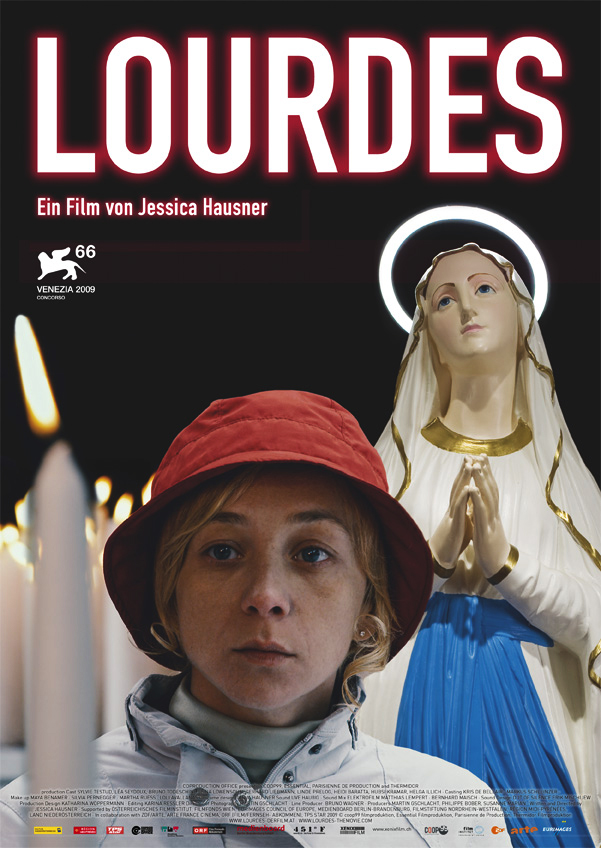
Lourdes

There are movies that just mesmerize you like this Jessica Hausner film that will absolutely mesmerize you in so many levels that will blow your mind watching the layered story, the astonishing images and most of all the amazing storytelling. I was really dubious if I should watch or not this film, but finally decided to just watch and mentally ‘prepare’ myself to whatever was going to see.

As film has so many layers, let me start by sharing the one that spontaneously got me inside this mesmerizing film. I was born Catholic and was baptized in a rush because died when I was days-old and well, came back as I’m still here; but after my religious fifteen-years-old mass, religion left my life. Still had time to learn a lot about Catholicism so the first and second thirds of this film was a true experience of reliving rites and beliefs that I chose to leave behind and my honest reaction was to nervously laugh at the absurdity –yet puzzling- reactions, rites, belief, faith, etc that people have at was have been called the “Disneyland of Miracles”. The last third marveled me with people’s reactions to the miracle. This is a brief summary with my reactions to one layer of this amazing film but there is another layer that I feel like sharing.

From a cinematic point-of-view the layer that I enjoyed most even above the ‘emotional’ voyage was the one related to an almost perfect film about religion that is not religious. This is an extremely well designed voyage into the nature of miracles very similar to films by Cavalier, Rivette, Bresson, Reygadas and most of all Dreyer’s Ordet, which Hausner confirms was her source of inspiration. Aesthetically film belongs to this group, but Hausner does something different when approaches the idea of miracles with a detached, quizzical eye; this is what makes this film not only really mysterious but extremely interesting to watch if you are or are not familiar with the Catholic Church rites, as honestly maybe the film first third will enlighten you with objective facts that happen at Lourdes. Is the first third of the movie what looks and feels like a Lourdes pilgrimage documentary but also has other layer that works as an introduction to Christine, brilliantly played by Sylvie Testud, with her perspective of everything she’s seeing and living.

Second third starts to explore the small group perspective about what they’re living and doing in this pilgrimage. Most amazing is the joke told by one member from the Order of Malta about Virgin Mary approving God’s idea to go to Lourdes, as she never has been there; this serves as an example of the wry humor found in this segment and sets the mood to many other pilgrims behavior we will watch.

Final third is the most astonishing exploration about human and Catholic Church reactions to a (possible) miracle, which specifically tells about needs and dissatisfaction's of film other characters. Here is where Testud performance becomes the true miracle when her facial expressions and body language tell and reflect absolutely everything that words don’t tell; before this moment Testud performance was marvelously done only with her face as she was paralyzed from her neck down thanks to multiple sclerosis.

Definitively there are more layers to this story that some consider ‘blasphemous’, others call it Buñuel-esque, while others saw a profound yet controversial religious sentiment, etc. To me was obvious that the ample range of opinions prove the deliberate ambiguity of this cinema masterpiece by Jessica Hausner.

How can a filmmaker do this outstanding film? Not really a surprise but I was glad to find that Jessica Hausner was Michael Haneke’s pupil and ‘script girl’ which easily explains (to me) her amazing ability to so objectively tell a story about what many tend to do very subjectively. Chapeau to this outstanding director that shows superb mastery even when is only her third film.

Yes the film absolutely blew my mind and is one that I strongly recommend as excellent cinema that I believe could profoundly engage many even when movie has a slow pace, not much dialogue, many silences (but some extraordinary music score moments like when Bach’s Toccata and Fugue plays or when Herr Jesu Christ plays which not coincidentally is the theme from Tarkovsky’s Solaris –and there are more moments where music score is totally integrated to narrative), and many, but many, mind blowing takes with absolutely beautiful framed scenes. Marvelous, marvelous, marvelous.

Have to close with a line that have to share with you all as according to me brilliantly resumes what this film is all about: “The mysteries of life (which some call God) may remain unknowable, but in Hausner’s remarkable film, the needs and doubts of mankind are made all too clear.”

A must be seen film for many that honor me visiting this blog.

Big Enjoy!!!

Watch trailer @MOC