Showing posts with label Germany. Show all posts

Wednesday, 22 June 2016

PODCAST 209: The Secret of the Black Widow & Nekromantik


This week the Horror Duo take their summer vacation to Deutschland to feast upon bratwurst and hearty German ales. Forest reviews The Secret of the Black Widow -- one of the many German crime (Krimi) films which predated the Italian Giallo. Cory reviews an indie film that has been and remains banned in several countries, Nekromantik.
CONTINUE READING

Monday, 15 June 2015

Fantastic Four: Rise of the Silver Surfer (2007)

Genre


Director


Country

USA | Germany | UK

Cast

Ioan Gruffudd, Jessica Alba, Chris Evans, Michael Chiklis, Doug Jones, Laurence Fishburne, Julian McMahon, Kerry Washington, Beau Garrett, Vanessa Minnillo, Andre Braugher, Stan Lee, Brian Posehn, Debbie Timuss, Moneca Delain, Kevin McNulty, Crystal Lowe

Storyline

As the Silver Surfer (Doug Jones, voiced by Laurence Fishburne) races around the globe wreaking havoc, Reed (Ioan Gruffudd), Sue (Jessica Alba), Johnny (Chris Evans) and Ben (Michael Chiklis) must unravel the mystery of the Silver Surfer and confront the surprising return of their mortal enemy, Dr. Doom (Julian McMahon), before all hope is lost.

Opinion

I did have really low expectations for this one, and it didn't disappoint me. While a little improvement on its predecessor, Fantastic Four: Rise of the Silver Surfer still is mediocre, dull, and a shame to the fantastic comic books.

As if letting Mark Frost write the script for the first film was a good idea, they called him back, and along with director Tim Story and screenwriter Don Payne, he did a bad job.
Although I like films to be faithful to the comic books, I tolerate some little differences or omissions. Unfortunately, in here, it is a huge problem. There is no backstory of Galactus - he is not even a character - and his servant, the Silver Surfer, has the power to destroy him. How ridiculous is that? Also, the Silver Surfer goes around resurrecting people. There is no explanation to the power swapping, the Torch can just swap powers with the others by touching them, and how the Torch manages to absorb everyone's powers, leaving them powerless, is a mystery.
And the villain for god's sake! Couldn't they come up with some other bad guy? Why did they have to bring Julian McMahon's awful Dr. Doom back?

Nothing exciting happens aside from the chase scene involving the Human Torch and the Silver Surfer. The visual effects suck. Mr. Fantastic looks fake most of the time.

The acting is bad as the rest. Ioan Gruffudd looks like some guy from a soap opera, and his accent still is bad. Jessica Alba is painful to watch. She is nothing more than a pretty face. And the chemistry between the two of them is inexistent. Chris Evans steals the show as Johnny Storm having the fortune to play the only character that evolves during the film. Michael Chiklis did a better job the first time. Julian McMahon is ok. Doug Jones and Laurence Fishburne do a good job as Silver Surfer's body and voice.


Saturday, 18 April 2015

The Lives of Others (2006)

Original Title

Das Leben der Anderen

Genre


Director


Country


Cast

Ulrich Mühe, Martina Gedeck, Sebastian Koch, Ulrich Tukur, Thomas Thieme, Hans-Uwe Bauer, Volkmar Kleinert, Matthias Brenner, Charly Hübner, Herbert Knaup, Bastian Trost, Marie Gruber, Volker Michalowski

Plot

In 1984 East Germany, Gerd Wiesler (Ulrich Mühe), an officer of the secret police, while conducting surveillance on writer Georg Dreyman (Sebastian Koch) and his lover Christa-Maria Sieland (Martina Gedeck), finds himself becoming increasingly absorbed by their lives.

Opinion

Danke, danke, danke für dieses Meisterstück! The Lives of Others is many things. It is a wonderful film, full of emotions and poetry. It is an example that must be followed by modern cinema, because it is possible to craft a magnificent film without special effects, violence and banalities. It is the kind of film what captures your attention from the first moment, and keeps you interested the whole time.

It is absolutely stunning to witness the process of transformation of Wiesler's character: he goes from being the bad guy, a slave of the system and enemy of freedom, to becoming a hero, a saviour. But why does the change happen? Is it maybe because of the reading of Brecht's poem? Or is it something else?

The music, stunning and heartbreaking, makes the final embrace between Georg, the writer, and his loved Christa-Maria look warm despite the tragic background.

However, the truly amazing part is that this is Florian Henckel von Donnersmarck's directorial debut and he manages to build such a fascinating and moving film.

Ulrich Mühe delivers a powerful an emotional performance. He is dramatically contained, as his character requires, but there is a lot in his bright eyes, the only part of Wiesler that's still alive. Martina Gedeck gives a great performance. 


Quotes

Georg Dreyman: You know what Lenin said about Beethoven's Appassionata, 'If I keep listening to it, I won't finish the revolution.' Can anyone who has heard this music, I mean truly heard it, really be a bad person?

Sunday, 29 March 2015

Inglourious Basterds (2009)

Genre


Director


Country


Cast

Brad Pitt, Christoph Waltz, Michael Fassbender, Eli Roth, Diane Kruger, Daniel Brühl, Til Schweiger, Mélanie Laurent, August Diehl, Julie Dreyfus, Sylvester Groth, Jacky Ido, Denis Ménochet, Mike Myers, Rod Taylor, Martin Wuttke, Gedeon Burkhard, B.J. Novak, Omar Doom, Léa Seydoux, Richard Sammel, Alexander Fehling, Christian Berkel, Söhke Möhring, Samm Levine, Paul Rust, Michael Bacall, Rainer Bock, Bo Svenson, Enzo G. Castellari, Samuel L. Jackson, Harvey Keitel

Plot

In Nazi-occupied France, young Jewish refugee Shosanna Dreyfus (Mélanie Laurent) witnesses the slaughter of her family by Colonel Hans Landa (Christoph Waltz). Shosanna narrowly escapes and flees to Paris, where she forges a new identity as the owner and operator of a cinema. Elsewhere in Europe, Lieutenant Aldo Raine (Brad Pitt) organizes a group of Jewish soldiers to engage in targeted acts of retribution. Known to their enemy as "The Basterds," Raine's squad joins German actress and undercover agent Bridget Von Hammersmark (Diane Kruger) on a mission to take down the leaders of The Third Reich. Fates converge under a cinema marquee, where Shosanna is poised to carry out a revenge plan of her own.

Opinion

The tagline says it all: you haven't seen war until you've seen it through the eyes of Quentin Tarantino. Inglourious Basterds is a brilliant, brave, exuberant, comic, dark, violent and glorious film.
Quentin Tarantino's pleasure to tell stories leads him to rewrite history, by telling the - fictional - assassination of Adolf Hitler, set in the only possible venue: a cinema.
The dialogue, the continuous tension, and the use of several languages - English, German, French and German -, on which irony is mostly based, make of this film a jewel of cinema. Also, the film is smooth and there is no heaviness resulting from its long running time.
The Spaghetti-Western score is magnificent, and the opening scene's song, The Verdict (Dopo la condanna), written by Ennio Morricone, is absolutely stunning.
The acting is pretty much great. Christoph Waltz is spectacular: he built a deep, detailed and realistic character, the kind of Nazi everyone would be afraid of. Brad Pitt's performance is not very good, and his Italian is pretty painful to be heard. August Diehl well plays the other sadistic German, very important in the final plot twist. Michael Fassbender is great as Lieutenant Archie Hicox, he has the chance to show off his almost perfect German, and he gets extra points for delivering the line, "There's a special rung in hell for people who waste good Scotch". 


Quotes

Lt. Aldo Raine: You probably heard we ain't in the prisoner-takin' business; we in the killin' Nazi business. And cousin, business is a-boomin'.

Bridget von Hammersmark: I know this is a silly question before I ask it, but can you Americans speak any other language besides English?

Rating

9.0/10

Thursday, 12 March 2015

Death at a Funeral (2007)

Genre


Director


Country


Cast

Matthew Macfadyen, Rupert Graves, Andy Nyman, Kris Marshall, Peter Dinklage, Keeley Hawes, Daisy Donovan, Alan Tudyk, Ewen Bremner, Peter Vaughan, Thomas Whatley, Jane Asher, Peter Egan

Plot

After his father passes away, Daniel (Matthew Macfadyen) arranges to contact their extended family and friends. Chaos ensues when a man (Peter Dinklage) tries to expose a dark secret regarding the dead patriarch of the family.

Opinion

Death at a Funeral is a brilliant black comedy, and one of the funniest ever made. I found myself laughing out loud pretty much the whole time. Director Frank Oz handles the different situations brilliantly. Writing Peter Dinklage's character was a fantastic move, since the character added lot of insanity to the situation. The cast of lesser known actors is assembled and delivers very well. 


Quotes

Daniel: Who is this?
Undertaker: Pardon me?
Daniel: That's not my father.
Undertaker: Oh shit, we've taken the wrong one.

Jane: Would you like a cup of tea, Sandra?
Sandra: Tea can do many things, Jane, but it can't bring back the dead.

Rating

8.5/10

Sunday, 21 December 2014

Run Lola Run (1998)

Original Title

Lola rennt

Genre


Director


Country


Cast

Franka Potente, Moritz Bleibtreu, Herbert Knaup, Nina Petri, Armin Rohde, Joachim Król, Ludger Pistor, Suzanne von Borsody, Sebastian Schipper, Julia Lindig, Lars Rudolph, Ute Lubosch, Monica Bleibtreu, Heino Ferch, Hans Paetsch

Plot
The film begins with Lola (Franka Potente) receiving a phone call from her boyfriend, Manni (Moritz Bleibtreu). During an important job, Manni collected 100,000 marks, but since Lola didn't shown up, Manni is forced to travel by subway but accidentally leaves the bad of money on the train.
Calling from a phone booth, Manni explains he has 20 minutes to gather 100,000 marks before Ronnie (Heino Ferch), his boss, arrives and kills him for not having the cash.
Planning to rob a nearby supermarket, Manni is urged to wait by Lola, who promises to find the money. She decides to ask her father (Herbert Knaup), who is a bank manager.
The main part of the film is divided in three runs. Each run starts from the same situation but develops differently and has a different outcome.

Opinion

Run Lola Run is one of the films symbol of the Post-Wall German cinema. The film fascinates from the very beginning. I was not expecting to see a 20 minutes story repeated 3 times with some differences but I didn't mind, it was never boring: I actually really liked it.
Frank Griebe deserves a special mention because what impressed me the most was the photography. The techno soundtrack, by Tom Tykwer, Johnny Klimek and Reinhold Heil, blends perfectly with the film.
There is one thing I asked myself throughout the film: why does Lola run? Franka Potente totally proved she can run well, but couldn't she just take a taxi?


Quotes

"We shall not cease from exploration. And the end of all our exploring will be to arrive where we started and know the place for the first time." - T. S. Eliot's Little Gidding


Rating


8.0/10

Monday, 1 December 2014

Rush (2013)


Cast
Chris Hemsworth, Daniel Brühl, Olivia Wilde, Alexandra Maria Lara, Pierfrancesco Favino, David Calder, Natalie Dormer, Stephen Mangan, Christian McKay, Alistair Petrie, Julian Rhind-Tutt, Colin Stinton, Jamie de Courcey, Ilario Calvo, Sean Edwards, Martin J Smith, Rob Austin, Tom Wlaschiha

Plot
James Hunt (Chris Hemsworth) and Niki Lauda (Daniel Brühl) are two highly skilled race car drivers who first develop a fierce rivalry in 1970 at a Formula 3 race at the Crystal Palace circuit in England. 
Hunt is a brash, young Englishman with a tendency to drink and vomit before every race, while Lauda is a cool, calculating Austrian technical genius who relies on precision.
After a falling out with his father, Lauda take a large bank loan and buys his way into the BRM - British Racing Motors - Formula 1 team, meeting teammate Clay Regazzoni (Pierfrancesco Favino) for the first time. Meanwhile, Hesketh Racing, the racing team Hunt drives for, enters Formula 1 as well. Lauda then joins Scuderia Ferrari with Regazzoni and wins his first championship in 1975.
In 1976, the fierce rivalry between Hunt and Lauda will reach the peak.

Opinion
As a Formula 1 fan, I already knew about the rivalry between the two of them, and, though I've only read about it, I was afraid the film could have been a disappointment: so it wasn't. Rush is a brilliant film that deserves to be watched at least once. 
Peter Morgan's screenplay is good, but it wouldn't be the same without the two stars of this film, Chris Hemsworth and Daniel Brühl, which portrayed Hunt and Lauda almost perfectly.


Quotes
A wise man can learn more from his enemies than a fool from his friends.

The closer you are to death, the more alive you feel. It's a wonderful way to live. It's the only way to drive.
Happiness is your biggest enemy. It weakens you. Puts doubts in your mind. Suddenly you have something to lose.

Rating
8.0/10

Sunday, 23 December 2012

Amour (Love)

First and foremost this is a Michael Haneke film, a 100% Haneke film very similar in almost every sense to his previous films. Yes there is love in this film but also there is illness and death. It's an extremely hard-to-watch magnificent oeuvre and know that as happens with all Haneke's films, each viewer will see what they want to see. The difference seems to be that this time many coincide in seeing love with some saying that is expressed with detachment and coldness. What all seem to agree is that is a great movie. I say no different, but then by now many of you know that I'm a HUGE admirer of master filmmaker Michael Haneke.

A very intense experience that crushed me into tears, exploded all kind of emotions in me and made me think about old age, illness and death, my own. After watching I experienced an intense sadness and took me days to overcome the feeling; but I'm grateful as was able to do an introspection into subjects that you tend to not think about, that tend to avoid. Yes, also saw love, the most realistic love I have seen in film, the one that celebrates qualities and defects, the one that exists when you are partners.

I'm so tempted to really dissect film but will stay out of it by saying that Haneke is as controversial as always with his excellent exploration on human dignity in the most difficult moments a person can live, when everyone wants to help the helpless, when outsiders have to help in the caring but for them is just work, when you see the person you have spend your whole life becoming ... a different being, but you still see that the person is still there, suffering. And all of the above applies to the ill and the caretaker.

This is a film so perfect that is impossible to talk about film as a film as you are absolutely overcome by what you saw, you felt and you are still thinking. You are overcome by images, performances, story and Haneke's mastery in filmmaking and storytelling. Still film is crafted very careful as much as a musician has to carefully interpret a masterpiece, with much work, much detail, much technique, much brain and at the same time with much feeling, much brilliance, and much emotion so those that hear the performance are moved beyond their self consciousness.

Some are talking about Haneke's rigorous, liberating unsentimental world view which I clearly understand what they are saying but absolutely disagree. I believe there is nothing unsentimental (or cold) in this and other Haneke's films as his work always make people feel something, make them think and make them to have "sentiments". Maybe he is very objective, his camera surely is, but unsentimental, no.

Subtle and moving performances by French cinema icons Jean Louis Trintignant and Emmanuelle Riva are breathless perfection with face expressions that say a lot more than what words say and sometimes contradict what they are talking reflecting the truth of the situation. Impressive. I am a huge follower of Trintignant and have seen almost all his movies, he has many where his performances are exquisite but in this "comeback" his performance has become one of the few that excel. Isabelle Huppert is magnificent as always in a role that is not like the ones she usually performs as she is not often only emotional in the screen.

Story is about Anne (Riva) and Georges (Trintignant), retired music teachers in their 80s, living in a handsomely furnished, book-lined Paris apartment; they are happy, affectionate, loving, active and content. We can hardly see them when they attend a concert (a magnificent scene where the concert audience is actually the film audience of unknowns) and see them coming back home to his life. One day Anne suffers a stroke, has a 95% success surgery and becomes one of the 5% unsuccessful cases. Everything changes for them and you know the end of the story as is the opening scene.

Filmmakers live from seeing his ideas materialized in the screen, perhaps that's their ultimate reward but they also live from recognition and viewers seeing their films. I believe this is Haneke's year and even when he already was honored with his second Cannes Palm d'Or for this film plus collected many more honors, is time the American Industry recognizes his immeasurable talent. This film deserves an Oscar (is Austria submission to foreign language category) and even a nomination in the Best Film category. Still, you never know with Academy members and its powerful influencers.

Truly believe that Haneke has to be seen in a very special mood, you have to prepare yourself to be surprised by whatever he selects to explore. No matter what you have read about story I strongly urge you to NOT skip this film, you only have to find the right moment to see it and you will have one of the most intense cinematic experiences of your life.

BIG ENJOY!!! PERFECTION!!!

Watch trailer @MOC

Sunday, 16 December 2012

Paradies: Liebe (Paradise: Love)

A movie that polarized audiences after the premiere in competition at 2012 Cannes with some highly disliking film and others highly liking film; but seems that no matter whether they like/dislike it, all agree that film is grotesque.

Was a bit concern about watching this film as Ulrich Seidl's previous film Import/Export was one that I stopped watching when couldn't take anymore whatever was happening in the screen. But to my surprise, this time his film was engaging and easier to watch even when I also consider film to be grotesque. Why? Mainly because he portraits "something" not often seen in any cinema.

Because of the story many relate this film to Laurent Cantet's Vers Le Sud (Heading South) but in my opinion films have the same story essence, sex tourism, however they are two very different films; so different that have to remind you that I did not liked much Cantet's film while I liked Seidl's "ugly" portrait more than whatever I imagined.

In this "ugly" sense I relate this film to Carlos Reygadas' Batalla en el Cielo (Battle in Heaven) that has some very "ugly" and grotesque scenes; the basic difference is that Reygadas shows us a man with a younger woman while Seidl shows a woman with younger men. The not often seen "something" that Seidl shows in an almost documentary style are the many scenes with naked older, overweight women, which obviously many tend to consider "ugly" as doesn't fit contemporary and mainly cinema standards of "beauty". So perhaps now you will understand better when I say that this is not an easy to watch film for most general audiences as they are not used to watch "ugliness" in the screen.

There you have it, I said it as clear as I can. So with this issue out of the way, let's talk about the movie.

On the surface Paradise: Love tells the story of a flabby, divorced, lonely 50-year-old woman, Teresa, that for her milestone birthday goes to a beach paradise in Kenya looking forward to indulge in what a friend told her she will find there: sex. But with what seems like naiveté she was expecting more love than sex, more caring about her than plain physical contact, which obviously she will not find at a place with young men living out from the "white mamas". She was expecting love and was not able to play the sex-game. But film is more complex and layered than the surface story mainly because Seidl's storytelling/filmmaking style that show us scenes that contain what could be considered as humiliating, racist, blur between exploited/exploitation which recalls colonialism and more.

Film is visually outstanding, especially in indoor scenes, with fantastic use of color, light and very detailed static compositions; some definitively inspired by paintings, like one scene that absolutely recalls Manet's Olympia. Fantastic as absolutely eases whatever we are watching in screen. Then narrative is rooted in improvisation which along with some camera takes gives film the almost documentary style where film purpose is to document situations more than telling a story. But let me be clearer, there is a story here; a story that deals with complex emotional truths about sadness, cruelty and the search of happiness. Last, this is the best example I have seen that clearly illustrates the now famous "Ulrich Seidl Method".

Film tells only Teresa's perspective, so don't expect to see development in any other character played by actors and non-actors; but Margarete Tiesel (Teresa) performance is outstanding in every sense, from carrying on the entire film to what many non-European viewers/critics comment, daring to undress in the screen. The last comment I consider very superfluous and tied to their "beauty" and/or what is acceptable to be shown in the screen concepts; but include it as yes, I was caught off guard the first time she was in any state of undressing, but honestly soon enough I forgot about it. That's how good Tiesel performance is.

Absolutely understand why this film was in competition at 2012 Cannes, understand why audiences are polarized and definitively understand that film is NOT for general audiences. My best reference to recommend watching the film is that if you saw Reygadas' Battle in Heaven and the grotesque scenes did not bothered you, then maybe you will enjoy this film as much as I did.

Film is the first installment of a trilogy called Paradies (Paradise) about three women form one family (you will see them together at the beginning of this movie) with one exploring Love, another Faith and the last one Hope. Paradise: Faith, the second installment about Teresa's sister, was premiered in 2012 Biennale to "better" reviews and the last one, Paradise: Hope is about Teresa's daughter that somehow I imagine will premier at a major 2013 festival. Yes, I'm looking forward to the next installments but truth is that the first is a film that I could watch only once, so no Paradise marathons for me.

Enjoy!!!

Watch trailer @MOC

Wednesday, 31 October 2012

Barbara

While waiting to be able to see movie, completely forgot about plot and I'm really glad this happened as believe that when you know nothing about story the experience with this movie has to be different than when you do. Since I feel that you should go virgin to the story, I'm forced to not analyze anything about this layered story that could touch you in many levels if you are willing to peel the layers and enjoy the slowly built slight tension that director Christian Petzold masterly impregnated to his film.

I met Petzold with his puzzling Gespenster (Ghosts) and while found film strange -especially for a lesbian interest film- I was highly impressed with his filmmaking and storytelling style. Then saw Yella, another strange movie that absolutely captured my interest as a darkish but very intellectual exercise. Then came Barbara a film that I found not strange at all and perhaps it's Petzold's most accessible film of all I have seen but know that many will find the pace extremely slow, especially Academy members that will see film as is Germany submission to 2013 Oscar.

Pace is so slow and narrative evolves so slow, that is inevitable for viewers to start wondering what is happening here. If you are patient soon you will start to uncover clues to where they are, what time-period story is set, who is Barbara, why she is harassed and why she end up there. But if you blink while watching there are chances that you could miss the clue. Still I believe that Perzold's storytelling style is so interesting that even if you cannot identify any of the above because you are captured by only the evident narrative, you could still enjoy the film that will motivate you to fill the gaps as you wish. To me this is amazing and is the reason why I suggest you see movie without knowing about the plot.

Then film is so good that after watching once and learning what movie is about you could go back and watch again to surely uncover many more layers to film and story. I bet that some will see a different story than the one you imagined the first time. Still the message will or could be the same, what is to live under very difficult circumstances and still be able to behave like a human being. Is all about trust.

Impeccable warmish cinematography -different to Petzold's usually cold visuals- plus an outstanding performance by Nina Hoss that delivers a great -but very slowly- transformation in front of our eyes, from cold and misanthropic to a warmer more living woman that cares no matter the damage she has endured. Truly impressive and a strong reason to make this movie must be seen.

Film premiered in competition at 2012 Berlinale to great reviews in German press, not so in other languages, and while traveling the fest circuit has collected more honors but none like the ones collected in German awards where Petzold got the Silver Bear for Best Director at the Berlinale, Film Award in Silver for Outstanding Feature Film at 2012 German Film Awards and Jasna Fritzi Bauer (Stella) won the New Faces Award for Best Actress. The above makes me think that film perhaps is "too German" for world audiences but if you are familiar with Petzold work I know that movie has to be must be seen for you and surely will enjoy this film that is both about the voyage as the destination.

Have seen it twice, have seen two different stories, maybe will see it again and surely will discover more; but what blew my mind the most, first and second time, is the amazing Nina Hoss performance, truly mesmerizing and in my opinion, superior to highly awarded Yella performance.

Enjoy!!!

Watch trailer @MOC

Sunday, 23 September 2012

Fraulein - Ein Detusches Melodram

The last made for TV movie by Michael Haneke before doing his first big screen film (later he did two more made for TV movies) is a film that honestly really confused me. My first spontaneous reaction was that this movie does not fit what I have in my head regarding Haneke as to me film looks and feels quite normal. Yes found film to be similar to several European movies from those years (the eighties) and before, as film is set in the near past, post-WWII and there was nothing I could find that told me this was a Haneke film. Sigh. But that doesn't mean at all that I didn't enjoy watching this unusual melodrama, a film that to enjoy it you have to really recall many movies, some cinema history and some WWII history, I'll explain later.

Then I started to read about this movie and what follows is a mix of what I read and what I saw in film. Let's start by sharing that this film is considered by some cinema academics as the "response" to Rainer Werner Fassbinder's Die Ehe der Maria Braun (The Marriage of Maria Braun) and perhaps it is as definitively this film looks like what Haneke said: "a deliberate attempt to create a counter-film against the heroizing of German postwar mentalities". In this film the lead role Anna, played by Angelica Domröse, is more concerned with her life and the inconveniences that came when his husband, believed to be dead, suddenly returns to the small German village; which is very different than the patriotic view that predominated in post-war set German cinema. I don't really remember Fassbinder's film as saw it a very long time ago, but maybe will see it again to see with my own eyes the two films relationship.

Nevertheless from what I read, what got my attention is that cinema academics claim that with this film Haneke "overcame" his Fassbinder "obsession". If factual, then we have to thank this film that helped Haneke to develop his own particular master style.

As mentioned film tells the story of Anna, who has a good life 10 years after her husband, Hans, became a POW in Russia. Film starts with Hans family discussing that is time to declare Hans dead, Anna's refusal and showing us how happy life was for this family in this sleepy German village. Anna has two teenage children, works/owns a movie theater and has a companion, Andre, who is accepted by all her family, including her in-laws. Everything changes when she gets a letter from the association of war returnees, telling her that Hans is returning home. Not a bad story, even when only seen in the surface, without analyzing the movie clips, the historic events and news seen in the movie theater and other screens.

If something I discovered after reading about film is that film is complex, very complex. To me contemporary Haneke's films have been quite easy to decode, but this one was not, even when I'm familiar with many -not all- the movie clips and other elements shown in film. Maybe now that I learned so much about this movie I could watch it again to decode all elements; so, I do recommend you read as much as possible about this movie before watching as surely will help to enjoy more film. Unlike previous Haneke's TV movie I posted, this film has many references and analysis that you can easily find in the net.

Spontaneously film as a film bothered me a lot because editing which I found intrusive instead of explanatory, which is not at all how contemporary Haneke's films are. But film has many absolutely beautiful compositions that are truly visually stunning and yes, is a black and white film that only at the end, for a few minutes, becomes full color.

Would I be talking like the above if film was not a Haneke film? No, probably not; but it is a Haneke film and had to learn more about film before writing and yes, surely will watch film again but have to wait a while as watching two Haneke's films in one day was too much, I knew it but couldn't resist watching. Sigh.

If you enjoy Haneke's contemporary work then this film is must be seen for you but as mentioned, suggest you read about film before watching; if you enjoy classic European melodramas then I know you could also enjoy this film.

I'm still amazed that this is a made for TV movie (German TV) as definitively does not look or feel like that; film looks and feels like big screen movies from the seventies and eighties, like many films from great French, Italian, and German directors. Truly surprising as before watching these two Haneke's films perhaps the best TV related film was 1989 Dekalog miniseries; but have to admit that I haven't seen Fassbinder's made for TV movies. If you wish to see film, use the link provided in previous Haneke's made for TV movie post.

Enjoy!!!

Friday, 17 August 2012

Mr. Nobody

Sometimes I make really bad decisions. Deciding to skip this film was one of them. I don't like the genre (fantasy/sci-fi), cast -especially lead- did not appeal me and most confusing, an European/Canadian production in English. So I forgot about it even when film did quite good in the 2009/2010 festival season. Big mistake.

This Jaco Van Dormael film is visually stunning, excellent production values, especially fabulous special effects; but what really blew my mind was the story. Then story is told with nonlinear narrative so well-told that have to mention the outstanding editing, that in my opinion and in this case, absolutely facilitates "understanding" the evident plus the not-so-evident chaotic story. Yes movie and story is chaos, fantastic, beautiful-to-watch, engaging and food-for-thought chaos. Last, is impossible not to notice the fabulous soundtrack with recognizable songs/music placed at the right moments to ease all the turbulence you're watching. Bravo! Truly an out of the ordinary cinematic experience.

So after pouring out praise for the movie as a movie let's plunge into the outstanding story written also by Jaco Van Dormael. One word of advice, if you have not seen the movie please stop reading as what follows has inevitable spoilers.

The evident story -told here in a linear way, which is NOT how you will see it in film- is about Nemo, who as a boy has to make a hard choice, a choice that allows the filmmaker to explore two different outcomes. One storyline follows Nemo going with his mother, in the other he stayed with his father. Then no matter the path he follows, narrative is anchored in how Nemo interacts with three women: Anna, Elise and Jean. Add that story spans for about 118 years as "ends" in the year 2092 where the "last mortal" is about to die in live television, which is actually the beginning of the movie and story, where a very old man called Mr. Nobody (Jared Leto) -he doesn't remember his name- tells his story to a reporter. So by now you can say that this story is about parallel lives and is all about choices as in each of the two paths you will find more choices that will split story further. Confused? As far as I read, many viewers stay with this story and end up confused; nevertheless, I found this story fascinating as also is peppered with young Nemo fantasy hammered into an old typewriter while you're able to see it portrayed in the screen. One of the few movies where I find "evident" story to be as good, complete, sufficient and fascinating as the "other" story.

But to me what makes film and story outstanding is that this complex story goes well-beyond the choices/consequences and parallel lives themes. There are a few films that have explored one or the two themes and perhaps one of the best choices-theme film is Tom Tykwer's Lola Rennt (Run Lola Run) while Peter Howitt's Sliding Doors represents well the parallel lives theme. Also and even if film is about dreams I believe that Christopher Nolan's Inception not only looks and feels like this movie but also shyly travels similar themes. But what distances Van Dormael film and story from these and other similar movies is that story is deeply rooted in science. So, if you recall (or as a recall-aid pay particular attention to one adult Nemo) your knowledge about several real mathematics, time, and more theories, film story not only uncovers more dimensions but becomes eerie, unsettling and well, philosophical. Then, for me, movie and story transforms from fantasy into possible reality. Amazing and absolutely out of the ordinary. I simply LOVE what I call the "other" story and definitively the merging of both stories makes film quite an intense emotional, yet very brainy, playful ride, being playful the key word.

I could write pages about story and movie production values, but is enough to give a brief idea of how impressive is Van Dormael imagination as a writer but also as a filmmaker that so successfully and amazingly dealt with such a complex story.

Casting and performances are also outstanding and surely is the best I have seen from Jared Leto; but young and adult actors perform quite well as they disappear into their roles and do not interrupt narrative flowing; well, there is one exception. Sarah Polley's character and role perhaps is the most disturbing with her bipolar disorder and she makes it more disturbing with her performance, she's really good performing disturbing characters. Polley (adult Elise) in the screen was the only character that for me interrupted the amazing narrative but was a positive yet disturbing interruption. Kudos to Toby Regbo (Nemo age 15), Juno Temple (Anna age 15), Rhys Ifans (Father Nemo) and less impressed but was good casting, Diane Kruger (Anna adult).

Obviously I recommend movie but not sure if general audiences will enjoy it as this movie first and foremost is an European production with a style that mixes successfully a few European non-commercial styles plus a bit of American commercial style. So if you haven't seen movie yet because you decided to skip it, like I did, suggest you contemplate watching and maybe you will be as surprised as I was.

Big Enjoy!!!

Watch trailer @MOC

Saturday, 7 May 2011

Una Vita Tranquilla (A Quiet Life)

Exactly my kind of movie thanks to great camera takes, nice outdoor/indoor framing, very good slowish pace that slowly very-slowly builds tension, and most of all an amazing performance by incredibly good Toni Servillo. It’s truly spectacular to watch this amazing actor that in this role has many moments where he speaks with facial expressions and particularly superb scenes where he says everything with his eyes.

A thriller by Claudio Cupellini that tells a very common story seen/told innumerable times but as someone said: never like this. It’s true never like how is told here but again is Servillo who makes story very fresh, almost like new. An ex-Camorra escapes his life of crime by faking his death while traveling from Naples to Germany where years after –now- has a wife (Julianne Köhler) and a nine year old son, is a chef that owns a popular restaurant and has a quiet life. But he gets the visit of two young Camorra hit men and as you can easily imagine, the past becomes Rosario Russo (Servillo) present and everything goes awry.

Almost told you the entire story, but is so common that is not guessing what will happen next (I did guess right) is watching how everything evolves and most of all how Servillo conducts the narrative with extraordinary ease allowing you to get inside the movie, like if you were there near him, watching him and living/feeling everything he’s living and feeling. Truly amazing and spectacular performance as good as … almost everything else he has done. What an exhausting cinematic experience, but very gratifying.

Cupellini’s film has above the norm tech specs with special mention to photography and one particular scene where Servillo is inside his car, we are outside, is raining, we can hardly see his face through the glass BUT we will know everything that he’s feeling by watching a slight movement in is left eye. Superb!!!

Was thinking that honestly this is a superior movie to the one submitted to the Oscar and wonder why was not chosen. Anyway the movie was in competition at the 2010 Rome fest where Servillo won the Best Actor award and believe me the honor is more than well-deserved.

Strongly recommend this movie that because the story I’m sure men will like it; but this movie is for adult audiences that enjoy excellent performances by Toni Servillo in a movie that’s a true example of good European cinema.

I’m still thinking about the movie, about what Rosario felt, about how sometimes the past becomes your present and always is not for good. Like the movie, but love Toni Servillo.

Enjoy!!!

Watch trailer @MOC

Saturday, 23 April 2011

Largo Winch II (The Burma Conspiracy)

After my positive entertaining experience with the first Largo Winch I was looking forward to the sequel hoping to have a good escape moment again with this French comic-to-screen character that looks and feels so human which is refreshing for a change from typical Hollywood movies. But this time I did not enjoyed the film that much as in my opinion this film lacks many key entertaining elements that were present in the first installment, including the story, the amazing locations, the cinematography, the action, the car chases with the WOW cars, the “normal” fights, a remarkable evil character -like Kristin Scott Thomas character in the first- and yes, the raw sex scenes typical of French cinema.

Still have to admit that Tomer Sisley again had a good performance which helped me to watch until the end and most surprising was to see Sharon Stone looking good in the big screen and yes, in that scene with the white dress that absolute recalls her most famous film. Have to share that during her scenes I was looking at her lips and to my surprise seems like she was speaking French, but there were some moments where I could tell she was not; still according to Sisley, Sharon Stone speaks good French and that’s news for me (LOL!).

Seems that I was more interested in finding if Stone really speaks French than following the story that starts with Largo being W Group’s CEO and on the very day he announces his intention to sell his corporation and use the proceeds to create a humanitarian foundation, he’s accused by the United Nations of crimes against humanity. To prove his and his deceased adoptive father innocence he will retrace the steps of his past three years, which will take us mainly to the Burmese jungle. According to what I read this time producers decided to create an original story while keeping some of the graphic novels characters; surely because of this decision, story ended up being a lot less interesting and entertaining.

To watch only if you wish to see Sharon Stone speaking (?) French and looking a lot better than in her previous films; but if you skip it won’t be missing much.

Enjoy.

Watch trailer @MOC

Sunday, 9 January 2011

La Solitudine dei Numeri Primi (The Solitude of Prime Numbers)

Not an easy movie to watch or understand but is a movie that will stay with you for a long, long time. Stayed so long in me that I decided to read the book by Paolo Giordano and I did. Can’t recall the last time a good movie made wish to learn the original story, but after reading some viewers and critics’ reviews I knew I had to read the book. It’s a very unusual and remarkable love story, both in the book as in the movie; but they’re a bit different as writer and co screenwriter Paolo Giordano didn’t want the movie to be the same as the book, according to what I read.

Story premise is based on the following:

“Prime numbers are divisible only by 1 and by themselves. They hold their place in the infinite series of natural numbers, squashed, like all numbers, between two others, but one step further than the rest. (…) Among prime numbers, there are some that are even more special. Mathematicians call them twin primes: pairs of prime numbers that are close to each other, almost neighbors, but between them there is always an even number that prevents them from truly touching. Numbers like 11 and 13, like 17 and 19, 41 and 43”. Excerpt from the book, Chapter 21, In and Out of The Water, 1998

As the above arid mathematic explanation, the also arid –yet remarkable and disturbing- story is about Alice and Mattia that since they met when they were kids there was something that prevented them from truly touching. They were like twin primes. But they were also damaged for life with events both kept secret and that happened when they were little kids, long before they met. In the book the story is told chronologically telling what happened in 1983, 1984, 1991, 1995, 1998, 2003, and 2007; the film also tells story from the same years but is not told chronologically, so scenes move back and forth in time which at the beginning confuses but soon enough you start to follow the entwined basic four stories: when Alice and Mattia are kids, teens, young adults, and adults. You have to watch the movie to learn more about the story because I already told you too much, but I believe what I told you are the basics to not get too lost while watching the movie; not get lost but still be puzzled, wondering what’s going on, what comes next, as I believe director Saverio Costanzo chose to tell story with a very unconventional and impressive storytelling technique.

I liked the movie but definitively wanted to know more about story as I got the impression things were left out. To my surprise not much was changed especially when Alice and Mattia are kids and teens; story starts to be a bit different when they’re young adults and adults plus the end in the film is ambiguously positive, while in book is not positive. In my opinion the “disturbing” story in film was toned down in detriment of really understanding what this love story was all about in film. But still I highly recommend this movie that absolutely is not for general audiences, this is for those that like their films to make them think a lot while watching non-pleasant things constantly happening, all done with very beautiful to watch visuals and attractive actors.

Just for information purposes, in the book there is a character that’s gay, Dennis who’s teen Mattia’s school friend. In film they changed the gay character into a “sort of” lesbian character, Viola is teen Alice school friend who kisses her once only to Alice developing a crush on her; Viola kisses her twice and absolutely behaves as she’s jealous when Alice ends up with Mattia. Quite nice to watch.

A story like this could not be told without good and intense performances by young and mature actors; I was absolutely impressed with the outstanding performance by Alba Rohrwacher (I like this actress more and more) but more with her physical change as Alice is anorexic and Rohrwacher lost so much weight to interpret adult Alice that looked disturbingly unhealthy. Also with impressing performances Arianna Nastro who plays Alice as a teen, Luca Marinelli as young/adult Mattia and none other than Isabella Rossellini in a too-short performance as Mattia’s mother.

I do recommend film but as mentioned I know that’s not for everyone, this is a movie beyond extremes as either you will watch it completely and story will not leave you for a long time, or you will stop watching. If you haven’t read the book I suggest you to follow my experience and watch film then read the book; I’m sure reading the book will enlighten you in the dark mind of Paolo Giordano, a real-life physicist that wrote his first novel only to win Italy’s premier literary award, the Premio Strega.

Enjoy!!!

Watch trailer @MOC

Friday, 22 October 2010

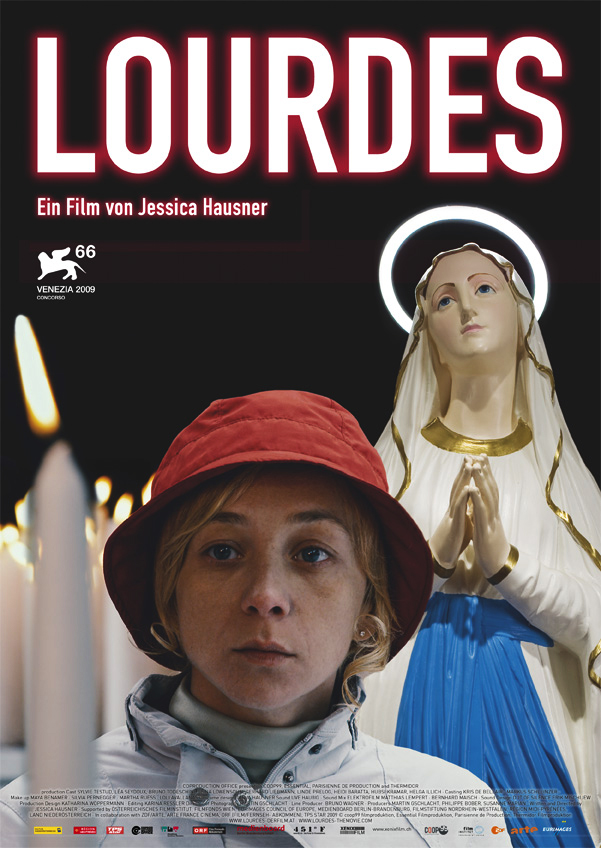
Lourdes

There are movies that just mesmerize you like this Jessica Hausner film that will absolutely mesmerize you in so many levels that will blow your mind watching the layered story, the astonishing images and most of all the amazing storytelling. I was really dubious if I should watch or not this film, but finally decided to just watch and mentally ‘prepare’ myself to whatever was going to see.

As film has so many layers, let me start by sharing the one that spontaneously got me inside this mesmerizing film. I was born Catholic and was baptized in a rush because died when I was days-old and well, came back as I’m still here; but after my religious fifteen-years-old mass, religion left my life. Still had time to learn a lot about Catholicism so the first and second thirds of this film was a true experience of reliving rites and beliefs that I chose to leave behind and my honest reaction was to nervously laugh at the absurdity –yet puzzling- reactions, rites, belief, faith, etc that people have at was have been called the “Disneyland of Miracles”. The last third marveled me with people’s reactions to the miracle. This is a brief summary with my reactions to one layer of this amazing film but there is another layer that I feel like sharing.

From a cinematic point-of-view the layer that I enjoyed most even above the ‘emotional’ voyage was the one related to an almost perfect film about religion that is not religious. This is an extremely well designed voyage into the nature of miracles very similar to films by Cavalier, Rivette, Bresson, Reygadas and most of all Dreyer’s Ordet, which Hausner confirms was her source of inspiration. Aesthetically film belongs to this group, but Hausner does something different when approaches the idea of miracles with a detached, quizzical eye; this is what makes this film not only really mysterious but extremely interesting to watch if you are or are not familiar with the Catholic Church rites, as honestly maybe the film first third will enlighten you with objective facts that happen at Lourdes. Is the first third of the movie what looks and feels like a Lourdes pilgrimage documentary but also has other layer that works as an introduction to Christine, brilliantly played by Sylvie Testud, with her perspective of everything she’s seeing and living.

Second third starts to explore the small group perspective about what they’re living and doing in this pilgrimage. Most amazing is the joke told by one member from the Order of Malta about Virgin Mary approving God’s idea to go to Lourdes, as she never has been there; this serves as an example of the wry humor found in this segment and sets the mood to many other pilgrims behavior we will watch.

Final third is the most astonishing exploration about human and Catholic Church reactions to a (possible) miracle, which specifically tells about needs and dissatisfaction's of film other characters. Here is where Testud performance becomes the true miracle when her facial expressions and body language tell and reflect absolutely everything that words don’t tell; before this moment Testud performance was marvelously done only with her face as she was paralyzed from her neck down thanks to multiple sclerosis.

Definitively there are more layers to this story that some consider ‘blasphemous’, others call it Buñuel-esque, while others saw a profound yet controversial religious sentiment, etc. To me was obvious that the ample range of opinions prove the deliberate ambiguity of this cinema masterpiece by Jessica Hausner.

How can a filmmaker do this outstanding film? Not really a surprise but I was glad to find that Jessica Hausner was Michael Haneke’s pupil and ‘script girl’ which easily explains (to me) her amazing ability to so objectively tell a story about what many tend to do very subjectively. Chapeau to this outstanding director that shows superb mastery even when is only her third film.

Yes the film absolutely blew my mind and is one that I strongly recommend as excellent cinema that I believe could profoundly engage many even when movie has a slow pace, not much dialogue, many silences (but some extraordinary music score moments like when Bach’s Toccata and Fugue plays or when Herr Jesu Christ plays which not coincidentally is the theme from Tarkovsky’s Solaris –and there are more moments where music score is totally integrated to narrative), and many, but many, mind blowing takes with absolutely beautiful framed scenes. Marvelous, marvelous, marvelous.

Have to close with a line that have to share with you all as according to me brilliantly resumes what this film is all about: “The mysteries of life (which some call God) may remain unknowable, but in Hausner’s remarkable film, the needs and doubts of mankind are made all too clear.”

A must be seen film for many that honor me visiting this blog.

Big Enjoy!!!

Watch trailer @MOC

Sunday, 29 August 2010

Ajami (عجمي‎ - עג'מי‎)

Soon we will learn Israel's submission to the Oscar and if is anything alike to last year submission and Oscar nominee, will have to watch it immediately as the debut by Scandar Copti (Palestinian born and raised in Ajami) and Yaron Shai (Jewish Israeli) is an amazing film that from the very beginning up to the end grabs your attention and won't let it go, not even for a second, not to think twice what's happening, not to analyze a thing; the film is one non-stop ride into the a slice-of-life of some characters presented not in chronological order, with the story moving back and forth, plus re-telling from a different point-of-view, until all stories merge in one point and it's the end. Amazing, truly amazing especially because you will not see violence (when everything is violent), you'll not see political statements or something in particular besides what could be normal life in an impoverish neighborhood with a melting pot of cultures and conflicting views among Jews, Muslims and Christians.

It's a story that looks and feels so real, but the way is told is what makes this film a cinematic experience in storytelling, hard, very-hard to believe that is the debut film of two young directors (and screenwriters), as shows great storytelling mastery with amazing narrative and especially the awesome cinematic language that fast involves you and doesn't let you go until the very end. Fantastic.

It was such an intense one long sigh voyage that when the film was over I had to stop my mind and review the whole film -in my mind- to really grasp everything that I watched for the past two hours; not the story, but the visuals and the amazing editing that creates an unique -and very compelling/involving- storytelling style. Absolutely a must be seen film that I hope many have already seen by now.

As brief as possible here is a plot summary, the story is narrated by young Nasri and tells about his older brother Omar fighting a criminal vendetta against his family. Omar is Muslim and in love with Christian Hadir, his boss daughter; the boss Abu Elias owns a restaurant where Omar and illegal immigrant Malek work. Malek is desperately trying to make money for her mother's life-saving surgery. Dando is a Jewish police officer obsessed with finding his missing brother and last, Binj a Palestinian dreaming of a future with his Jewish girlfriend and played by none other than Scandar Copti. Most -if not all-characters are played by non-actors, which absolutely adds to the realistic look of the story and film.

The film collected many honors including Special Mention Camera D'Or at 2009 Cannes, winning the top awards at 2009 Ophir Awards, and being one of the five Oscar nominees in the Best Foreign Film category.

Strongly suggest you don't skip this movie that I know will watch more than once as I have to understand -more- the amazing storytelling style.

Enjoy!!!

Watch trailer @Movie On Companion

Thursday, 26 August 2010

Die Fremde (When We Leave)

An excellent film by Feo Aladag that is very disturbing film especially for westerners who have in their various cultures, customs and traditions nothing similar to what is shown here. I learned a new word thanks to this movie, Namus and to share with all here is the etymology.

The Arabic word "nāmūs" (ناموس) may mean "law", "custom", or "honor". The Hebrew words "nmūs" (נמוס) or "nūmūsā" (נומוסא) again means "law". The Ancient Greek word "nómos" (νόμος) meaning "law, custom".

And here is the context.

For a man and his family, namus, among other things, may mean sexual integrity of women in the family, their chastity in particular. On the other hand, the man has to provide for his family and to defend the namus of his house, his women in particular, against the threats (physical and verbal) to members of his extended family from the outer world.

Namus of a man is determined by namus of all the women in his family (i.e., mother, wives, sisters, daughters). In some societies, e.g., in Pashtun tribes of Afghanistan, namus goes beyond the basic family and is common for a plarina, a unit of the tribe that has a common ancestral father.

For an unmarried woman, the utmost importance is placed on virginity before marriage, and "proof of virginity" in the form of bloodstains on a bed sheet is required in some cultures to proudly demonstrate after the wedding night. Professor of sociology Dilek Cindoğlu writes: "The virginity of the women is not a personal matter, but a social phenomenon".

In the Middle East, for a woman, namus is in obedience, faithfulness, modesty (in behaviour and in dress), "appropriateness".

If you want to learn more about Namus I suggest you check wikipedia here.

Why am I talking about Namus? Because that's what the story in this movie is all about and I wished I knew about this concept before watching the film as I know would have make it a lot easier to watch, as without knowing it became almost unbearable to watch such (to me) absurd behavior in women, brothers, father, mother, siblings, etc especially in the times that we are currently living. I took it like a cultural behavior, but now I know is more than that, more than Turkish 'traditions' and the story, as well as the film, became completely different in my mind.

Excellent production values plus extraordinary performance by Sibel Kekilli makes this film totally a must be seen for every woman in the world (men too) as shows the struggle that some women have to live when they want something different for them and their children while trying to keep one of the basic life elements, family, intact.

The film tells the story of Umay (Kekilli) abused by her husband she flees Turkey with her little son and goes back to her family in Germany. Her family gives her a chilly welcome as they realize she's doing something forbidden, leaving her husband. Eventually she has to leave her "home" as the family wants to return her son to the "true owner", the father in Turkey and ends up in German protection services, who ask her not to be in touch with her family at all. But that's not easy for Umay, she needs her family. As the story unravels you will never suspect the ending, unless you learn more than what I told you about Namus.

Strongly suggest to learn about Namus before watching this film that absolutely is a must be seen. This is not a film to enjoy, but to keep the ratings system I'll will close with it. I believe that this is a film to learn something many of us westerners are totally unaware of. The film won the Label Europa Cinemas award at 2010 Berlinale and got many nominations in the 2010 German Film Awards (Lola's) including Best Director to Feo Adalag, who was better known before as an Actress but her directorial debut assures her the transition to great storyteller and filmmaker.

Enjoy!!!

Watch trailer @ Movie On Companion

Saturday, 5 June 2010

Carlos

Many times having expectations is not really wise as it's almost impossible than a movie made-for-TV could satisfied them, much less if is a miniseries in three installments not shown one day after another but one week after another. Still, I really appreciate and are grateful to my friends from France for allowing me to watch my first Cannes 2010 film. No, Carlos was not what I expected, as a very long biopic I find it acceptable and definitively has its moments but they are not many.

The story smartly skips his youth and the first part has Carlos in Paris starting to be active in his maybe then revolutionary quest and goes up to days before the OPEC incident. Starts slowly and not very interesting to follow, but suddenly it becomes really intense! I got so excited with the first part that got my expectations even higher.

Part two, starts with OPEC incident which was not that exciting especially after the buildup of part one. Continues with him being kicked-out of the PFLP and forming his own group. By now he's a media icon and a well-known -I should say- 'mercenary' that will work for many that opposes imperialism. Perhaps the last part of the story of this second installment was lesser known to me, so I got interested in learning how and why he ended up working for Syria.

Part three is his slow decline up to his arrest in Sudan which as a story is less interesting, but has its moments when the group goes violent in Paris trying to liberate their imprisoned colleagues.

My take away from what I saw in the story is that Carlos became a 'mercenary', but truth or not, what impresses is how he was able to do everything he did -most of which today is impossible- and who backed up him in the different decades. As a movie has top notch production values, good slow pace at times and fast action pace at the adequate moments; performances are above average for main characters and the many other actors with secondary roles. No complaining at all with the film tech specs that are well above for a film made for television.

So what exactly was missing for me? A more compelling and engaging storytelling, both visually as well as narrative. But definitively has its moments when is intense, compelling and engages you with whatever is happening.

When I finished watching the last installment my honest thought was that the two Mesrine films were a lot more compelling and engaging. Surely Mesrine does not have all the important characters Carlos has, but the style was more exciting to watch with a roller-coaster of contradictory emotions felt for the main character and everything they show. Except for the last half of the first part, Carlos was flat and didn't engage me with feeling any kind of emotions for the main character, other characters, situations or the story in general. It was like watching a impassive factual series of -real- events film.

I strongly suggest to see this film with no expectations and if you are lucky enough not to know Carlos story I imagine you will enjoy more this vision by Olivier Assayas. Right now I do not think I'll watch the shorter 2 1/2 version, but maybe I will when it comes to cable. By the way I saw the French dubbed version, which maybe it didn't help much to engage me as dubbing is always bad; consequently I strongly suggest you to watch Carlos in the original languages with subtitles in the language of your choice, perhaps this way will be a little bit more engaging.

My 2010 Cannes experience does not start well, but I hope two or three films will change my experience for the more positive.

Enjoy.

Watch trailer @ Movie On Companion

Monday, 15 March 2010

Sherlock Holmes

I definitively enjoy Robert Downey Jr. performances and in this movie I like it for a long while, but then it became too much Downey Jr. and much less a character especially when you think that the character is none other than Sherlock Holmes. I knew before watching that this Sherlock film was going to be different and gee, it was. Seeing Jude Law as Dr. Watson was fun for a while, but then the character became sooo secondary and boring that made me think that the 'real and immortal' Dr. Watson was more interesting.

I blame the director. No, I'm not a fan of Guy Ritchie films and even if this film had some interesting special and visual effects most looked like that: effects and were quite distracting from whatever was going on. Fights were too long for me, perhaps I'm not the target but if is a "hero" film you know who's going to win the fight before hand, so unless there is interesting choreography it becomes very boring.

The effect that I did enjoyed best is when they show Holmes future logical deductions, that was quite interesting and when he does what he thinks in fast camera, the fighting makes a lot more sense. But in general I was disappointed with this film that I wanted to enjoy but thanks to the filmmaker style didn't do much and got to the point where I was about to stop all the nonsense, but Downey Jr. was what kept me until the end.

Cannot recommend the film unless you're Downey's fan (like me) and if you're a Holmes fan I suggest to prepare to an action-packed (James Bond style) very different Sherlock. I imagine that there will be a sequel and I strongly suggest to producers to carefully choose a new director. Somehow I imagine the sequel directed and produced similarly to one Batman installment, the one directed by Tim Burton; let's hope it happens and the film could be not only different but outstanding. The casting should be the same as is an excellent cast that got lost without proper direction.

Sigh.

Watch trailer @ Movie-On Companion