Showing posts with label alan arkin. Show all posts

Sunday, 31 March 2019

The Change-Up (2011)

I added The Change-Up on my watchlist a long time ago because of Jason Bateman but never cared to watch it because I knew it'd be some idiotic comedy. There are those days though when I feel like watching these movies, like today. 

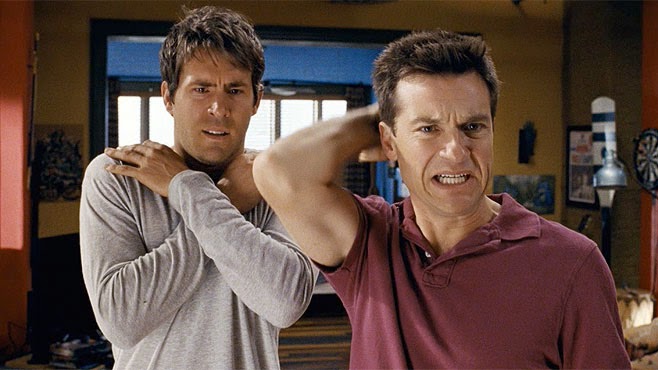
The story follows two friends —Dave (Jason Bateman) who is a hard-working lawyer married with the beautiful Jamie (Leslie Mann) and father of three, and Mitch (Ryan Reynolds), a single, reckless and unemployed stoner who never concludes anything. One night, after getting drunk, they urinate in a park's fountain and at the same time they wish they had each other's lives. The next morning, they wake up and discover that they have switched bodies. 

It certainly isn't the most original premise as there's plenty of body switch movies out there whose execution is why less juvenile than The Change-Up's. That being said, the plot as predictable and clichéd as it gets —I mean, that epiphany you could see it coming a mile away— isn't terrible as watching Dave and Mitch switch bodies and try to adapt to the other's life is enjoyable, entertaining almost. 

As for the characters, they are tremendously superficial as well as the typical characters played by these actors as Jason Bateman plays the serious and kind of awkward workaholic, with a family this time around, he always plays, and Ryan Reynolds plays the idiotic, carefree, irresponsible ladies' man he plays most of the time. However, Dave and Mitch switching bodies means Bateman and Reynolds switching roles and, despite the fact that cheap laughs are all they get, it's quite refreshing to see them play atypical roles. Leslie Mann is a bit of a show-stealer though as she manages to give her shallow, non-existent character a little depth. Olivia Wilde is here only for eye-candy purposes. And Alan Arkin is terribly underused as Mitch's father. 
Universal Pictures
Despite the enjoyable plot and the actors, The Change-Up still is a mediocre film, nothing more than an idiotic bro movie for the most part —at some point, it gives up its bro tone to become an overly sentimental mess—, with plenty of gross moments, vulgarity and gratuitous nudity. Sure, it's entertaining and fun-ish but at the same time it's offensive and most of the jokes fall flat.

Saturday, 23 March 2019

Little Miss Sunshine (2006)

I don't remember why I was drawn to Little Miss Sunshine when I first watched —it was probably on some list featuring dark comedies—, all I know is that I ended up loving this quirky road trip indie movie, and I loved it every single other time I watched it over the years. It's quite embarrassing that I've never written about it, so here it is. 

Just in case you are not familiar with this —I'm judging you if you are not though—, the story follows the Hoovers, a dysfunctional family composed of Richard (Greg Kinnear), his wife, Sheryl (Toni Collette), his father, Edwin (Alan Arkin), his brother-in-law, Frank (Steve Carell), his step-son, Dwayne (Paul Dano), and his daughter, Olive (Abigail Breslin). When Olive qualifies for the finals of the Little Miss Sunshine pageant, the family goes on a road trip on their old Volkswagen bus to take her to the contest. 

As it happens with road trip movies, Little Miss Sunshine does not have a plot, only plenty of clichés of the genre and a series of bizarre and unlikely situations and worst case scenarios. It does, however, take some surprising and amusing twists and turn and ultimately it ends up being a quite powerful story of a family who, despite all, love each other, stick together and would do anything for each other.

The story certainly wouldn't be as effective, engaging and entertaining if it wasn't for the characters though, which is by far the aspect of Little Miss Sunshine I love the most. First, there's no main character, no one is more important than the other, and, while they share the same goal, each out of them has his/her own arc. Second, they all have a distinctive personality and quirks that make them unique and memorable —Richard is a neurotic motivational speaker who hates losers; Sheryl is a chain-smoking wife who tries to make everybody happy but she is fed up with her husband's optimistic crap; Edwin is the foul-mouthed, heroin-snorting grandfather; Frank is the depressed gay uncle who has just attempted to commit suicide because his lover left him for his rival professor; Dwayne is a moody teenager who has taken a vow of silence until he gets into the Airforce; and Olive is a little girl who is exactly the opposite of what beauty pageant encourage young girls/women to be. No matter how stereotyped they are, these characters are interesting, believable and you care about them.

Fox Searchlighting Pictures
The actors all do a fantastic job, but there still are a few standouts. While Alan Arkin is the one who won an Oscar for his sharp, sarcastic, hilarious performance as the grandpa, and Abigail Breslin got a deserved nomination as she gives a charming, full-of-heart performance and brings quite a spark to the film, Steve Carell and Paul Dano are those, in my opinion, who deserved the awards. Although unknown at the time the Little Miss Sunshine was filmed —at some point, the filmmakers weren't even sure about him because of this—, Carell proves he is more than a comedian with a serious, subtle performance as the brilliant professor; Dano, who has to rely on his body language and facial expressions only for most of the film's running time, carries the role of the troubled teenager effortlessly and delivers some of the film's most emotional and touching moments.

Ultimately, Little Miss Sunshine is a charming, dark, funny and touching film, with great jokes, memorable moments —Olive performing at the beauty pageant sure will stick with you—, and a commentary on the futility of beauty pageants.

Tuesday, 6 November 2018

Catch-22 (1970)

I rarely decide to read a book because of its plot  —most of the time, I don't even know the plot—; it's because it was suggested by someone I know and trust, it was on a books you must read before you die kind of list, or I liked the cover —yes, I'm that shallow. The second applied to Joseph Heller's Catch-22 and when I read the back cover and learnt it was a war novel I had the impulse to return it to the library without reading it. I gave it a shot anyway and I loved it. Then, of course, I did what I always do, I searched the internet for a movie based on the novel and I stumbled upon Mike Nichols's Catch-22.

It follows Captain Yossarian (Alan Arkin), a bombardier in World War II who desperately tries to be certified insane so he can stop flying missions and go home. In the process of doing this, he watches most of his friends die.

If you have read the novel, then you know that there's a lot more going on. The story indeed features so many subplots, it's hard to keep count of them all. The problem with Nichols's film is that many subplots, which are very important to understand the ending, are not included in the film and therefore if you haven't read the book, the whole thing makes very little sense. And because of it, the non-linear storytelling that worked beautifully in the novel does not work here. It only makes it all very confusing.

The other big problem with this adaptation is the characters. Not only many characters didn't make it to the film —I get that you can't include everyone in a film, but one does not cut out a character like Lt. Scheisskopf— but those who made it to the film, are barely two-dimensional and their portrayals do not recall the characters from the novel. Also, the relationships between the characters are never explained.

Despite that, the cast does a good job. Alan Arkin gives a believable and humorous performance as Yossarian, the only sane man in an insane world; Jon Voight gives a mesmerizing performance as Milo Minderbinder, a mess officer obsessed with expanding mess operations and trading goods, the satire of a businessman —Milo was my favourite character and Voight really did him justice; Anthony Perkins fits the role of Chaplain Capt. A.T. Tappman very well; and Bob Newhart does fine as Major Major Major Major —the character ended up being a disappointment anyway.

Paramount Pictures

At last, there's the entertainment factor. First of all, the pace is too slow, which makes the film kinda dull and boring. Second, the brilliant humour from Heller's novel is nowhere to be found here. There are some hilarious scenes here and there but unfortunately many of the most interesting and funny moments from the novel were left out and therefore there's not enough material to entertain. 

Friday, 9 March 2018

Going in Style (2017)

When three movie legends like Morgan Freeman, Michael Caine and Alan Arkin make a movie together it's very hard to pass it. It's even harder if said movie is a heist movie, a genre I love, and it's even suggested to you by someone you usually trust with movie suggestions. And it's terrible when said movie just isn't that good. Yes, I'm talking about Going in Style. 

Joe (Michael Caine), Willie (Morgan Freeman) and Al (Alan Arkin) are senior citizens and lifelong friends trying to survive with their pensions in New York. But when their pensions are cancelled, they plan to rob a bank. None of them has ever done anything criminal in their lives and to pull off the heist, they are going to need help and a lot of practice.

I haven't seen the original movie (I found out this was a remake only after watching it), and yet the plot turned out exactly as I was expecting it to be, very predictable and not original at all. It doesn't take any interesting or surprising twist, and it has a way too happy happy ending. So happy that make me sick. 

The writing isn't any better in the characters department. The characters aren't that interesting, they are kinda full and rather forgettable. They all are given a reason for doing the bank robbery, but those subplots kinda feel forced and clichéd. And other than that, they have no such thing as development.

Warner Bros. Pictures
That said, the leading trio, Freeman, Caine and Arkin, actually have a nice chemistry. They really look like friends (and maybe they are in real life, I don't know) and the heist isn't the only thing they pull off. Although most of the humour is dull, a little contrived and eventually gets very repetitive and kind of annoying, the three actors manage to deliver several funny moments and make the film a little entertaining and not a complete waste of time. 

The gags aren't spectacular but a few of them work nicely, like the supermarket heist, especially the escape, and the bank robbery. The bank manager played by Josh Pais made me laugh pretty loud. 

Friday, 12 April 2013

Tales of the '70s: Freaks, Geeks, and Slums

Whether by coincidence or fate, two of the titles I decided to review today are late-1990s takes on growing up in the late '70s. One is a snappy indie comedy, the other a painfully honest (and funny) TV series that continues to deserve all belated praise hurled its way.


Slums of Beverly Hills (1998) - EXPIRED


For a long time I avoided this movie. A long time. Like, since it was first released, which goes back 15 years now. Why? I remember the positive reviews when it came out, and it still seems well regarded today. But despite that�and the fact that it co-stars my alternate-reality future wife, Marisa Tomei�I just never felt drawn in enough to give it a shot.

Maybe it was the title. For whatever reason, titles are important to me, and the word "slums" has never exactly squeezed my happy gland. (Come to think of it, that may be why I still haven't seen Slumdog Millionaire.) And though I'd loved Paul Mazursky's Down and Out In Beverly Hills (and liked Beverly Hills Cop well enough), as a devout New Yorker at the time I may have simply had my fill of things L.A.

I was wrong. Twenty lashes for Past David. This brash little comedy/drama is that all-too-rare coming-of-age story told from the girl's point of view, and unlike a lot of American films on the subject, it's not afraid to push a few buttons. That's attributable not only to its indie outlier status, but to writer/director Tamara Jenkins, who based much of the film on her own nomadic childhood. This isn't a rose-colored portrait of (cue violins) "one girl's coming of age." There's little sentimentality here�at least when it comes to the kids�even if it's not as comically merciless as 1995's Welcome to the Dollhouse. Still, any film that depicts its 14-year-old heroine on a bathroom floor experiencing her first vibrator gets big points in a film industry still notoriously squeamish dealing with young girls' sexuality.

Read more �