Sunday, 13 September 2015

Blood Alley (1955)


Blood Alley (1955), a "vigorously directed action picture" (Clive Hirschhorn, The Warner Bros. Story), was one of director William A. Wellman's final pictures and his third with John Wayne. It was also the first picture produced by John Wayne's production company, Batjac.


The film was originally supposed to star Robert Mitchum, who was fired from the production, followed by Humphrey Bogart (he wanted too much money) and Gregory Peck (who turned down the offer). In order for the film to be made, John Wayne took on the role of Captain Tom Wilder. Lauren Bacall played Cathy Grainger, a surprising choice considering her political views. Read more about it in this TCM Article.
William Wellman was great; Wild Bill, a fascinating man! I liked working with Duke. We didn't agree politically, but we got along well and had a sort of chemistry."
 ~ Lauren Bacall
 

From the back of the DVD:
"Powder your nose, baby," the craggy-voiced skipper bellows. "We're coming into Hong Kong." Getting there wasn't easy for wily Merchant Marine Capt. Tom Wilder. But it's exciting - and all an action fan might expect from a movie teaming legends John Wayne, Lauren Bacall, and director William A. Wellman.
Wilder braves dangerous waters and pursuing Red Chinese forces while steering a boatload of Chinese refugees and a doctor's daughter (Bacall) along a 300-mile waterway to freedom's shores. Wellman and his crew cram the CinemaScope frame with riches both scenic (Northern California locales authentically stand in for the Formosa Straits) and action-packed. This ship is under full steam. Destination: Blood Alley!

The film was based on a short news bulletin which was turned into a novel by A.S. Fleischman and then a screenplay.


I was surprised to learn that the movie was filmed in Northern California. Locations included the Sacramento River, where they used the old snag boat PUTAH which was called the "Chicu San" in the movie (source), and the China Camp State Park and the San Pablo Yacht Club in Marin County. The cast and crew stayed at the Stockton Hotel, where after filming, John Wayne would sign around 100-400 autographs for his fans waiting outside (source).

Here's a commercial featuring John Wayne on the set of Blood Alley selling Christmas Seals.
Don't miss William Wellman at the beginning!

Wayne and Wellman receiving a certificate from the U.S. Air Force.
 
 
Make sure and read this 1955 New York Times Review! It mentions Wellman, the subject of this Blogathon, multiple times. Also, for the guys: weapons used in Blood Alley.

This post is part of the William Wellman Blogathon hosted by Now Voyaging. Be sure and read all of the other posts celebrating the work of this great director!

 
All images are screenshots from the DVD and its special features.

Saturday, 12 September 2015

The Weekly Movie Watch Volume 60

This week I watched Drive Angry, Detachement.

I watch movies every week and then write down my thoughts. Read my previous reviews!
My rating is simple, Watch It, It Depends, Skip it.

Amber Heard and Nicolas Cage in Drive Angry
Drive Angry - Crazy Nic Cage, cars, and the rule of cool.

Drive Angry (2011) 
Watch Drive Angry
Written by: Todd Farmer, Patrick Lussier
Directed by: Patrick Lussier
Starring: Nicolas Cage, Amber Heard, William Fichtner
Rated: R

Plot:
Nicolas Cage is John Milton, a man with a dark past set on avenging his daughter, killing a Satanist, and saving his granddaughter. He picks up Amber Heard's character Piper along the way.


Review:
It's a simple revenge flick that is over the top in every way, and that includes Nic Cage. It's a lot of fun provided you don't mind the R rating it earns.

From the start this movie acknowledges that it's a ridiculous B movie. I like a movie that knows what it is and revels in it. It's got ridiculous one liners like, "I never disrobe before a gunfight." It follows the 'rule of cool'. If it's cool, include it even if it doesn't make sense.

The story is simplistic. I have to imagine the pitch started with an idea of Nic Cage being invincible, and then figuring out the rest from there. Let's have him escape Hell. Let's add cool cars. Wait, we need a girl.
While Nic Cage is average, William Fichtner does a great job, and Amber Heard's accent is absolutely terrible. We see cool cars, explosions, and invincible Nic Cage. It's got a fair bit of subtle humor. The ending alone is a great joke, making fun of over dramatic, cliche endings.
The CGI is fair to bad, but it's a fun romp. Why did Nic Cage want to be in this movie? He joined the movie because his character would be shot in the eye. That is the full breadth of his decision making process.

Verdict:
If you're looking for a fun movie that revels in B movie glory with little sense, story, or plot, but cool cars, and Nic Cage phoning it in, this is the movie.
It depends.


Adrien Brody in Detachment
Detachment - Thought provoking, touching, and depressing.
Detachment (2011)
Watch Detachment
Written by: Carl Lund
Directed by: Tony Kaye
Starring: Adrien Brody, Christina Hendricks, Marcia Gay Harden, James Caan, Lucy Liu
Rated: --

Plot: 
Drifting from school to school, Adrien Brody is substitute teacher Henry Barthes. With an intense desire to help his students, he can't change bureaucracy and he can't help students and their parents who don't want to help themselves.


Review:
The cast list is impressive. Adrien Brody has won an Oscar, but also starred in Predators (2010). Brody has many impressive moments, and the supporting cast each gets one moment to really shine. James Caan really stands out. This movie could almost be funny in moments if it wasn't so haunting in others. It feels very raw and very real. It's shot in a documentary style with a hand held camera and a grainy image. The animations don't really feel out of place, they serve to bring thoughts to life, things you know are being thought, but not spoken. The film almost reminds me of a book, the way it unpacks these characters and adds layers, though it's not a complete picture of any of them. The layers only serve to expound upon the deep seated sorrow and remorse the characters have, adding to the feeling of futility.  While we get to know Brody's character the best, he still remains a mystery. We can only wonder at his backstory told with quick flashes here and there.
 While it's a well done movie, directed by Tony Kaye of American History X fame, it's incredibly saddening. Brody tries to help not only students, but even a stranger, and this is off putting because most people wouldn't bother. Instead of rejecting people, his insight helps him see the pain beneath their violence and antics. The movie criticizes parents maybe more than anyone else, thought it's not as blatant. The students' attitudes are a symptom of the problem, but the movie shows multiple times that students' attitudes are derived from parent feedback. Educators can't change that and face an increasingly difficult battle to teach students who don't want to learn. Teachers become galvanized and indifferent, and who can blame them?


Verdict:
The movie is as amazing as it is haunting and depressing. It's a very good movie with something to say about the school system and education, but it's hard to recommend a movie that could put a damper on your day.
Watch it.

Friday, 11 September 2015

CUTAWAYS: GIRLFRIEND FROM HELL

Ever heard someone toss around the old term Church Militant? Well, I think I’ve discovered video evidence of just what that means in this clip from 1989s Girlfriend From Hell…

Okay, so maybe not.

Perhaps its best if we just stick with the old Catholic Encyclopedia’s explanation. It tells us how the word Ecclesia, meaning body of believers, “may signify the whole body of the faithful, including not merely the members of the Church who are alive on earth but those, too, whether in heaven or in purgatory, who form part of the one communion of saints. Considered thus, the Church is divided into the Church Militant, the Church Suffering, and the Church Triumphant.”

Taking a closer look at this division, it goes like this.

  • The Church Militant refers to members of the Church on Earth, the ones actively living a Christian life and working together to try and make things on Earth as they are in Heaven. 
  • The Church Suffering refers to the members of the Church who didn’t quite attain their full perfection in life and are now in Purgatory getting cleaned up a bit.
  • The Church Triumphant describes the members of the Church who have already made the cut and are in Heaven praying for the rest of us.

The Catechism doesn’t actually use the old terminology anymore (maybe the word militant is just too scary these days), but it does recognize this threefold state of the Church, proclaiming…

“When the Lord comes in glory, and all his angels with him, death will be no more and all things will be subject to him. But at the present time some of his disciples are pilgrims on earth. Others have died and are being purified, while still others are in glory, contemplating in full light, God himself triune and one, exactly as he is. All of us, however, in varying degrees and in different ways share in the same charity towards God and our neighbors, and we all sing the one hymn of glory to our God. All, indeed, who are of Christ and who have his Spirit form one Church and in Christ cleave together.”

So, whether we use the old terminology or not, pondering the three divisions of the Church can be an uplifting exercise as it reminds us that we are not alone in our struggles here on Earth, that those who went before us are still an active part of the Church, interceding and adding their prayers to ours in the battle against evil. Thus, while I imagine a rocket launcher could come in handy for those times when you absolutely need to blow up a devil-possessed road-raging girlfriend from hell, I’m pretty sure having the kind of spiritual firepower the ENTIRE Church provides is going to turn out to be a lot more useful to us in the end.

Tuesday, 8 September 2015

Watch: First Clip From Ridley Scott's THE MARTIAN

Check out the first clip from Ridley Scott's THE MARTIAN from 20th Century Fox. The movie stars Matt Damon as astronaut Mark Watney based on the best selling novel from Andy Weir (an excellent read by the way).

The clip is reserved in that it doesn't give much away in regards to plot or characters, but definitely sets up a story based in real science and an expectation that it's believable. The crew has a great dynamic too. Ridley Scott is known for these traits and so my excitement for the movie is off the charts.

Here's the storyline for the movie:
During a manned mission to Mars, Astronaut Mark Watney is presumed dead after a fierce storm and left behind by his crew. But Watney has survived and finds himself stranded and alone on the hostile planet. With only meager supplies, he must draw upon his ingenuity, wit and spirit to subsist and find a way to signal to Earth that he is alive. Millions of miles away, NASA and a team of international scientists work tirelessly to bring “the Martian” home, while his crewmates concurrently plot a daring, if not impossible, rescue mission. As these stories of incredible bravery unfold, the world comes together to root for Watney’s safe return. Based on a best-selling novel.

THE MARTIAN launches wide on October 2 and premieres at the Toronto International Film Festival.


Monday, 7 September 2015

THE B-LIST: QUESTIONABLE MUSICAL MOMENTS #21 – YETI, GIANT OF THE 20TH CENTURY

As those of you who follow me on Facebook or Twitter are well aware, I stumbled across this little gem on YouTube over the weekend…

Yeti

Yeti, Giant of the 20th Century was the Italian entry in the international stampede to cash in on the popularity of Dino De Laurentiis’ 1976 remake of King Kong, a surprisingly crowded field that included the likes of Hong Kong’s bizarre Mighty Peking Man, South Korea’s jaw dropping A.P.E., and Britain’s utterly ludicrous Queen Kong. While each of those knockoffs have something to recommend them to diehard bad movie lovers, the one thing I can’t say is that I remember any of their soundtracks. I assure you, that will not be the case with Yeti, Giant of the 20th Century. Give a listen to the movie’s theme song and you’ll see, or should I say hear, exactly what I mean…

Oh, 1970s, you’re the gift that keeps on giving. Even better than the simple fact that this exists, though, is the realization that they actually released this thing in Greece as a single. You can listen to the flipside, Funky Disco Sound, on YouTube as well, providing your heart and ears can take it.

yetirecord

Now I’m sure everyone out there recognized how The Yetians (most likely a group of studio musicians assembled by composer Sante Maria Romitelli) took the liberty to, shall we say, ‘borrow’ just a little bit of O Fortuna from Carl Orff’s Carmina Burana. Not that I’m complaining, mind you. How could I? It’s not like we Americans raise a fuss over My Country, ‘Tis Of Thee lifting its tune straight from Britain’s God Save The Queen, and no self-respecting Catholic would ever say a word about Charles Gounod appropriating Bach’s Prelude No. 1 in C major for use in his Ave Maria.

Still, My Country, ‘Tis Of Thee was just trading one anthem for another, and Bach, while a devout Lutheran, accepted a commission for at least one Catholic mass, so he probably wouldn’t have been too put off by his work being used for an Ave Maria. Yeti, Giant of the 20th Century, on the other hand, is a story about a defrosted oversized beast-man, while O Fortuna is about… what exactly? You know, the tune is so ubiquitous in movies that I don’t think I’ve ever bothered to check. Wikipedia (yeah, I know, but it was quick) translates the Latin lyrics as follows:

O Fortune, like the moon you are changeable, ever waxing and waning; hateful life first oppresses and then soothes as fancy takes it; poverty and power it melts them like ice. Fate – monstrous and empty, you whirling wheel, you are malevolent, well-being is vain and always fades to nothing, shadowed and veiled you plague me too; now through the game I bring my bare back to your villainy. Fate is against me in health and virtue, driven on and weighted down, always enslaved. So at this hour without delay pluck the vibrating strings; since Fate strikes down the strong man, everyone weep with me!

Basically, the poem (originally written by Catholic monks, it’s a long story) is a rant against Fortuna, the Roman goddess of luck, and her annoying habit of turning on people at a moment’s notice. One minute you’re up, the next you’re down. Solomon sure seems to have recognized this sentiment when he penned in Ecclesiastes…

Again I saw under the sun that the race is not won by the swift, nor the battle by the valiant, nor a livelihood by the wise, nor riches by the shrewd, nor favor by the experts; for a time of misfortune comes to all alike. Human beings no more know their own time than fish taken in the fatal net or birds trapped in the snare; like these, mortals are caught when an evil time suddenly falls upon them.

Of course, it was Solomon who also wrote in Proverbs…

The Lord has made everything for a purpose, even the wicked for the evil day… Into the bag the lot is cast, but from the Lord comes every decision.

So, yeah, we Christians complain when bad things happen, but we also recognize that in some mysterious way, those same misfortunes still fall within God’s providence, either because he directly wills them or, more likely, because he allows them to happen in order to preserve our own free will. Doesn’t really make them suck any less, but it’s an ultimately more satisfying explanation than ascribing misfortune to pure blind chance.

You know, maybe that theme of sudden turns in fate is the reason why they used a bit of O Fortuna for the theme to Yeti, Giant of the 20th Century. After all, the big fellow never asked to get frozen in an iceberg or to get thawed out by flamethrowers and brought to civilization in chains. I mean, who could have possibly predicted stuff like that was going to happen. So it kind of fits.

Or maybe I’m just over thinking a terrible movie and they simply ripped off O Fortuna because they could. Unless Orff is stuck in an iceberg somewhere waiting to be defrosted, it’s not like he’s going to come back and complain about it.

Sunday, 6 September 2015

BMC MOVIE OF THE WEEK: THE LAST CHILD

Last Child, The

“Back before he was producing Charlie's Angels, Aaron Spelling was a major supplier of made-for-television feature films, particularly to ABC, on which this movie premiered in 1971. The Last Child takes place in America in 1994, a time in which a massive, chronic overpopulation crisis has resulted in the passage of Draconian laws, declaring that no couple can have more than one child, and that nobody over the age of 65 can receive any but the most superficial medical treatment. Michael Cole and Janet Margolin play a young married couple whose first child died; she is pregnant again, and they now find themselves hounded by the authorities when she refuses to submit to a legally mandated abortion. Chased across country by Population Control agent Edward Asner (a sinister figure in his pre-Mary Tyler Moore period), they plan to escape to Canada but find the border closed. They receive unexpected help from Van Heflin, in his final screen performance, portraying retired U.S. Senator Quincy George, who opposed the Population Control Laws. He shelters Cole and Margolin at great risk to himself, using what political clout and respect he still commands in his own state to block Asner's pursuit. They must find a means of escaping the country, however, as the authorities close in even on this momentarily safe haven.” ~ AllMovie

September 6, 2015: Twenty-third Sunday in Ordinary Time (Year B)

Sometime in the not too distant future... It’s with those ominous words that the 1971 made-for-television movie The Last Child begins. Of course, the near future the film was predicting was 1994, so I suppose you can take any warning it contains about impending dystopias with a grain of salt. Still, the story is designed to make you think, and that it does.

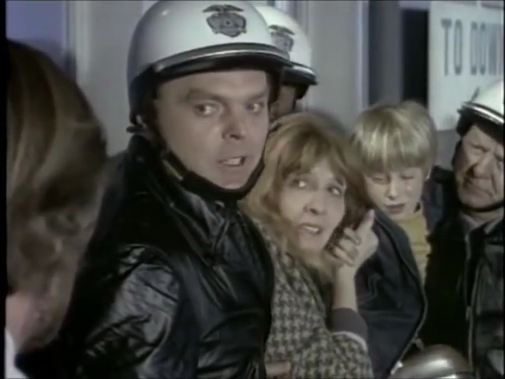
As with most made-for-TV movies of the time, robbed of the graphic sex and violence filling the movie screens of the early 70s, The Last Child has to rely on atmosphere to keep things interesting. In that respect, the film opens pretty strong with a scene set in a bustling airport in which a frantic woman trying to find her lost son is discovered by security guards to be pregnant with a second child. As American law forbids women to have more than one child during their lifetime, she is immediately arrested so she can undergo a forced abortion. Two men gallantly step forward to complain about the woman’s rough treatment, only to be taken into custody themselves for daring to question the law. All in all, the opening sequence does an admirable job setting up a sense of paranoia and desperation.
image

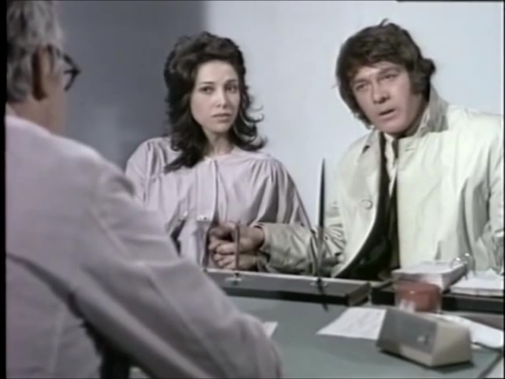
One of the men detained by the police, it turns out, also has a wife who is pregnant with a second child, their first having died only 15 days after birth. As the above synopsis indicates, it isn’t long before this young couple, The Millers, are on the run for the Canadian border with an angry Ed Asner in hot pursuit (which is actually more unnerving than it sounds). At one point, they are temporarily detained and interrogated by a doctor, leading to what is probably the eeriest scene in the film. Calmly, the physician explains how, because Mrs. Miller’s pregnancy is so far along, they will have to wait until the baby is delivered and then dispose of it with quick and efficient kindness. “Not every human being has a right to live.” he politely intones.

Now, before you start thinking The Last Child is some nightmare vision of the future (near or not) concocted by the pro-life movement, remember this was made in 1971, two years BEFORE Roe v. Wade. So what was the deal? Well, according to Michael McKenna’s book, The ABC Movie of the Week: Big Movies for the Small Screen, "The Last Child was a byproduct of a burgeoning cultural and academic point of view arguing that the planet and its in-habitants faced inevitable extinction if global population controls were not enacted. The most well known, if not infamous work, was Paul Erlich's bestselling book, The Population Bomb (1968). There were also a number of TV shows and theatrical films featuring the overpopulation theme, including a very similar ABC presentation from the show Stage 67 (1966), and feature films, such as Soylent Green (1973) and Logan's Run (1976)."
image

These days, Erlich’s book is finally being discredited as the junk science it is, leading those with teaching authority in the Church (as we already noted in our review of Elysium) to declare its erroneous findings a work of unmitigated evil. Back then, though, Erlich’s ideas were pretty much accepted as gospel (at least by the media) and the fears they engendered were just beginning to seep into the public consciousness. That’s why, even though the Millers are undoubtedly the heroes of The Last Child and the audience is encouraged to root for them, the film also in some ways is downright sympathetic to the population control methods employed by its fictitious police state. Just about every public scene is filmed in tight, claustrophobic medium shots and close-ups, depicting throngs of people jostling and bumping into each other. In this way, the movie makes it quite evident that the overpopulation problem in its version of 1994 is real. And the doctor that questions the Millers, while clinical in his discussion, isn’t entirely without humanity. He admits to having many sleepless nights, but does what he must for the greater good of all. "If only we had practiced planned parenthood in the past." he opines. Yes, the movie actually name drops the organization that has since turned the unnecessary industry of population control into a blood-soaked cash cow.

Which brings us to the actual here and now where the overpopulated future of The Last Child never materialized and the science which predicted it has been debunked. And yet, despite all of that, some of the population control methods the film depicted, such as limiting care for the elderly, seem uncomfortably closer to becoming a reality (yes, I understand the linked article is about nudging oldsters to voluntarily forego care rather than outright denying it to them, but this kind of crap has to start somewhere). That reality makes the movie, despite its humble made-for-television production values, quite unsettling.

image

Still, even though we seem to be inching ever so slowly towards the police state depicted in The Last Child, it’s hard to get too scared because of passages like this week’s first reading from Isaiah which was directed towards the Jews who had been subjugated in Babylon for decades:

"Thus says the Lord: Say to those whose hearts are frightened: Be strong, fear not! Here is your God, he comes with vindication; with divine recompense he comes to save you. Then will the eyes of the blind be opened, the ears of the deaf be cleared; then will the lame leap like a stag, then the tongue of the mute will sing. Streams will burst forth in the desert, and rivers in the steppe. The burning sands will become pools, and the thirsty ground, springs of water."

So, perhaps it will one day get as bad as what we see in The Last Child, or maybe even worse, such as what we currently see happening in Syria (don’t forget to pray for those folks daily), but evil eventually gets its just due in the end. And when that day comes, things will be even better than before. The lame won’t just walk, they’ll dance in the streets. The mute won’t just talk, they’ll burst into song. There’s a better tomorrow out there, be it next week or a few generations away, we just have to stick to what is true and good right now.

NOTE: Sadly, since The Last Child is a made-for-TV movie, there’s no trailer available, but hey, the whole thing is on YouTube, so watch away.